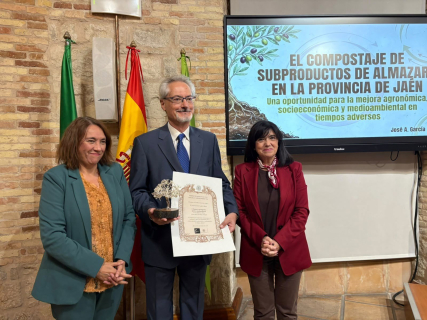

The Culture Classroom of the Palacio Provincial has been the setting, on the afternoon of this Thursday, for the awarding of the 2026 Agricultural and Environmental Research Prize of the Institute of Giennense Studies (IEG) of the Provincial Council to the researcher José Antonio García, recognized for his study titled "Composting of almazara byproducts in the province of Jaén: an opportunity for agronomic, socioeconomic and environmental improvement in adverse times".
Fourth Vice President and person in charge of the IEG, Francisca Medina, has presented this prize, endowed with 3,500 euros and the edition of the work, at an event in which the IEG vice-director advisor, María Luisa Grande, also took part, according to what the provincial institution reported in a press release.
During her remarks, Medina highlighted the quality of the awarded work, its scientific solidity, and the educational value that its dissemination provides, since "it makes sure that this knowledge is not lost." Likewise, she underscored the relevance of this research for the agricultural sector and the natural environment of Jaén, "since it compiles unprecedented scientific data."
Medina recalled that the call for this award, together with the Premio Cronista Alfredo Cazabán and the grants for the financing of research projects from the IEG, "form part of this autonomous body's contribution to scientific research" and allow "we fulfill one of our major objectives, which is to be a tool at the service of knowledge of the province and thus to promote its development."
In particular, she noted that the Agricultural and Environmental Research Prize, created in 1979, "is a reference for the IEG as a research center of the province and this year's winner goes on to be part of the more than 400 prizes and scholarships awarded since the 1980s." Likewise, she emphasized the organization's research activity, which "each year records more than 5,000 in-person consultations and 1.7 million digitally."
This prize distinguishes in each edition scientific works of special relevance, both unpublished and already published, in various areas of knowledge, such as Social Sciences, Natural Sciences, History, Heritage, or Medicine, among other disciplines.
The author of the study recognized in 2026 is a graduate in Chemistry and carries out his work at the Venta del Llano center of the Andalusian Institute of Research and Training for Agriculture and Fisheries (Ifapa), located in Mengíbar.
García Mesa has an extensive scientific and professional career, of more than forty years, in which he has promoted various tools for the sensory characterization of virgin oils. At present, her work is aimed at reducing the generation of byproducts in the process of obtaining these oils and at making use of them through alternatives that are more sustainable from a social and environmental point of view, among them composting.