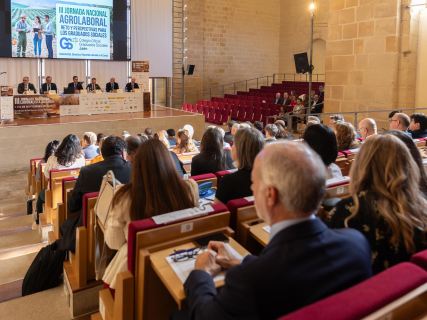

The III National Agrarian Labourist Conference brings together this Thursday and Friday in Baeza (Jaén) more than a hundred specialists to delve into the keys and challenges of labour relations in the countryside, addressed from an integral perspective.
Social graduates, lawyers and technicians in labour and social justice take part in the event, in a forum that “is consolidating as a reference space for the study of the legal regime, of Social Security and of the prevention of risks in agricultural work”.
The official opening took place at the Auditorio Antiguas Ruinas de San Francisco, the venue chosen again for this event promoted by the Colegio Oficial de Graduados Sociales de Jaén and the Fundación Justicia Social of the Consejo General de Graduados Sociales.
Among those who attended the opening ceremony were, among others, the mayor of Baeza, Pedro Cabrera; the delegate of the Government of Andalusia, Érik Domínguez; the general secretary of the Subdelegación del Gobierno, Pedro Garrido; the first vice president of the Consejo General de Colegios de Graduados Sociales de España, Juan Fernández; the president of the Consejo Andaluz de Graduados Sociales, Eduardo Ruiz, and the president of the Jaén college, José Luis Rodríguez.
Rodríguez highlighted the work carried out by the professional body to make this third edition possible. “Holding these forums for three consecutive years reflects our college’s firm commitment to ongoing training and professional improvement for our members, bringing together top-level experts in each area to respond to the changing challenges of the agricultural sector”, he said.
During the inauguration, the authorities emphasized the strategic importance of having a regulatory and management framework that is agile, and tailored to the current needs of the agricultural sector. They also highlighted the key role of social graduates as guarantors of compliance with the law, social peace, and the defense of the rights of workers and of agricultural holdings.
Along these lines, the delegate of the Junta de Andalucía wanted to highlight the daily work of these professionals. “They are the first to arrive at the job site, to process the contracts of the day labourers, and the last to leave, when they take care of the company certificates”, he said.
He has specifically referred to the work they carry out during the olive harvest campaign, essential for the province of Jaén, that "is the world capital of olive oil" and "leads the number of jobs during the campaign in the olive grove sector."
Domínguez has also valued that Baeza will be chosen again as the city to host the event. "The union between the events, the olive grove sector and Baeza is embedded in a record of success because the setting and the city invite it," he emphasized.
Program and debate tables
After the institutional event, the program development has begun, which is structured under the slogan "Keys and challenges of Labor Relations in the agricultural field: A global vision". The training and outreach block began with the presentation "Labor perspective and retirement", in which the Labor and Social Security inspector Antonio Benavides Vico has set out the issue of compatibility between agricultural employment and retirement.
In the roundtable on "Leadership and equality", Rocío Martínez, vice dean of the Faculty of Social and Legal Sciences of the University of Jaén, has examined the challenges of female leadership in the field of the social economy.
Likewise, analysis and prevention roundtables were held with representatives of the General Treasury of Social Security, of the INSS, of the Foreigners Office and of the Labor Inspectorate, focused on the classification of family relationships in the countryside. Next, specialists in occupational risk prevention in the agricultural sector and in conflict mediation have intervened.
The event will continue this Friday with legal roundtables dedicated to social jurisprudence, the treatment of workplace and sexual harassment in the agricultural environment, and effective judicial protection, with the participation of magistrates from the Superior Court of Justice of Andalucía and from social courts.