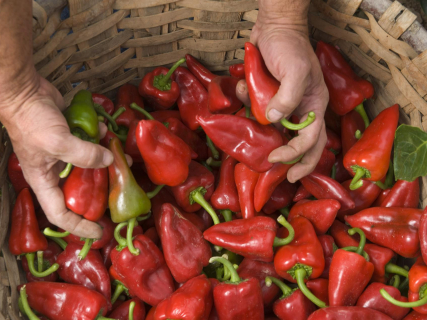

The DOP Pimiento del Piquillo de Lodosa faces the definitive stage of the planting campaign in the coming days, after the interruption forced by the high temperatures recorded in recent weeks. The sector is confident it will be able to complete this phase during the next week.
In the 2025 campaign, the sector increased the registered area to reach a total extension of 189 hectares, distributed in 193 plantations managed by 57 farmers from the municipalities integrated into the Protected Designation of Origin.
According to a press release from the president of the Regulatory Council of Pimiento del Piquillo de Lodosa, Jesús Aguirre, "going out strongly to the national market is not only an opportunity for growth for the piquillo, but a commitment to the sector and the territory." "El Piquillo de Lodosa is a product well known in Navarra, but we will continue working so that any consumer, whether in Madrid, Barcelona or Seville, knows how to recognize it," he pointed out.
For Aitziber Isturiz, secretary of the Regulatory Council of Pimiento del Piquillo de Lodosa, the certification "offers a guarantee of quality for this product so representative of our gastronomy." "At this time of the start of the campaign, it is important to register the plantations that are carried out in the eight municipalities protected by the DOP. This traceability allows us to assure the final customer that the logo and the numbered back label on the packaging is authentic Piquillo de Lodosa," she emphasizes.
57 farmers and 189 hectares under the DOP
In the 2025 campaign, a total registered area of 189 hectares was recorded, distributed in 193 plantations. In total, 57 producers are dedicated to the cultivation of DOP Piquillo de Lodosa, while 11 processing companies make up the Regulatory Council.
Mendavia, with more than 63 registered hectares, concentrates the largest part of the cultivation, followed by Lerín, which exceeds 56 hectares. The municipal terms of Andosilla, Azagra, Cárcar, Lodosa, and San Adrián complete the protected geographical area where the cultivation of DOP Piquillo de Lodosa is developed.
The public company INTIA comprehensively supervises all stages: from the cultivation and reception of the fruit to the processing, packaging, and certification of the final product. This certification, backed by the Reyno Gourmet quality seal, guarantees the complete traceability of the pepper from the plot to the consumer. Each package includes the numbered back label of the Regulatory Council, which certifies the origin of the food and compliance with the production and processing standards set by the Protected Designation of Origin DOP Piquillo de Lodosa.
Project to promote peppers from the Euroregion
The Piquillo de Lodosa pepper is included in the RetPIM II project, financed by the Euroregion formed by Navarra, Basque Country, and Nouvelle-Aquitaine, in which INTIA, HAZI, and the Espelette Pepper Syndicate as the coordinating entity collaborate. This initiative aims to strengthen the value of peppers with DOP/IGP from the Euroregion: the DOP Pimiento del Piquillo de Lodosa, the DOP Pimiento de Espelette, and the IGP Pimiento de Gernika.
The first phase of the RetPIM project, developed between 2023 and 2024, aimed to "strengthen the cross-border relationship and cooperation between producers, management bodies, and technical organizations working with these foods, in order to face common challenges related to their production, traceability, and commercialization, and to design coordinated responses to these problems."
Through technical congresses and awareness-raising events, this second stage, called RetPIM II and rolled out throughout 2025, has favored the exchange of experiences to "delve deeper into common problems," as well as promoting the dissemination among the public of the particularities of protected peppers.