A 93-year-old woman who was admitted to the Intensive Care Unit of the Torrecárdenas University Hospital, in Almería, has died this Sunday, according to health sources cited by El Correo de Andalucía.
The woman was part of the group of people hospitalized as a result of the emergency. The same sources specify that she did not have burns and that her death would be related to previous pathologies, although she had been transferred to the hospital during the operation activated by the fire.
With this death, the provisional death toll linked to the fire rises to 13. The last update of the day already included this figure while the fire remains stabilized and operations on the ground continue.
Who the deceased woman was
The victim was 93 years old and was admitted to the ICU of the Torrecárdenas Hospital.
For the moment, no further details about her identity, place of residence, or the specific circumstances in which she was evacuated during the fire have been publicly released.
Health sources consulted by the Andalusian media indicate that the cause of death was not burns. The woman suffered from previous pathologies and was part of the group of eight people who needed hospital assistance after the emergency.
This clarification is relevant: her death is included in the provisional toll related to the fire, but it is not directly attributed to injuries caused by the flames.
Four seriously injured remain hospitalized in Seville
The patients with the most severe burns were transferred from Almería to the Major Burns Unit of the Virgen del Rocío Hospital in Seville.
Four people remained hospitalized there in serious but stable condition after suffering significant burns during their attempts to flee the affected area. Other people were treated for smoke inhalation, respiratory problems, or less serious injuries.
The condition of these patients continues to be monitored by doctors, and any changes in their state must be communicated by the health authorities.
The fire is now stabilized
The death is known after the Junta de Andalucía declared the forest fire stabilized.
The fire has affected approximately 7,000 hectares and a perimeter of about 40 kilometers, after advancing with extraordinary speed during its first hours through the Cabrera-Bédar mountain range.
That a fire is stabilized means that it is evolving within the planned control lines and is no longer advancing freely. It does not imply, however, that it is controlled or extinguished.
Infoca teams, the Military Emergencies Unit, and the rest of the operation continue to monitor hot spots, extinguish flare-ups, and consolidate the perimeter to prevent the flames from regaining intensity.
Nearly 1,600 people were evacuated
The fire forced the evacuation of around 1,600 people from settlements, urbanizations, campsites, and scattered homes in Los Gallardos, Bédar, Lubrín, Antas, and other municipalities in the Levante region of Almería.
The improvement of the situation has allowed the Junta to authorize the progressive return of those affected to their homes. Before each return, emergency services check the access roads, the electricity supply, the condition of the houses, and the presence of any nearby outbreaks.
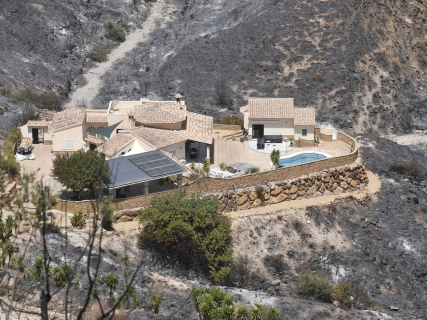
Most of the homes located within the threatened area were saved, although the fire caused damage to properties, vehicles, agricultural facilities, and power lines.
Searches conclude without locating new victims
Throughout Sunday, about a hundred personnel from the Guardia Civil, the UME, and the Andalusian Emergency Group searched the burned areas to check if there were more trapped people.
The searches focused on dry riverbeds, ravines, roads, damaged homes, and areas that could not be inspected during the initial hours due to fire and smoke.
The operation concluded around 2:00 PM without locating new bodies. The teams inspected hundreds of homes and approximately 217 hectares considered a priority for the search.
The completion of these tasks brings relief, but does not close the checks related to missing person reports.
Eight formal missing person reports
As of Sunday, the Guardia Civil had received eight formal reports of missing persons.
This figure should not be confused with the number of citizens who were initially listed as "unlocated." In the early hours of the emergency, numerous cases were reported of family members, foreign residents, or tourists with whom contact had not been established.
Some were able to leave the area on their own, move to hotels or the homes of acquaintances, or temporarily be without a phone and coverage. The Civil Guard must check each case individually before considering it a disappearance linked to the fire.
Identification of the twelve bodies found continues
The Institute of Legal Medicine has already performed autopsies on the twelve bodies recovered in the areas affected by the fire.
Due to the condition of some bodies, definitive identification depends on genetic testing. DNA samples have been sent to the Civil Guard's Criminalistics Service in Madrid to be compared with those provided by potential relatives.
Until that process is completed, Spanish authorities are maintaining caution regarding the identity and nationality of the victims.
Several European countries have requested information about citizens they have not been able to locate, but possible nationalities cannot be confirmed until forensic tests are concluded.
The deadliest fire in Andalusia's recent history
The Los Gallardos fire has become the most serious forest tragedy recorded in Andalusia in terms of the number of fatalities.
The first twelve victims were located in two different scenarios. Four people died inside a vehicle hit by flames, while others were found in a mountainous area after trying to escape on foot.
The speed of the fire, the change in wind direction, the poor visibility, and the complicated terrain turned some paths into real traps.
Local authorities maintain that several victims had received evacuation or confinement instructions but later undertook an escape along routes different from those indicated.
A falling cable, the main hypothesis
The investigation into the origin of the fire remains open.
The first alerts received by 112 placed the start of the fire near the N-340A, after witnesses observed the fall of an electrical cable and the immediate appearance of flames in the vegetation.
The combination of extreme temperatures, very low humidity, intense wind, and abundant vegetation allowed the fire to advance at enormous speed during the first hours.
The fall of the cable remains the main hypothesis, but it will be up to the Civil Guard's investigation to determine its origin, ownership, and if there was any breach related to the installation's maintenance.
A still provisional toll
The death of the 93-year-old woman raises the provisional death toll related to the Los Gallardos fire to 13.
Twelve of the victims were found within the perimeter affected by the flames. The thirteenth had been hospitalized since the emergency and, according to the cited health sources, died from pre-existing conditions and not as a consequence of burns.
The fire is stabilized, the searches have concluded without locating new bodies, and the evacuated residents are progressively returning to their homes. However, investigations, DNA tests, and care for the four seriously ill patients admitted to Seville continue.