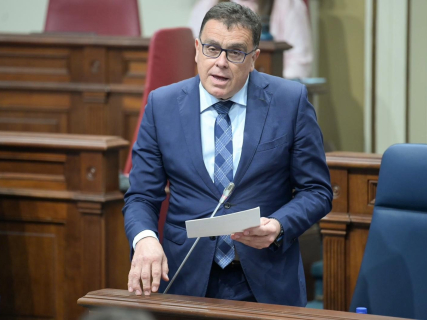

The adviser for Territorial Policy, Waters and Emergencies of the Government of the Canary Islands, Manuel Miranda, reported this Thursday that the autonomous community has disbursed so far 275 million euros under 27 agreements reached with tourism-sector businesspeople affected by moratoriums.
During an appearance before a parliamentary commission, he detailed that on August 14 the first payment was made, which included 25 agreements for a total of 261 million, with interest included. The second payment was authorized on October 26 and incorporated 13.9 million euros in concept of capital and interest, leaving still pending a little more than 40 million to be paid.
He specified that there are 36 agreements in total, of which 32 already have judicial approval, so nine remain to be fully paid.
The adviser assessed that, "almost 20 years later," numerous lawsuits have been avoided and it has been possible to reverse the development-oriented model "inherited in the second half of the 20th century." He underlined that the initial claims amounted to 990 million and have been reduced to 316 million, without including interest.
Miranda explained that the economic estimate of each agreement has been carried out by civil servants of the autonomous community through calculations that are "completely objective," without linking them to the urban development potential of the land, given that the developer "maintains its use."
He added that lost profits have been ruled out and that the indemnities have been set by applying the legal interest on money in order to measure the "loss of opportunity" between November 13, 2009, the deadline date for submitting applications, and January 31, 2025.
He emphasized the "rigor" of the procedure, as well as the technical and legal support it has, and he said he was convinced that a "good agreement" has been reached for the general interest of the Canary Islands. "The formula that has been sought is the most convenient," he pointed out.
Miranda recalled that this Executive "has had to manage the consequences of decisions by several governments that, in good faith, sought to halt tourism growth" and criticized that the so-called 'Pacto de las Flores' did not address the resolution of the conflict in the previous legislative term.
He warned that, if the process were not closed now or were to be “closed for good,” a “cascade of complaints” would have been triggered and that “kicking things forward” for another ten or 15 years would have meant monthly interest of 800,000 euros and “an unassumable break and a catastrophe” for the regional finances in the event of losing in the courts.
“This Government, of course, is not going to play with that uncertainty or with public money,” he stressed, insisting that it gives him “peace of mind” the judicial endorsement of the agreements and the fact that they do not commit the actions of future executives.
“Not leaving poisoned inheritances”
“The goal of the entire procedure has been to not leave poisoned inheritances to the people of the future in the Canary Islands, to not leave unpaid mortgages that could condition future budgets; we believe that this is how a responsible Government acts by taking on challenges and difficulties however thorny they may be and by proposing solutions,” he said.
Deputy Esther González (NC-BC) said that paying the amounts initially claimed by the businessmen would have been a “recklessness,” but she called for clarification on how the final figure of 316 million was set and questioned whether the Executive has exhausted all avenues to safeguard the general interest.
“Recognizing an obligation does not mean approving any amount,” she pointed out, while also outlining the “concern” that existed in the former president of the Canary Islands and former vice president, Paulino Rivero (CC) and José Manuel Soria (PP), respectively, regarding the possible failure to comply with the 2009 law and its article 17, noting that there were also claims related to the 2001 and 2003 moratoriums that were rejected.
“That moratorium had zero cost, so something was done wrong with this,” she highlighted.
González asked the minister to clarify “what risk he assessed, with what report, and why he considered that these agreements were the best option,” and expressed her incomprehension at the fact that the negotiation was started “without having all the valuation reports, the ones that determined the maintenance of rights and the possible alternatives and costs of each option.”
Along the same lines, she stated that the head of the Valuations service prepared 36 reports in 2020 and 2021 that “reduced in a very significant way the amounts claimed by the promoters,” and that the path finally chosen by the Government practically doubles them.
"We are not talking about loose change; we are talking about hundreds of millions of euros and, in addition, it is not enough to respond that a negotiation can achieve or can serve to reach agreements; that does not automatically make the agreement good, valid or acceptable," he has highlighted.
PP: "Face the problem"
Luz Reverón, spokesperson for the Popular Group, recalled that this is a "inherited problem" resulting from decisions made years ago and from judicial proceedings that have generated responsibilities for the autonomous community, and for that reason it has been decided to "face the problem".
She acknowledged that 316 million "is an important amount", but warned that, in the current context of claims and litigation, "it is not only a question of how much it costs to resolve a problem; it is also a question of knowing how much it could cost not to resolve it".
Natalia Évora (CC) emphasized that it is a "inherited problem" from two decades ago "that at the time was not addressed" and that now has been attempted to prevent it from ending up becoming an "unsustainable burden" for the public accounts of Canarias.
In this regard, she defended that the agreements "represent the option with the lowest cost and risk" for the autonomous community.
For his part, Nayra Alemán (PSOE) stated his interest in "knowing how" the overall amount of the indemnities has been set at 316 million, warning that "the paper holds everything you throw at it", and for that reason he demanded the complete file from the councillor.
"We are talking about public money and our obligation is to guarantee that every euro of public money, every euro that comes out of the autonomous treasury, must be duly justified and above all must respond to the general interest of Canarias," he has said.