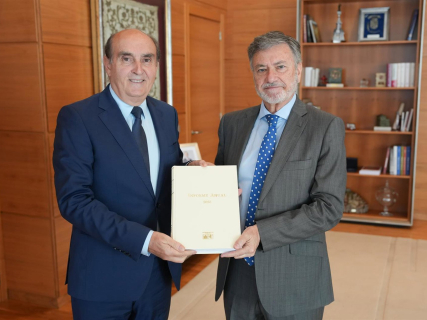

The Ombudsman, Tomás Quintana, delivered this Friday to the president of the Cortes of Castilla y León, Francisco Vázquez, the annual Report corresponding to 2025, which will be defended by the regional ombudsman in a plenary session whose date has not yet been set.
According to the document sent to the highest official of the Legislature, the Ombudsman's institution processed 6,267 files in the past year, initiated 143 ex officio actions —one less than in the previous year— and issued 1,333 resolutions, with an acceptance rate of 84.39 percent.
Within the total number of files, 4,078 were grouped around 17 specific matters, so that, for statistical purposes, they were counted as 17 claims classified as multiple complaints. Consequently, the Ombudsman registered a total of 2,206 individual complaints in 2025, the majority coming from León, with 524; followed by Valladolid, with 339; Burgos, with 219; Palencia, with 164; Ávila, with 143; Salamanca, with 139; Segovia, with 114; Zamora, with 110; and Soria, with 77.
To these claims are added 112 complaints sent from other provinces, three complaints affecting several provinces, two from abroad, and 260 of undetermined territorial origin, "although their authors were perfectly identified, as it is a requirement for admissibility," the Ombudsman's Office has specified.
Regarding the matters addressed in the 2,206 complaints, Local Administration issues are once again in first place, representing 22.85 percent of the total. These are followed by issues of Development, with 13.42 percent, and Public Employment, with 10.79 percent. The Health area accounts for 10.43 percent and Environment for 10.02 percent.
Below 10 percent are Interior and Justice, with 7.39 percent; Family and Equal Opportunities, with 6.71 percent; Education, with 5.67 percent; Treasury, with 4.62 percent; Industry, Commerce, Employment, Social Security and Benefits, with 4.26 percent; Agriculture, Livestock and Rural Development, with 2.22 percent; and finally Culture, Tourism and Sports, with 1.63 percent.
In relation to the 17 multiple complaints, each of them referring to a different matter and promoted by numerous citizens, 4,078 files were generated. Of these, 206 focused on public employment and 173 on the professional reclassification of labor personnel in the categories of educational technical assistant, higher technician in Early Childhood Education, Laboratory technicians, and Physiotherapists.
Another 52 files refer to the working and remuneration conditions of Nursing supervisors and 35 to the integration as statutory personnel of the workers of the Center for Hemotherapy and Blood Donation of Castilla y León.
In the area of environmental protection, 2,962 files were initiated linked to the project for the installation of a biogas plant in La Lastra (León) and a dozen due to disagreement with municipal management during the forest fire in Castrocalbón (León).
In health matters, 476 files have been processed due to the reduction of Pediatric consultations in the Cistierna Health Center (León), while in the educational section, 39 files are counted regarding the request for school transport in the IES Merindades de Castilla, in Villarcayo (Burgos).
Regarding the activity of Development, there are 248 files related to the cleaning of properties and plots due to fire risk in Marugán (Segovia) and another 12 on the same problem in Castrocalbón (León). In the area of Local Administration and Interior, opposition to the way municipal accounts are published, lack of public information, deficiencies in the fire protection system, and the absence of a Fire Emergency Plan in Castrocalbón (León) led to 48 files. In the area of Family, 21 files were promoted linked to the child protection system.
The 2025 statistics are completed with the 143 ex officio actions processed by the Common Procurator and directed, depending on the case, to the regional administration, provincial councils, and various city councils, mainly larger ones, "always on issues that have been considered of interest for the exercise of citizens' rights."
The Common Procurator has placed special focus on the supply of drinking water in numerous small towns in Castilla y León, in order to reinforce effective control of consumption, turbidity, nitrate presence, and the monitoring of natural sources.
Likewise, following the "serious fires" recorded in August, it has initiated investigations ex officio on the possible use of livestock as a fire prevention tool and on the maintenance of hydrants, irrigation outlets, and other devices used in extinguishing fires in urban environments.
In the area of Family, equal opportunities, and youth, the institution has intervened regarding thermal conditions in the Early Childhood Education Schools of León, conflict and violent behaviors towards the staff of the children's centers of Castilla y León, the reservation of parking spaces for vehicles transporting people with reduced mobility near their workplaces, the accessibility conditions of public road transport vehicles in the Community, the procedures for issuing and renewing the large family title, and possible shortcomings in the operation of certain residences.
In the health sector, ex officio actions have been initiated regarding the early detection of rare diseases through neonatal screening, the establishment of priority criteria in the Traumatology specialty, and the financing, by the provincial councils, of personalized medication dosage in rural municipalities.
In education, actions have been promoted regarding the setting of school hours in September, the economic requirements to access the Releo Plus program, and the conversion of grades obtained by students from public universities of Castilla y León in foreign centers within mobility programs.
Regarding municipalities, action has been taken, among other aspects, on deficiencies detected in children's play areas in several towns. Intervention has also occurred regarding problems presented by various regional or provincial roads and "numerous properties" in poor condition or in a state of possible ruin, as well as on the duty to conserve commercial premises, all of which are matters subject to different ex officio actions.
In environmental matters, the institution has paid attention to the treatment of out-of-use solar panels, with the aim of preventing their abandonment. In the agricultural sector, delays in the renewal of the necessary permits for the handling and application of phytosanitary products have been analyzed.
Lastly, in public employment, action has been taken ex officio regarding the provision of service under teleworking arrangements and the adaptation of working hours.