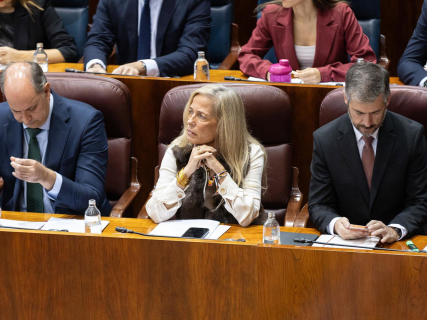

The adviser for Economy, Finance and Employment of the Community of Madrid, Rocío Albert, insisted this Thursday on the "lack of the power grid" in an autonomous community where, as she emphasized, "there are too many projects" because of a central Executive that "limits and controls it." In response, the PSOE replied that the Council of Ministers has agreed to double the electricity capacity initially planned for the region, with an additional reinforcement of 6.5 gigawatts (GW).
"A company looking for somewhere to set up considers the land, talent and legal security. But once it takes that as a given, it asks, will there be electricity to operate and how long it will take. And as always the answer is the same, either there is none or it will take years," the adviser said, who appeared in the Assembly to report on how the current situation of the power grid affects Madrid's productive fabric.
Her words come after the central Government agreed to double the electricity capacity projected for the Community of Madrid, adding 6.5 GW of new capacity and placing the region as the second community that receives the most additional capacity, only behind Aragón.
Albert warned that the power grid has "gotten too small" for the Community of Madrid, which concentrates "11% of all the electricity" consumed in Spain and continues to increase its demand. However, she criticized that Red Eléctrica only allocated "3.3%" of total investment in the country, a figure that she described as "what is left over and small change."
The adviser attributes this situation to decisions by the national Government and pointed out that, for example, there are more than 100,000 planned homes in the regional southeast that currently "do not have guaranteed electricity supply."
"The same thing happens with data centers. They have 15 billion euros in project portfolio. In December 2025, more than 70% of the power the centers were asking for, with a real project, still did not have real power in order to be able to connect. And on those same data centers weighs that new draft decree law from the Government," she added.
In her view, this regulation would put connection permits already granted at risk and shows a "lack of foresight" that jeopardizes "housing, industry and transport."
Vox demands a push from a central Government without Sánchez
The Vox deputy Ana Cuartero has defended that, in order to move forward with a new Industrial Plan in Madrid, it is “essential” to have a change in the Government of Spain. She has described the power grid in the region as “saturated with 300 substations that have no available power”.
She has argued that actions such as extending the grid to major industrial and urban developments, its modernization, the reduction of losses, the integration of all possible generation, or the deployment of energy storage systems, fundamental for the system, “require great institutional coordination and, above all, need the impetus of the policy of a” central “Government that decides once and for all to move forward toward Spain’s energy sovereignty”.
In addition, she has called for the “complaint” in the European Union of the policies that, in her view, cause “the strangulation of industry,” and has demanded the withdrawal of a “National Integrated Energy and Climate Plan that prevents the exploration and exploitation of the country’s energy resources”.
The PSOE claims credit for Sánchez’s management
The Socialist deputy Agustín Vinagre has rebuked the right for going to the Assembly to “reproach the socialist Government for the regulation that the PP approved” and for overlooking that Pedro Sánchez’s Executive has “authorized an additional €17,900 million in investment in regulated-return grids up to 2030, €10,200 million for distribution and €7,700 for transport”.
He has emphasized that the new energy planning sets aside for Madrid 6,500 megawatts of extra capacity, as well as 17 new power plants and substations and 463 kilometers of new or reinforced lines.
Vinagre has reminded Albert that on October 26 the deputy minister of the same Department met with the Ministry to learn about these projects and that the regional Executive “has intervened to unblock some situations”. “They have a very particular way of governing. If an investment comes in, Ayuso’s medal. If a problem arises, it’s Sánchez’s fault. The medals are for you; responsibility is for others, forgetting what their competencies are and what their own responsibilities are,” he concluded.
Más Madrid focuses the debate on energy generation
On behalf of Más Madrid, Paz Serra has intervened, who has placed emphasis on the fact that the Community produces much less energy than it consumes and has highlighted that only data centers project for 2023 a consumption equivalent to three times the installed generation capacity.
She has described Spain as “energy freeloaders of the country” and has questioned whether there is any plan to increase renewable generation or whether “their only plan is to keep burning trash and putting the health of the people of Madrid at risk.”
“The current state of the grid is not a natural phenomenon that has simply happened, nor the umpteenth biblical plague that you want to attribute to the progressive Government,” she said, to argue that it responds to managing a public service “like a private business.”
Finally, she has rejected that the Community’s model, “focused on attracting companies and data centers without demanding much from distribution companies,” is “sustainable either economically or environmentally.” “Energy and light are not a business; they are a right,” she stressed.