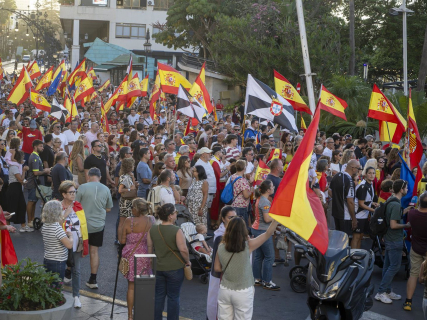

The controversy over the concentration of support for Ceuta scheduled for this Wednesday in Cibeles has its origin in a legal issue regarding who can exercise the right of assembly, according to information conveyed from the Government Delegation.
The Madrid City Council maintains that the Delegation has prevented the celebration of the event, while the state agency denies that there is a prohibition and explains that it has only rejected processing the communication presented by the City Council as a demonstration.
The document sent this Tuesday by the Government Delegation in Madrid allows for reconstructing what has happened and what the difference is between both positions.
What did the City Council communicate?
The Madrid City Council has conveyed to the Government Delegation its intention to hold this Wednesday, September 2 at 8:00 PM in Cibeles, a support event for Ceuta.
The call is framed within the concentrations promoted due to the migratory crisis of the autonomous city and had been proposed by the Madrid City Council.
The Delegation has responded that this communication cannot be processed as a concentration subject to Organic Law 9/1983, regulating the right of assembly, because the City Council, when acting as a municipal Administration, is not the holder of that right.
It is this point that has caused the subsequent confusion.
Has the Delegation prohibited the concentration?
According to the Government Delegation, no. The agency maintains that it has not adopted a resolution prohibiting the concentration. What it has done is communicate to the City Council that it cannot process its request through the fundamental right of assembly.
The difference is important because Organic Law 9/1983 establishes that no meeting is subject to prior authorization. For demonstrations and meetings in public transit places, what exists is a regime of prior communication to the governmental authority.
The Delegation itself has explained that its response refers to who can be the organizer of a demonstration, not to the content of the call or its purpose.
Why can't the City Council call it as a demonstration?
The Delegation bases its position on Article 21 of the Constitution and on the doctrine of the Constitutional Court.
Organic Law 9/1983 establishes that meetings regulated by this norm can only be promoted and called by persons who are in full exercise of their civil rights.
The document sent to the City Council interprets that a council is not the holder of the fundamental right of assembly when acting as a public Administration.
The reason is that a City Council is a public institution responsible for the organization and management of the municipality, and not a temporarily constituted association of citizens to express a claim.
Therefore, according to the Delegation, the City Council cannot use the procedure provided for a demonstration communicated by its organizers.
So, can the event be held?
Yes, according to the Government Delegation. This is one of the keys to the controversy. The document expressly leaves open the possibility that the City Council, "within its competencies and under its responsibility", organizes the institutional event it deems appropriate.
Therefore, the alternative proposed by the Delegation is not to cancel the event, but to change its legal nature: to stop presenting it as a demonstration called by the City Council under the protection of the fundamental right of assembly and to become a municipal institutional act.
The Delegation also assures that it has communicated this to the State Security Forces and Corps so that they can take the necessary measures to ensure the safety of the event.
What is the difference between a demonstration and an institutional act?
A demonstration is a collective expression protected by the fundamental right of assembly of Article 21 of the Constitution. Legislation requires prior communication of meetings in public transit places and demonstrations, but does not subject them to prior administrative authorization.
The governmental authority can only prohibit them when there are well-founded reasons for disturbing public order, with danger to persons or property, and must do so through a reasoned resolution.
A municipal institutional act, on the other hand, is an activity organized by the City Council itself within its competencies. In this case, the Delegation considers that Madrid can organize a support event for Ceuta, but cannot legally present it as a demonstration whose promoter is the City Council itself.
Why does Madrid speak of a prohibition?
The City Council has interpreted the Delegation's response as an impediment to holding the concentration as it had been called.
After receiving the document, municipal sources denounced "this attempt by Sánchez's Government to sabotage the citizen demonstrations of support for the people of Ceuta" and announced that they would study possible responses.
The Government delegate, Francisco Martín, responded on X calling the assertion that the concentration had been prohibited a "lie".
The Delegation has insisted afterwards that its document exclusively addresses a legal issue regarding the condition of the City Council as the holder of the right to assemble.
What does the law say about prohibitions?
Here is another relevant difference. The Delegation's response is not a prohibition for reasons of security or public order.
The Organic Law 9/1983 establishes that the governmental authority can prohibit a meeting or demonstration when there are well-founded reasons that disturbances of public order may occur, posing a danger to people or property. It can also propose changes in the date, place, duration, or route. The decision must be justified.
In the case of Cibeles, the explanation offered by the Delegation does not invoke those causes, but questions whether the City Council can be the holder of the right to assemble and, therefore, whether its communication can be processed according to that law.
What will happen this Wednesday?
The City Council maintains its intention to hold the event in Cibeles at 8:00 PM.
The Delegation, for its part, argues that the City Council can organize it as an institutional event and has communicated the situation to the State Security Forces and Corps to ensure safety.
The dispute is thus concentrated on a question that may seem merely formal, but has practical consequences: whether the event is considered a demonstration exercised under the protection of article 21 of the Constitution or an institutional initiative organized by the City Council.
That is why, although during the afternoon there was talk of a supposed prohibition, the Delegation's version is different: it has not vetoed support for Ceuta nor has it ordered the suspension of the event; it has rejected processing the City Council's communication as a demonstration and has pointed out the route of the institutional event.