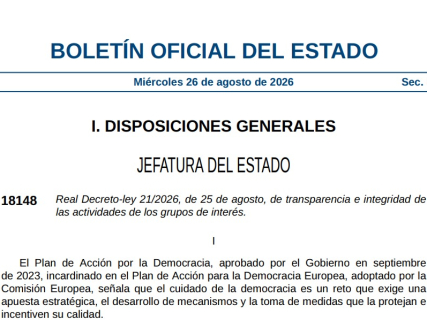
Lobby law: read here the full text published in the BOE

The Government has approved a Royal Decree-Law on transparency and integrity of interest groups that requires the creation of a public and mandatory interest groups registry.

1 minute

WhatsApp Image 2026 08 26 at 12.59.31

WhatsApp Image 2026 08 26 at 12.59.31

Add DEMÓCRATA to Google

Ask FREN

Published

Last updated

1 minute

Most read

The Council of Ministers gave the green light this Tuesday to a Royal Decree-Law on transparency and integrity of interest groups. The new Lobby Law aims to align our country with the EU where this activity is widely recognized and regulated. The formula chosen by the Executive requires it to gain the support of the Lower House in the debate on validation or repeal that must take place within 30 days. Consult the full text published in the BOE:

📄 Read here the full text proposed by the Government
Preview in the news (if your browser allows it)
If you do not see the document (some mobiles block the viewer), use "Open in tab" or "Download".

More key points, information and questions with FREN

AI-GENERATED CONTENT

What is the current status of the parliamentary processing of the Royal Decree-Law on transparency and integrity of interest groups?

The Royal Decree-Law you are interested in is the Royal Decree-Law 21/2026, of August 25, on transparency and integrity of the activities of interest groups. As of today, August 26, 2026, its status is as follows: it is approved by the Council of Ministers and published in the Official State Gazette (BOE), so it is already in force, but it has not yet been ratified or repealed by the Congress of Deputies and, therefore, the parliamentary processing is in the initial phase of pending ratification.

Identification and executive phase

The institutional database shows:

  • Official title: Royal Decree-Law 21/2026, of August 25, on transparency and integrity of the activities of interest groups.
  • Registered phase: publication in the Official State Gazette (BOE) on 08/26/2026, with reference BOE-A-2026-18148.
  • Scope: General State Administration and its institutional public sector.

A note from Moncloa on the “Commitments of the Recovery, Transformation and Resilience Plan (C11, R1)” confirms that the Council of Ministers approved the decree-law on August 25, 2026, as an instrument to create a state, public, and mandatory register of interest groups and regulate their relations with officials and public personnel susceptible to influence.

Status in the Congress of Deputies

Unlike other decree-laws already processed (for example, Royal Decree-Law 15/2026, whose ratification was voted on and rejected on 06/25/2026), in the case of Royal Decree-Law 21/2026 the available parliamentary information only records, for now, the publication in the BOE. The following are not yet recorded in the schedule:

  • Registration of the initiative in Congress.
  • Debate on ratification or repeal in Plenary or in the Permanent Deputation.
  • Votes associated with that ratification.
  • Decision to process it as a bill.

Press pieces coincide with this data. Various reports from Demócrata indicate that the decree-law has been approved by the Council of Ministers to unblock the regulation of lobbies after the Bill on transparency and integrity of the activities of interest groups had been stuck in Congress for months, but they emphasize that the decree:

  • “still must pass a decisive procedure: Congress has neither voted on nor ratified it”,
  • and that the Government must submit it to Congress to decide on its ratification or repeal within the constitutional period of 30 days.

That is, in strict parliamentary processing terms, RDL 21/2026 is in force due to its publication in the BOE, but pending debate and ratification vote in Congress. Until that vote takes place, there is no parliamentary decision nor, therefore, agreement to process it as a bill.

Relation to the previous bill (“Lobby Law”)

In parallel to the decree-law, the Bill on transparency and integrity of the activities of interest groups still exists in Congress, with parliamentary identifier 121/000046 (process process_ini_360183). Its history shows:

  • Submission as a bill by the Government and registration on 01/30/2025.
  • Admission for processing and opening of amendment period, with multiple extensions until 09/10/2025.
  • Total rejection debate on 03/25/2025, in which the total rejection amendment was rejected (32 yes, 177 no, 136 abstentions), allowing the bill to continue its course.
  • Closure of the amendment period to the articles and publication of these on 09/22/2025.
  • Vote on 09/17/2025 by which the Plenary decided to take over the final deliberation and vote on the text (340 yes, 0 no, 6 abstentions), so the Commission's report had to be submitted to Plenary before being sent to the Senate.

Despite this procedural progress, press sources and European Commission reports indicate that, by mid-2026, the bill had not yet been approved by Parliament nor sent to the Senate and was effectively blocked. Precisely this blockage explains why the Government has now resorted to Royal Decree-Law 21/2026 to immediately implement the lobby register and transparency framework, without waiting for the ordinary processing of the law to conclude.

Summary

In summary, the Royal Decree-Law 21/2026 on transparency and integrity of the activities of interest groups is today:

  • Approved by the Council of Ministers (08/25/2026).
  • Published in the BOE and, therefore, in force (08/26/2026).
  • Pending ratification or repeal by Congress, which must decide within a maximum period of 30 days.
  • No agreement yet recorded for its processing as a bill nor any parliamentary vote on the text.

What are the powers of the Council of Ministers in the approval of Royal Decree-Laws in Spain?

The Council of Ministers is the Government body that holds the power to approve Royal Decree-Laws, that is, norms with the rank of law issued by the Executive in cases of extraordinary and urgent necessity. Its role is central both in the decision to use this exceptional instrument and in the formal approval of the text that will later be subject to control by the Congress of Deputies.

The constitutional basis of this power is found in Article 86 of the Spanish Constitution, which enables the Government to issue provisional legislative provisions called decree-laws “in cases of extraordinary and urgent necessity,” with certain material limits and always subject to parliamentary ratification. Alongside this, Article 97 CE assigns the Government the direction of internal and external policy, civil and military administration, and the defense of the State, as well as regulatory power, which serves as a general basis for its normative capacity, including this singular form of emergency legislation.

From a material point of view, the Council of Ministers can only approve Royal Decree-Laws when the notes of extraordinary and urgent necessity are justified. It is politically the Government’s responsibility and, in practice, the Council of Ministers itself, to assess and make explicit in the statement of reasons the circumstances that justify resorting to this instrument, which the Constitution configures as exceptional compared to the ordinary legislative procedure. This decision is later controllable by Congress and, ultimately, by the Constitutional Court.

Additionally, the Council of Ministers must respect the material limits of the decree-law: it cannot affect the organization of the basic institutions of the State, the rights, duties, and freedoms of citizens regulated in Title I of the Constitution when they must be developed by organic law, the regime of autonomous communities, nor the general electoral regime. The examination that the content of the Royal Decree-Law remains within that perimeter of matters is, in fact, a political and technical responsibility of the Council itself, which approves the text after preparatory work by the involved ministries.

Procedurally, the Council of Ministers is the body that approves the normative text. The procedure, simplified, runs as follows:

  • One or more ministries prepare a draft norm, with reports and justificatory memoranda, including the motivation of extraordinary and urgent necessity.
  • That draft is submitted to the Council of Ministers, which debates its opportunity, scope, and wording.
  • The Council adopts the formal agreement to approve the Royal Decree-Law, collectively assuming political responsibility for its content and the decision to use that route.
  • After approval, the President of the Government and the competent minister countersign it, it is sent to the King for sanction, and its immediate publication in the BOE is ordered, the moment it comes into force unless otherwise provided.

The Council of Ministers’ power does not end with approving the text: it is also responsible for arranging the submission of the Royal Decree-Law to the Congress of Deputies, which must meet within a maximum period of 30 days to debate and vote on it. In practice, the Government, through the Council, sets the moment of that submission and organizes the political defense of the norm before the Chamber, usually by the proposing minister or the Government member designated for that purpose.

In its relationship with the General Courts, the Council of Ministers thus has a dual function: on the one hand, initiator and approver of the emergency norm, which comes into force immediately; on the other, subject to parliamentary control, since Congress can ratify, repeal, or agree to process the Royal Decree-Law as a bill. If Congress opts for the latter route, the text approved by the Council of Ministers becomes the basis of a complete legislative procedure, in which the Chambers can introduce amendments and substantially modify the initial content.

In summary, the Council of Ministers concentrates the political decision to resort to the Royal Decree-Law, the collegiate elaboration and approval of the text, and its promotion to Congress, but its power is delimited by the Constitution: it must prove extraordinary and urgent necessity, respect material limits, and accept that the norm’s validity is conditioned on control and eventual transformation by the legislative power.

What laws or regulations currently govern lobby activity in other European Union countries?

In the European Union, there is no single model for lobby regulation, but rather a combination of national registers and laws. Based on available information, the most developed and clearly identified frameworks are those of France, Ireland, Germany, and Portugal, along with the transparency system of the EU institutions. Other states (such as Belgium, the Netherlands, Poland, or Sweden) combine general transparency rules, codes of conduct, and, in some cases, partial registers, but without a law as structured as in those four cases.

France: Sapin II Law and registration before the HATVP

France has one of the most advanced systems in Europe. The main framework is the so-called Sapin II Law (2016), which establishes the regulation of représentation d’intérêts and, since 2017, requires certain actors to register in a directory managed by the High Authority for the Transparency of Public Life (HATVP).

  • Requires registration of companies, associations, consultancies, and other interest representatives who try to influence public decisions.
  • Demands declaration of activities carried out, objectives pursued, areas on which influence was attempted, and categories of public officials contacted.
  • Includes a key element: the declaration of expenses on lobbying activities, such as personnel, consultancy, events, or professional services, allowing measurement of economic influence capacity.

A summary of this system can be seen in the comparative analysis of France, Ireland, and Germany published by Demócrata: article on lobby law in Europe.

Ireland: Regulation of Lobbying Act 2015

Ireland regulates interest representation activity through the Regulation of Lobbying Act 2015, in force since that year. Its philosophy is that citizens can know who lobbies, for whom, on what issue, what outcome is sought, and before which public officials.

  • Establishes a mandatory register of those who carry out lobbying activities on certain officials and institutions.
  • Registered entities must submit declarations every four months, so information is updated three times a year, not just annually.
  • Each declaration links the influence activity with the specific topic and the recipients of the communications.

This model is one of those cited as a reference in comparative analyses of lobby transparency in Europe, where Ireland appears among the best-rated democracies in the matter.

Germany: Lobby Register Act (Lobbyregistergesetz)

Germany launched the mandatory register of interest representation before the Bundestag and the federal Government on January 1, 2022, under the Lobby Register Act (Lobbyregistergesetz). Subsequently, a reform that came into force on March 1, 2024, expanded transparency obligations.

  • Requires registration of those who carry out activities aimed at directly or indirectly influencing political processes and decision-making of the federal Parliament and Government.
  • Demands information on areas of activity, persons responsible for representation, and certain resources used.
  • Distinctive element: the register allows identification of which specific regulatory projects are the object of influence activities and publishes positions and documents sent to the Bundestag or the Executive.

In some Länder, such as Hamburg, there are also specific lobby register laws at the regional level, with legislative footprint and code of conduct, as reflected in the note from Hamburg’s data protection authority on its lobby register law: statement from Hamburg authority.

Portugal: Law No. 5‑A/2026

Portugal has recently approved Law No. 5‑A/2026, of January 28, which establishes the institutional relations framework applicable to legitimate interest representation. According to information from the regulatory authority ANACOM, the norm:

  • Defines the principles of action and duties of entities that carry out interest representation and their representatives.
  • Creates the Transparency Register of Interest Representation (RTRI), which operates in connection with the Assembly of the Republic.
  • Provides for the public designation of a person responsible for institutional relations and adherence to a code of conduct as a condition to participate in hearings or meetings with public authorities.

Details can be consulted in ANACOM’s note on adherence to the code of conduct annexed to the law: ANACOM note on Law 5‑A/2026.

EU institutions and other Member States

Besides national laws, EU institutions have a Joint Transparency Register (Commission, Parliament, and Council) that identifies companies, associations, consultancies, NGOs, unions, and other groups trying to influence European policy-making. As sector professionals recall, this register is fully normalized in Brussels and is part of the usual functioning of interlocution: article on lobby and influence trafficking.

Also, the European Parliament is working on a directive on interest representation by third countries, with a system of interconnected national registers and a European Interest Representation Number (EIRN): European Parliament note.

In other Member States (Belgium, the Netherlands, Poland, Sweden, Italy, etc.) regulation combines general transparency rules, parliamentary codes of conduct, and, in some cases, sectoral or parliamentary registers, but the information available in the consulted sources does not allow specifying here a single and detailed law comparable to the described cases.

Play

Test your knowledge with FREN!

How much do you know about this topic? Answer the following 3 questions.

Which body approved the Royal Decree-Law on transparency and integrity of interest groups?

Question 1 of 3

What is the main objective of the new lobby law approved by the Government?

Question 2 of 3

Where has the full text of the new lobby law been published?

Question 3 of 3

Hola, soy Fren. ¿Cómo te ayudo?