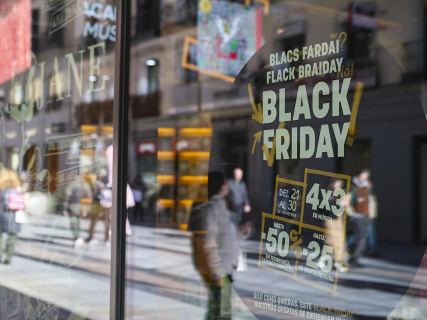

The Black Friday 2026, which will be held next November 27, comes with thousands of deals on the main e-commerce platforms. However, before taking advantage of a discount on technology, clothing, or home appliances, there is a detail that can go unnoticed and prove decisive if the purchase ends up causing problems: the “sold by” section that appears on the product listing. Even if the consumer places the order on a well-known page, they are not always buying directly from the company that owns that platform.
The European Consumer Centre in Spain (CEC-España), which depends on the Ministry of Consumer Affairs, reminds that large digital marketplaces, known as marketplaces, work as intermediaries between buyers and sellers. This allows different companies and even individuals to market products using the same website. The problem arises when the consumer confuses the platform where they make the payment with the merchant that is actually selling the item.
The distinction is not minor. As a general rule, the seller is responsible for responding to defects in the product and for fulfilling the obligations arising from the sales contract, while the platform may simply limit itself to facilitating contact, handling payment, or arranging shipping. Therefore, the same item can be found on a well-known website with different prices, delivery timeframes, and conditions, depending on who is marketing it.
This situation takes on special importance during Black Friday, when the speed of promotions, discounts, and messages about limited units can lead buyers to confirm their orders without reviewing all the details. An offer that appears identical may offer different warranty and claim conditions depending on the identity and location of the seller.
What “sold by” means and how it differs from “shipped by”
On platforms such as Amazon, commercial information usually distinguishes between the company that sells the product and the entity that takes care of shipping it. Although both pieces of data may appear together, they do not mean the same thing and it is advisable to check them before completing any purchase.
When an item is listed as "sold by Amazon", the company itself acts as the seller. In contrast, if the name of an external store appears, the sales contract can be concluded with that merchant, even if the order is processed through Amazon and its payment tools are used.
The situation can become more complicated when the product appears as "sold by an external company" and "shipped by Amazon". In this case, the platform may be responsible for storing, preparing, and delivering the item, but that logistical intervention does not necessarily mean that it has assumed all the legal responsibilities of the seller.
An example helps to understand the difference. A consumer finds discounted headphones from 120 to 79 euros. The listing indicates that the product is sold by an external store and shipped by the platform. If the package does not arrive, there may be an assistance procedure related to shipping; however, if the headphones have a defect months later, the warranty claim must, in general, be directed to the merchant responsible for the sale, without prejudice to any additional protections offered by the platform.
Consumo insists that it is not enough to identify who manages the shipment. It is also necessary to check who is listed as the seller in the contractual terms, because responsibility will depend on the specific actions of each company and on the obligations it has assumed.
Where to check the seller’s identity before paying
Information about the merchant usually appears on the product listing, near the price or purchase options, under expressions such as "Sold by", "Seller name", "Store information" or "Merchant details". The exact location depends on each platform and can vary between the mobile app and the desktop version.
The consumer should access that section and check the name or company name of the business, its address, the country where it is established, and the means available to contact it. It is also advisable to review shipping conditions, return costs, and the procedure for submitting claims.
Spanish legislation requires that online markets provide information about whether the third party offering the product is a business or a private individual, as well as about the distribution of certain obligations between the seller and the platform. These requirements are set out in the article 97 bis of the General Law for the Defence of Consumers and Users.
The rule also requires information that, when the seller is a private individual, the specific consumer protection rules do not apply to that contract. This is an important difference because two products advertised on the same platform may be subject to different legal regimes.
In addition, a web address ending in ".es" or ".eu" does not guarantee that the selling company has its registered office in Spain or in another country of the European Union. The European Consumer Centre recommends expressly verifying this information, especially when purchasing products from unknown traders.
What rights do you have if you buy from a company, a private individual or a foreign seller
When the purchase is made from a professional seller established in Spain, the consumer generally has a legal guarantee of three years for new products. During that period, if the item shows a lack of conformity covered by law, the seller must offer the corresponding solutions, such as repairing or replacing it and, in the situations provided for, a reduction in the price or a refund of the money.
For purchases made online, there is also, unless legal exceptions apply, a period of 14 natural days from receipt of the product to withdraw from the contract without needing to justify the reason. The fact that the item was purchased during Black Friday does not eliminate these rights.
The situation changes when the seller is a private individual who does not act as a business. In these transactions, the three-year consumer legal guarantee and the general right to withdraw from a 14-day contract do not apply automatically. This does not mean that the buyer has no legal protection, since there may be liabilities under the Civil Code, but the mechanisms and the conditions for making a claim are different.
When the seller is a company established in another country of the European Union, there is also a common framework for consumer protection, although the specific deadlines and mechanisms must be analyzed according to the applicable legislation. In the event of a dispute, the buyer residing in Spain may request assistance from the European Consumer Centre in an attempt to reach an amicable solution.
The greatest difficulties may arise when the trader is outside the European Union. European consumer regulations may still be applicable if the company directs its commercial activity to European consumers, but getting those rights enforced can be more complicated due to distance, jurisdiction, and difficulties in carrying out a possible complaint.
That is why, buying from a foreign company does not automatically mean losing all rights, but it can make their exercise more difficult when a problem arises.
What to do if the order does not arrive or the seller does not respond
The European Consumer Centre recommends that, before placing any order, you review the contractual terms and the protection tools offered by the platform. Some have their own procedures to intervene when an external seller does not deliver the product, does not process a return, or fails to comply with the announced terms.
If an incident arises, the first step is to identify which company is responsible and submit a written complaint, keeping the order confirmation, the invoice, payment receipts, and the conversations held with the seller. It is also advisable to save a screenshot of the original offer, especially if it included special delivery or return conditions.
When the problem is related to payment handling or to a logistics service assumed by the platform, it may be necessary to contact it. In contrast, if the dispute affects the product’s warranty, the main responsibility usually lies with the professional seller, although the platform may offer additional assistance mechanisms.
In Spain, companies must respond to consumer complaints within a maximum period of 30 days, in accordance with the applicable regulations. If the problem cannot be resolved, the buyer may turn to public consumer bodies and, in cross-border cases included within their scope, to the European Consumer Centre.
This organization reminded in its recommendations of November 11, 2026 that consumer rights remain in place during discount campaigns and that it is essential to know the contracting conditions before paying.
In short, the logo of a well-known platform does not guarantee that that company is directly responsible for the sale. Before confirming a purchase during Black Friday, checking who appears in the section “sold by,” where it is established, and what conditions it offers can help avoid later problems to recover the money, return the product, or exercise the warranty.