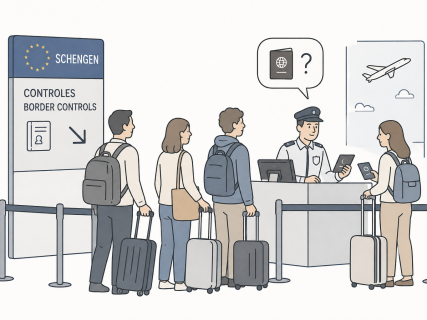
Traveling from Spain to Italy is still perfectly possible. A Spanish citizen does not need a visa to enter Italy nor faces a ban on entry. Neither does an Italian need any special permission to travel to Spain.
But the journey is no longer exactly the same as it was a week ago. The decision of Giorgia Meloni's Government to temporarily restore controls at the internal borders with Spain, starting from August 1, has effectively broken the usual normality of the Schengen area between both countries. And the response announced by Pedro Sánchez's Government comes into effect this Saturday, August 8.
The result is an unusual scenario: two countries of the European Union that are part of Schengen are again controlling travelers who until now crossed their internal borders without ordinary border controls.
The dispute arose from the migration crisis in Ceuta and now threatens to move to the more sensitive area for the summer: tourism.
What does a Spaniard find upon arriving in Italy?
Italy reinstated temporary controls for travelers coming from Spain at airports and seaports on August 1.
In practice, for a Spanish citizen traveling directly to Italy, his right to enter the country does not change. It remains sufficient to carry a valid identity document or passport.
What changes is that the Italian authorities can carry out a border control that would not exist under normal conditions within the Schengen area.
The first experiences collected at Italian airports show that specific lines or points have been set up for travelers coming from Spain, with document checks before leaving the arrivals area.
Airlines had already anticipated that Spanish passengers could travel without extraordinary procedures and that the main impact would be concentrated on certain travelers from third countries.
Therefore, one should not confuse border control with visa requirements.
The Spaniard traveling to Rome, Milan, Venice, Sicily, or any other Italian destination can do so. The difference is that he may have to stop in front of an agent to verify his identity.
Are there queues?
This is where it is important to distinguish between what is already happening and what may happen.
Yes, there are images and testimonies of specific queues at Italian airports since the entry into force of the controls. There have also been waits at some arrival points, including Fiumicino, although there is no data to affirm that all Italian airports are suffering from large queues or that the problem has the same intensity throughout the day.
It is an important difference.
The measure does not require all Spanish passengers to necessarily go through a long procedure. The impact will depend on the airport, the number of flights coinciding in a certain time frame, and the police resources allocated to the control.
But the risk of longer waiting times exists.
And it arrives precisely in August, when Italian airports and ports bear one of the highest volumes of travelers of the year.
What happens now with Italians coming to Spain?
Since midnight this Saturday, Spain is applying temporary controls to travelers coming from Italy.
The measure will initially be in effect until September 7, although the Spanish Government has indicated that it could be modified if circumstances change. The controls are carried out at ports and airports and are random.
The Spanish authorities will check the identity, nationality, and documentation of travelers.
For Italian citizens, just like for the rest of the citizens of the European Union, there is no new entry requirement. They still have the right to travel to Spain.
The difference is again in the control.
In other words: an Italian arriving in Madrid, Barcelona, Palma, Málaga, Tenerife, or any other Spanish airport from Italy may be subjected to a police check that was not part of the normal transit within Schengen before.
And what if the traveler is neither Italian nor Spanish?
Here the situation can be somewhat more complex.
Spain has indicated that the controls will also apply to travelers from third countries arriving from Italy. In those cases, in addition to identity and passport, the visa or residence permit may be checked when applicable.
This is important for those who use Italy as a stopover or entry point to the Schengen area.
A non-EU citizen flying from Rome to Madrid may now encounter an additional check that would not take place under normal circumstances within the Schengen area.
The measure, therefore, does not affect all travelers in the same way.
Spain and Italy remain within Schengen
The term "suspension of Schengen" used in the political debate can be misleading.
Italy has not left Schengen nor has Spain ceased to be part of the free movement area.
What European regulation contemplates is that, under certain circumstances related to security or public order, States may temporarily reintroduce controls at their internal borders.
The Spanish Ministry of the Interior itself explains that internal borders may be subject to national controls for a limited period when public order or national security demands it.
That is what is happening now. The political discussion is whether Italy has sufficiently justified its decision and whether the measure is proportionate to the risk it intends to address.
Madrid believes not. Rome maintains the opposite.
Why did it all start?
The origin lies in the massive entry of people in Ceuta at the end of July.
Italy decided to reestablish temporary controls with Spain citing security reasons linked to migratory pressure and the possibility of new movements.
The Spanish Government demanded that Rome lift the measure and argued that the situation in Ceuta did not justify restricting movement between two partner countries of the European Union in this way.
Italy rejected the Spanish ultimatum.
The response from Madrid has been to apply reciprocal controls since this Saturday.
The conflict has thus shifted from being a discussion about immigration to becoming a bilateral problem within the Schengen area itself.
Tourism, in the midst of the standoff
The moment could not be more delicate.
August concentrates a significant part of the tourist movements between both countries. Spain and Italy are, moreover, two of the major European tourist destinations and maintain an intense exchange of travelers.
Spain closed 2025 with 96.8 million international tourists, a historical maximum, and during the first five months of 2026 received more than 36.8 million, 5% more than in the same period of the previous year.
Italy is also facing a summer of strong tourist activity. The Italian Ministry of the Interior reinforced security measures in art cities and main tourist destinations during July and August in response to the increase in visitors and movements.
In this context, any additional friction at airports and ports can have an effect that goes beyond the minutes a traveler takes to show their documentation.
Uncertainty can also influence the tourist experience.
Can it affect bookings?
In the short term, the sector does not handle data that allows for talking about a widespread drop in bookings due to the controls.
The first reaction of the airlines was to maintain the schedule and convey that flights between Spain and Italy would continue to operate normally.
Travel agencies, on the other hand, have had to incorporate an additional recommendation: inform clients that they must carry their valid documentation and allow enough time for possible checks upon arrival. The Galician Association of Travel Agencies has warned its members of the need to review this issue during August.
The problem, for now, is not that a Spaniard cannot travel to Italy or that an Italian cannot come to Spain.
It is that the border may cease to be invisible.
And that is precisely one of the advantages that the Schengen area has provided to European tourism for decades.
The risk is that the standoff prolongs
The true tourist impact will depend on the duration.
A random check that adds a few minutes to a trip will likely have a limited effect.
A prolonged situation, with more intense checks, accumulation of passengers, and new reciprocal measures, would be different.
The Italian press itself has already focused on this risk. Some media outlets raise how long the confrontation between Rome and Madrid can last without affecting travelers and particularly warn of the potential impact on Spanish destinations with a high presence of Italian tourists.
There is also a particularity: Spain has decided to respond to Italy with a similar measure.
This introduces a dynamic of escalation that did not exist when Rome announced its controls.
Is there a solution?
Yes.
And it is likely to be a political and diplomatic solution rather than a logistical one.
The controls can be lifted. The Schengen Borders Code allows them to be temporary and linked to certain circumstances. The ultimate goal of the European system remains the absence of controls at internal borders.
The simplest solution would be for Rome and Madrid to agree to withdraw their respective measures.
But for that, they will first have to resolve the issue that originated it: what level of migratory threat really exists and to what extent can it justify controls between two Schengen countries.
Spain considers that the Italian decision stems from a mistaken interpretation of what happened in Ceuta. Italy defends that it is acting preventively in the face of a security risk.
While both governments maintain their positions, travelers are the ones who are starting to experience the practical consequences.
A problem that arrives at the worst moment
For now, there is no closed border between Spain and Italy, there are no new visas for Spaniards or Italians, and the right to travel has not been suspended.
There are controls.
And there are already points where those controls generate queues or additional waits, although it cannot yet be said that there is a widespread collapse of airports.
The Spanish Government maintains its controls, at least, until September 7. Italy had initially set its controls for 30 days, until September 1, while the diplomatic standoff continues.
The paradox is evident: a migratory crisis that occurred at the border between Spain and Morocco has ended up generating controls at the borders between Spain and Italy.
And the potential cost is not only measured in minutes of waiting.
It is also measured in the trust that millions of Europeans have placed in an idea that seemed irreversible: being able to take a plane in Madrid, Barcelona, Palma, or Rome and arrive in the other country without encountering a border again.
This summer, that border reappears.
Even if it is, for now, behind a random document control.