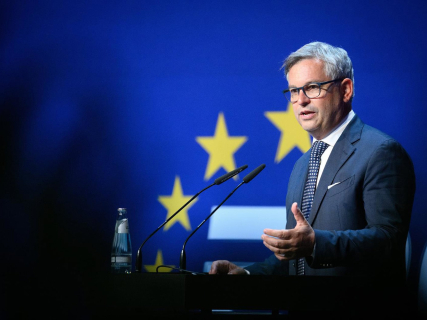

The European Commission has proposed this Thursday to intensify support for Spain with more financial, technical, and operational aid, also through the European Border and Coast Guard Agency (Frontex), to "control the situation" in Ceuta. At the same time, it has confirmed that it is maintaining contacts with the Moroccan authorities to adopt "immediate measures" to put an end to the "dangerous crossings" to the autonomous city.
I conveyed to Minister Grande-Marlaska the EU’s readiness to increase support to Spain, including through Frontex, to control the situation. We are also following up with the Moroccan authorities to ensure all necessary efforts are made to prevent these dangerous journeys.
— Magnus Brunner (@magnusbrunner) July 30, 2026
"The protection of the external borders of the Union is a crucial part of our efforts to combat irregular immigration. We are in contact with the competent authorities regarding the evolution of the situation in Ceuta," indicated the European Commissioner for Home Affairs and Migration, Magnus Brunner, who specified that he has already communicated to the Minister of the Interior, Fernando Grande-Marlaska, the bloc's willingness to reinforce its support.
The EU plans to deploy FRONTEX in Ceuta
In this context, Brussels proposes to use Frontex, the European agency responsible for assisting Member States in the surveillance and management of the external borders of the EU, as the central piece of the community response to help Spain face the migratory pressure in the autonomous city, while discussions with Morocco continue to try to curb new crossing attempts.
"I have conveyed to Minister Grande-Marlaska the EU's willingness to increase support for Spain, also through Frontex, to control the situation. Likewise, we are working with the Moroccan authorities to ensure that all necessary efforts are made to prevent these dangerous crossings," the commissioner added.

In the same vein, community sources have emphasized that Brussels is "aware of the latest events in Ceuta" and is closely following a reality that continues to change, stressing that "combating irregular immigration, protecting the integrity of the external borders of the Union, and preventing the abuse" of the legal framework is "of utmost importance."
In the same way, they have highlighted the "close cooperation" between Spain and Morocco to address these flows and "ensure the rapid return of those who have entered Ceuta illegally, in accordance with applicable regulations."
Furthermore, Brussels has reiterated that Morocco remains a "key and trusted partner" for the EU in migration matters and has emphasized that both parties have strengthened collaboration in border control, combating human trafficking networks, and migration management in recent years, with the intention of now elevating this relationship to a strategic and comprehensive partnership.
Ceuta faces its largest migration crisis since 2021

The reaction of European institutions comes after Ceuta experienced the largest migration crisis since May 2021 on Thursday, with the entry of thousands of people for several hours, mostly young Moroccans, although also families with women and minors. Many accessed the autonomous city by swimming, skirting the Tarajal breakwater or overcoming the border fence.
In light of this scenario, the Spanish Government and Morocco have agreed to strengthen coordination to return "as soon as possible" all individuals who have entered irregularly, while the President of the Government, Pedro Sánchez, has emphasized that both countries are collaborating to restore normalcy. For his part, the Minister of the Interior, Fernando Grande-Marlaska, will travel to Ceuta on Friday to manage the migration crisis on the ground.