Critical situation in Ceuta: thousands of immigrants storm the border but the Government refuses to take command

The Government rejects declaring a national emergency and reforming the Immigration Law while the Police cannot cope and Jupol demands reinforcements. The crisis coincides with the Throne Day of Mohamed VI, despite Morocco claiming that it collaborates with Spain to contain the departures.

2 minutes

EuropaPress 7695266 varias personas intentan cruzar frontera nado 30 julio 2026 ceuta espana

EuropaPress 7695266 varias personas intentan cruzar frontera nado 30 julio 2026 ceuta espana

Add DEMÓCRATA to Google

Ask FREN

Published

Last updated

2 minutes

Most read

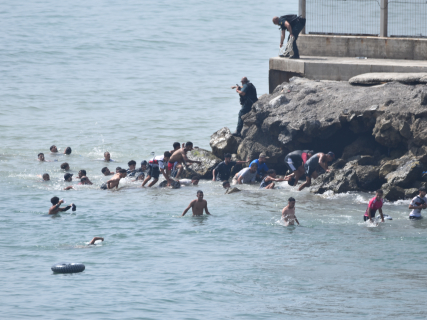
Ceuta is living a critical situation. Today, the entire Assembly of Ceuta unanimously has requested help from the Government and that it declare a national emergency, but the response from the Interior has been rejection. Meanwhile, around 1,500 immigrants, mostly young Moroccans and with a high presence of minors, have entered the city during the last week. In the meantime, thousands of people have approached the border or have attempted to reach Spanish territory by swimming, through the beach or skirting the breakwater of El Tarajal.

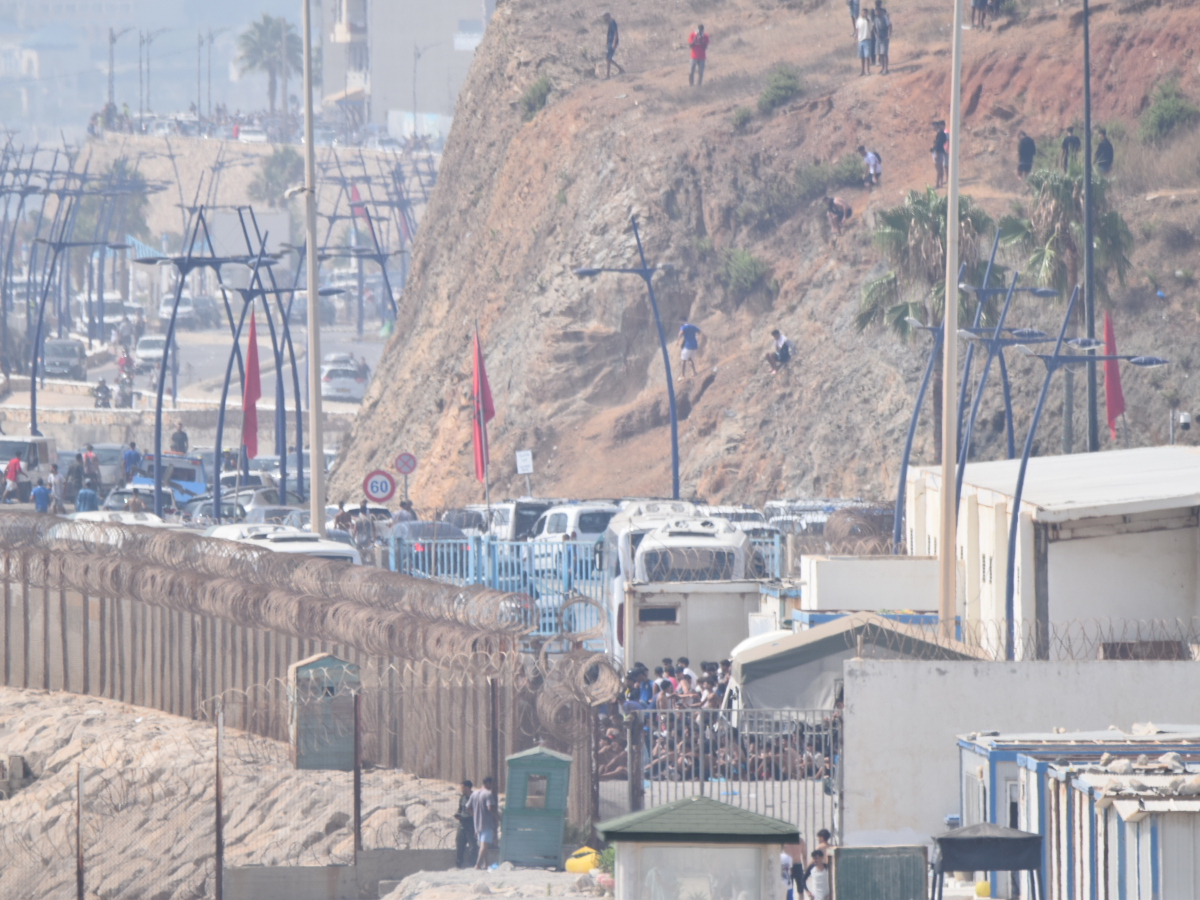
The images from the last days show groups advancing through the water and crossing on foot through the border area. Morocco claims to have intercepted hundreds of people before they reached Ceuta, but the figures show that the device has not been sufficient. The CETI is saturated, the minor protection system is overwhelmed, and the Police cannot keep up.

And while the immigrants manage to break the police cordon, the agents must monitor the border, participate in rescues, identify the newcomers, and process each file individually. Jupol and other police unions have been warning for some time that there are not enough personnel and resources in Ceuta. Now they openly speak of a situation of chaos and demand urgent reinforcements, clear instructions, and a reform of the Immigration Law.

The Government's Rejection

The Government, however, has so far rejected the two main requests made from Ceuta. The Interior maintains that the arrivals of immigrants do not fit among the assumptions provided by the Civil Protection Law to declare a national emergency. It also does not contemplate immediately modifying the immigration legislation.

Fernando Grande-Marlaska will travel this Friday to Ceuta, after the president of the city, Juan Jesús Vivas, requested an extraordinary intervention from the State. The Ceuta Assembly demands a common response to a problem that the city, due to its size and lack of space, cannot handle alone.
EuropaPress 7695274 varios migrantes intentan cruzar frontera nado 30 julio 2026 ceuta espana
EuropaPress 7695274 varios migrantes intentan cruzar frontera nado 30 julio 2026 ceuta espana -

The Day of the Throne of Mohamed VI

The crisis coincides also with the Throne Day of Mohamed VI. While Morocco celebrates the 27 years of reign of the monarch, thousands of young people are moving towards the northern coast of the country with the intention of reaching Ceuta. Rabat claims that it cooperates with Spain and that its security forces are stopping numerous attempts. However, the entry of 1,500 people in one week raises the question of whether that collaboration is working and if Morocco is doing everything necessary to control the departures from its territory. That is at least what Ceutí media are asking this Thursday, stating that, while Moroccan citizens are jumping the fence of Ceuta, their monarch looks the other way.

What happened also worries Europe. Ceuta is an external border of the European Union and those who arrive in the city enter the community migratory space. Predictably, and as has been happening so far, a part will try to move on to the Peninsula and continue towards France or other countries.

Italy does not directly receive those who enter through Ceuta, but shares with Spain the pressure of the Mediterranean routes and has been demanding greater control of the external borders for years. Spanish decisions, therefore, do not only affect Ceuta. They also condition European migration policy and relations with neighboring countries that may receive subsequent movements.


More key points, information and questions with FREN

AI-GENERATED CONTENT

What are the parliamentary steps required to declare a national emergency in Spain?

In Spain, the “national emergency” in a legal sense is exclusively articulated through the states of alert, exception, and siege. The Constitution (art. 116) and the Organic Law 4/1981 establish who declares them, the role of the Government, and the controls and authorizations exercised by the Congress. The Parliament does not process an ordinary law but controls, authorizes, or directly declares these situations through specific and expedited procedures. The parliamentary steps in each case are detailed below.

1. Constitutional and legal framework

Article 116 of the Spanish Constitution states that:

  • An organic law will regulate the states of alert, exception, and siege.
  • The state of alert is declared by the Government by decree, for a maximum of 15 days, reporting to the Congress, which must authorize any extension.
  • The state of exception is declared by the Government by decree, but with prior authorization from the Congress, which sets duration, scope, and effects.
  • The state of siege is declared directly by the Congress, by absolute majority, at the exclusive proposal of the Government, setting scope, duration, and conditions.
  • While any of these states last, the Congress cannot be dissolved and the Chambers are automatically convened if they are not in session.

These mandates are developed in the Organic Law 4/1981, on the states of alert, exception, and siege, which details the steps, deadlines, and content of parliamentary decisions.

2. State of alert: declaration and control by Congress

a) Initial declaration (without prior authorization)

  • The Government, in the Council of Ministers, approves a Royal Decree declaring the state of alert when the foreseen circumstances occur (disasters, health crises, paralysis of essential services, shortages, etc.).
  • The decree sets the territorial scope, duration (max. 15 days), and effects.
  • It is immediately published in the BOE and comes into force at that moment.
  • The Government must report to the Congress and provide the information it requests.

b) Extension (does require parliamentary authorization)

  • If it is desired to extend beyond 15 days, the Government must submit to Congress a request for authorization of extension, again indicating scope, duration, and conditions.
  • Congress debates the request in Plenary and may:
    • Authorize it as proposed.
    • Authorize it modifying duration, scope, or conditions.
    • Not authorize it (in which case the state of alert lapses).

The conditions of control and extension were subject to interpretation by the Constitutional Court in rulings on the COVID-19 states of alert, such as STC 148/2021 and STC 183/2021.

3. State of exception: prior authorization and extension

Here the parliamentary role is more intense from the start:

  • The Government, when public order disturbances are so serious that ordinary powers are insufficient, may request authorization from Congress to declare the state of exception.
  • This request must detail, according to Organic Law 4/1981:
    • The rights whose suspension is requested (only those in art. 55.1 CE).
    • The measures to be adopted regarding those rights.
    • The territorial scope and duration (max. 30 days).
    • The maximum amount of possible sanctions.
  • The Congress debates the request and may approve it as is or with modifications.
  • Only once authorization is obtained, the Government declares the state of exception by Royal Decree, adhering to what was authorized.
  • To modify essential measures or extend (for another max. 30 days), the Government must again request authorization from Congress.

4. State of siege: direct decision of Congress

This is the most extreme form of national emergency and parliamentary intervention is maximal:

  • The Government submits a proposal for state of siege to Congress.
  • The Congress, by absolute majority, decides whether to declare the state of siege.
  • In its agreement it sets:
    • The territorial scope.
    • The duration.
    • The conditions (including the extension of the military scope, according to the Constitution).

During these states, certain governmental and parliamentary acts are subject to control by the Constitutional Court, as emphasized by STC 83/2016 regarding a challenge to the 2010 state of alert.

5. Common features from the parliamentary point of view

  • The Congress is the center of political control: it authorizes, extends, or declares depending on the type of state.
  • A debate in Plenary is required, with accountability by the Government.
  • There is no processing as an ordinary law: no committee, working group, or Senate, but direct decisions by the Plenary of the Congress.
  • The Chambers cannot be dissolved and are always convened while the emergency situation lasts.
How do the measures that can be adopted materially differ in the states of alert, exception, and siege? What role does the Constitutional Court play in controlling decisions about states of alert, exception, and siege? How were the parliamentary procedures for states of alert managed in practice during the COVID‑19 pandemic?

What powers does the Minister of the Interior have in managing migration crises?

The Minister of the Interior is the highest political authority over internal security, security forces, and civil protection, and in a migration crisis exercises command and coordination of the entire border control and public order device. His powers are supported by laws on security forces, immigration, citizen security, national security, and civil protection, as well as royal decrees that develop the Ministry's structure. Although the management of the underlying migration policy (reception, asylum, integration) falls to other departments, the Minister of the Interior directs the immediate response at ports, land borders, and airports, and participates in the main crisis coordination bodies. All this is articulated through the National Police, Civil Guard, Government Delegations, and national security mechanisms.

Political direction and internal security

Organic Law 2/1986, on Security Forces and Corps (LO 2/1986) and Organic Law 4/2015, on citizen security protection (LO 4/2015) configure the Minister of the Interior as the political head responsible for public security at the state level. Through the State Secretariat for Security, he exercises political command over the National Police and Civil Guard and sets operational guidelines in the face of public order disturbances linked to mass arrivals, conflicts in detention centers, deployments at ports, or possible incidents in neighborhoods and settlements.

The structural royal decrees (currently developed by Royal Decree 207/2024, whose erratum is published in the erratum, in connection with Royal Decree 139/2020 on basic ministerial structure) specify that the Minister politically directs the entire department, approves strategic instructions, and coordinates the general directorates (Police, Civil Guard, Civil Protection and Emergencies, Traffic, etc.).

Border control and immigration police

The central piece is Organic Law 4/2000, on the rights and freedoms of foreigners in Spain and their social integration (LO 4/2000) and its reforms (LO 8/2000, LO 2/2009, LO 10/2011), which assign to the State – and operationally to the Ministry of the Interior – the functions of controlling entries and exits, combating irregular immigration, and executing expulsions and returns. The Minister, through the National Police, directs:

  • Border control at authorized posts (ports, airports, and land borders).
  • Immigration police: documentation, detention in cases provided by law, and processing of sanctioning files.
  • Management of foreigners' internment centers (CIE), regulated by Royal Decree 162/2014, which depends organizationally on the Interior Ministry.

Additionally, international agreements channeled through Interior, such as the Agreement with the International Organization for Migration (IOM) on voluntary return and integrated border management (agreement with IOM), reinforce its role in return programs and border control in contexts of migratory pressure.

Cooperation with other ministries and with Autonomous Communities and municipalities

In a migration crisis, the Minister of the Interior does not act alone. The very architecture of national security, defined by Law 36/2015, on National Security (Law 36/2015), foresees coordination among Interior, Foreign Affairs, Defense, Inclusion/Migration, Transport, and other departments when a situation affects State security.

In the specific field of immigration, the Specialized Immigration Committee of the National Security Council – regulated by Order PRA/31/2018 – articulates strategic coordination. In these collegiate frameworks, the Minister of the Interior participates in defining joint responses: distribution of people among devices, coordination with Navy and Rescue in rescues, planning of territorial referrals, etc.

Cooperation with Autonomous Communities and local entities is mainly based on LO 2/1986 (police coordination), specific agreements, and the network of Government Delegations and Subdelegations, whose competences Interior partially delegates through orders such as Order INT/1059/2019 (delegation to Delegations and Subdelegations) and various resolutions on immigration matters.

Emergencies, civil protection, and national security

When a migration crisis has a humanitarian dimension (mass arrivals, resource saturation, risk to life), the Minister of the Interior also activates the pillar of civil protection. Law 17/2015, on the National Civil Protection System (Law 17/2015) places the Ministry of the Interior – and ultimately its head – at the forefront of the direction and coordination of emergencies of national interest.

Through the Directorate General of Civil Protection and Emergencies, the Minister can:

  • Propose or assume the direction of emergencies of national interest that have a migratory component.
  • Mobilize state resources (UME through Defense, Civil Protection means, coordination with regional 112 services).
  • Apply the General State Emergency Plan, approved by Council of Ministers agreement published by Resolution of December 16, 2020.

If the situation is considered a threat to national security, Law 36/2015 allows declaring a “situation of interest for national security,” within which the Minister of the Interior is a key actor within the National Security Council and the possible Situation Committee.

Participation in coordination bodies

Besides the above, the Minister of the Interior chairs or participates in collegiate bodies for police and crisis coordination, such as the Executive Committee for the Unified Command of Security Forces and Corps (created by Order INT/1251/2004). Although the cited norms do not detail all specific migration crisis tables, they reflect that Interior concentrates the political leadership of security and emergency devices and integrates into national security and immigration bodies.

In sum, in a migration crisis the Minister of the Interior directs security and border control, coordinates police and Civil Guard, cooperates with other ministries and territories, can lead the civil protection response, and participates in national security decision-making bodies, always within the normative framework configured by LO 2/1986, LO 4/2000, LO 4/2015, Law 17/2015, Law 36/2015, and the Ministry's structural royal decrees.

How do Interior and the Ministry of Inclusion and Migration coordinate in practice when there is a mass arrival of people in the Canary Islands or the Strait? What role does the Minister of the Interior have in the management and supervision of CIEs in situations of tension or riots? In what cases could a migration crisis be declared a “situation of interest for national security” and what would it imply for Interior?

What legal requirements does the Civil Protection Law establish to declare a national emergency?

Law 17/2015 does not use the expression “national emergency,” but the category of “emergencies of national interest”. For an emergency to be declared of national interest, certain material assumptions must be met and a procedure followed in which competence lies with the Minister of the Interior. Once declared, the Minister assumes direction of all actions and resources of the different Administrations, with strong centralization of coordination. All this is regulated in Law 17/2015 itself and has been interpreted by the Constitutional Court in Ruling 58/2017.

Basic legal framework and constitutional fit

Law 17/2015, of July 9, on the National Civil Protection System configures civil protection as part of public security and recognizes the state competence derived from article 149.1.29.ª of the Constitution to:

  • Respond to emergencies involving a national interest, mobilizing available resources.
  • Guarantee coordination of civil protection services and resources in a “minimum national model.”

The Constitutional Court itself heard a challenge against several provisions, including article 29 of Law 17/2015, “legal provision regulating the declaration of emergencies of national interest,” and declared its constitutionality conditioned by Ruling 58/2017, which requires an interpretation respectful of the distribution of competences.

Material criteria: when there is an “emergency of national interest”

The Law expressly establishes which situations are considered emergencies of national interest (article 29 Law 17/2015, according to the text reproduced in the BOE):

  • 1. Application of exceptional states: Emergencies of national interest are “those requiring, for the protection of people and goods, the application of Organic Law 4/1981, of June 1, regulating the states of alert, exception, and siege.”
  • 2. Supraterritorial emergencies: Those in which “it is necessary to foresee coordination of various Administrations because they affect several Autonomous Communities and require a contribution of resources at a supra-autonomous level.”
  • 3. Emergencies by dimension or severity: “Those which, due to their actual or foreseeable dimensions, require national-level direction.”

These three blocks act as material requirements: if the emergency does not fit any, it cannot be classified as of national interest in the strict terms of the law.

Competence for declaration and basic procedure

The same article 29 sets who declares the emergency of national interest and how it must be done:

  • Competent body: the declaration of emergency of national interest corresponds to “the holder of the Ministry of the Interior.”
  • Initiative:
    • May act ex officio (“on own initiative”).
    • Or at the request of the Affected Autonomous Communities.
    • Or at the request of the Government Delegates in them.
  • Prior communication to the Autonomous Communities: when the declaration is made at the initiative of the Ministry of the Interior, “prior communication with the affected Autonomous Community or Communities will be required in any case, by means that do not harm the speed of the declaration and the effectiveness of the public response.”

This provision, interpreted by the Constitutional Court in STC 58/2017, emphasizes that the final decision is state-level (Minister of the Interior), but must be accompanied by minimum information and coordination with the affected communities, without sacrificing speed in case of urgency.

Legal effects of the declaration

After the declaration of emergency of national interest, Law 17/2015 establishes a reinforced state direction regime (article 29 and related provisions):

  • Centralized direction: “The holder of the Ministry of the Interior will assume its direction, which will include the ordering and coordination of actions and the management of all state, regional, and local resources in the affected territorial scope,” without prejudice to Organic Law 4/1981 and national security regulations.
  • Request for resources from other Public Administrations: The Minister of the Interior may “require the collaboration of different Public Administrations that have mobilizable resources, even if the emergency does not affect their territory.”
  • National Center for Monitoring and Coordination of Civil Protection Emergencies: Acts as an operational coordination center in emergencies of national interest, integrating regional centers.
  • Military Emergency Unit (UME): In case of emergency of national interest, the UME “will assume operational direction of it, acting under the direction of the Minister of the Interior,” which strengthens state operational capacity.

Relation with states of alert, exception, and siege

Law 17/2015 itself makes clear that when the emergency requires application of Organic Law 4/1981, it is an emergency of national interest, but the regime of powers and guarantees is determined by that organic law and the Constitution. That is, the “emergency of national interest” is a civil protection category that can coexist with exceptional states but does not replace or modify them.

What is the difference between an emergency of national interest and an area severely affected by a civil protection emergency in Law 17/2015? What exact limits did Constitutional Court Ruling 58/2017 set on State intervention in emergencies of national interest? What role does the National Center for Monitoring and Coordination of Civil Protection Emergencies play in practice when an emergency of national interest is declared?

Play

Test your knowledge with FREN!

How much do you know about this topic? Answer the following 3 questions.

What has the Ceuta Assembly requested from the central Government due to the migration crisis?

Question 1 of 3

What urgent measure have Spain and Morocco agreed on to address the massive influx of immigrants in Ceuta?

Question 2 of 3

What is one of the reasons the Government has rejected declaring a national emergency in Ceuta?

Question 3 of 3

Hola, soy Fren. ¿Cómo te ayudo?