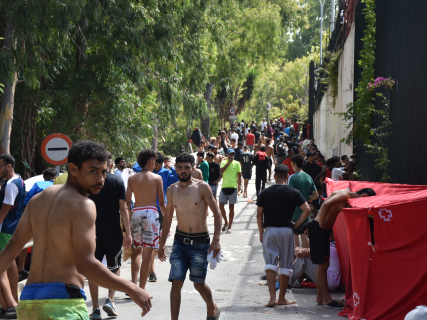

Ceuta is preparing for an uncertain night after experiencing one of the most serious migratory days in its history. Thousands of people crossed the border from Morocco on foot or by swimming on Thursday, overwhelming the controls at Tarajal, the Security Forces, and reception services that were already at their limit before this new avalanche. (((Follow live the massive entry of immigrants in Ceuta)))
The image left by the day is profoundly human and devastating. On the beaches and next to the breakwater, deflated floats, fins, shoes, bottles, and soaked clothing have been left behind. They are the remnants of the journey of those who threw themselves into the water to reach Spanish territory and abandoned everything they carried with them before continuing to walk into the city.
From the early hours of the afternoon, long columns of people are advancing from the border to the assistance centers and the points set up for their identification. Some testimonies describe routes of several kilometers in a city that barely exceeds 84,000 inhabitants and that does not have the capacity to absorb an arrival of this magnitude in just a few hours.
The uncertainty worsens as night approaches. Ceuta must identify, feed, care for, and find a safe place for thousands of people, while trying to maintain normalcy for its neighbors and prevent disorder from leading to a tragedy. The reception centers are overcrowded, hundreds of newcomers remain outside the facilities, and the agents deployed at the border acknowledge that they cannot keep up.
An impossible figure to close
The exact dimension of the avalanche remains an unknown. The counting is particularly difficult because entries have not ceased throughout the day, they have occurred at different points, and many people have dispersed throughout the city before being able to be identified.
RTVE places the number of people who would have crossed the border in recent hours between 2,000 and 3,000. The estimate coincides with other estimates released by international media, although police sources admit that it is still impossible to provide an accurate figure.
Other information considerably raises the balance. El Mundo talks about around 20,000 entries, while OKDIARIO claims, citing Moroccan television, that up to 30,000 people would have entered Ceuta irregularly in the last 24 hours. The same outlet attributes to initial calculations by the Guardia Civil a figure exceeding 5,000 entries during the first hours of Thursday.
Neither the Government Delegation nor the Ministry of the Interior have confirmed the higher estimates so far. If a volume of between 20,000 and 30,000 people is confirmed, Ceuta would be facing the largest migratory avalanche in its history and would have received in a single day the equivalent of between a quarter and more than a third of its population.
The dimension would far exceed the crisis of May 2021, when around 10,000 people entered the city amid serious diplomatic tension between Spain and Morocco. If the count ultimately approaches RTVE's estimates, it would be, in any case, the worst border crisis experienced in Ceuta since that episode.
Children, families, and elderly people
The profile of those who have crossed constitutes another of the differences compared to previous migratory episodes. It is not just young people. Among the people who have entered are children, women, complete families, elderly ladies, and people with difficulties moving.
Some have skirted the Tarajal pier holding onto floats, jugs, or any object that could keep them above water. Others wore fins or wetsuits. There have also been entries on foot after the human pressure exceeded the police cordons deployed in the border area.
At several moments in the afternoon, the agents have tried to organize the entry, avoiding an action that could cause falls, crushes, or new deaths at sea. The immediate priority has been to prevent a tragedy, but the lack of resources and the constant flow have ended up collapsing the device.
The maritime route around Tarajal had already left a tragic balance before this Thursday. More than 60 people have died in the last twelve months trying to reach Ceuta, according to data collected by RTVE. Just in the last few hours, new fatalities have occurred.
More people outside than inside the centers
The crisis does not end when someone manages to reach the beach. From that moment begins a process of identification and attention that requires police, translators, lawyers, health workers, social workers, transportation, food, and accommodation.
The Temporary Stay Center for Immigrants is already exceeding its capacity. RTVE estimates that more than 400 people were waiting outside the CETI, whose 512 places were occupied before being able to absorb the new arrivals. Sources from Ceuta warn that there are already more people outside the centers than inside.
Especially delicate is the situation of minors. The autonomous city is already caring for about 700 children and adolescents, 130 more than the previous day, after having to reopen and enable new spaces. According to the data released during the day, the overcrowding of resources allocated to minors would have reached extraordinary levels.
The City lacks sufficient places to accommodate everyone. The arrival of night forces the search for emergency solutions for hundreds or thousands of people who remain on the streets, next to the identification centers or walking towards different assistance points.
Concern is also growing among residents. The feeling of loss of control has led some establishments to close and has disrupted traffic at various points. Ceuta faces the difficult balance of providing dignified attention to those who have just arrived while ensuring the safety and tranquility of its neighbors.
Ceuta asks the State to take command
The president of Ceuta, Juan Jesús Vivas, described what happened as an "absolute humanitarian and social emergency" and asked the central Government to declare a national emergency, take command, and provide sufficient resources to address the collapse.
The request received the support of all members of the Board of Spokespersons of the Assembly: PP, PSOE, Vox, MDyC, and Ceuta Ya! The political forces jointly demanded the temporary closure of the Tarajal border, the immediate reinforcement of the Security Forces and Corps, and a state intervention capable of regaining control.
The initial response from the Ministry of the Interior was negative. The department led by Fernando Grande-Marlaska argued that migratory flows are not included among the risks that allow for declaring an emergency of national interest within the civil protection regulations.
The Assembly of Ceuta subsequently reformulated its request under the National Security legislation. According to its statement, the massive entry on foot and through the breakwater represents a "qualitative leap" regarding the migratory pressure endured during the previous days.
The Executive has ended up mobilizing additional resources and military units to support the Civil Guard, although without formally declaring the national emergency requested by Ceuta. Grande-Marlaska is scheduled to travel to the city this Friday to assess the situation on the ground. And it is more than possible, according to the information verified at the close of this edition, that the President of the Government, Pedro Sánchez, will also travel to the autonomous city.
A difficult return agreement to apply
Spain and Morocco have agreed to strengthen border coordination and expedite the return of those who have entered irregularly during the crisis. The commitment aims to regain control of Tarajal and prevent the flow from continuing during the night.
Its implementation, however, will be complex. Before returning a person, it is necessary to identify them, verify their nationality, determine if they are a minor, and examine if they need international protection. The same procedure cannot be applied to children, families, dependent persons, or potential victims of trafficking.
The recent ruling of the Supreme Court has added legal difficulty. The ruling establishes that the immediate rejection provided for in the Immigration Law cannot be applied automatically to those intercepted at sea after swimming around the breakwater. The court links that figure to the attempt to physically overcome the containment elements of the land border.
That does not mean that one can enter Spain without documentation or that the return procedures have disappeared. It means that the authorities cannot automatically hand over to Morocco all intercepted persons without identification, legal assistance, and an individual examination of their circumstances.
For its part, the Interior Ministry maintains that human trafficking networks have spread a false interpretation of the ruling, presenting it as a supposed authorization to enter Spain without papers and remain in the country. Some of the newcomers would have explained that they heard in Morocco that they could no longer be returned immediately.
It has not been proven that this rumor alone explains the avalanche. The coincidence with Throne Day, the main official celebration of Morocco, again places Rabat's role under observation. While the Spanish Government describes Moroccan cooperation as active, sources from the Civil Guard consider that the actions on the other side of the border have been insufficient to curb the pressure.
The night as the first test
The first test will no longer be solely to regain control of the border. It will be to get through the night without more deaths, serious incidents, or an even greater collapse in assistance.
Ceuta needs to know how many people have entered, where they are, and how many require immediate attention. It needs to reinforce identification, enable sleeping spaces, guarantee food, and separate minors from adults. It also needs to explain to its citizens what security measures will be maintained and for how long.
Estimates vary extraordinarily, but all describe a city overwhelmed by events. While the administrations discuss the legal formula to intervene and Spain negotiates with Morocco on returns, the beaches remain covered with floats and shoes, in a day whose mark has been left by thousands of people who, possibly, arrived convinced that on the other side of the border they would find an opportunity.