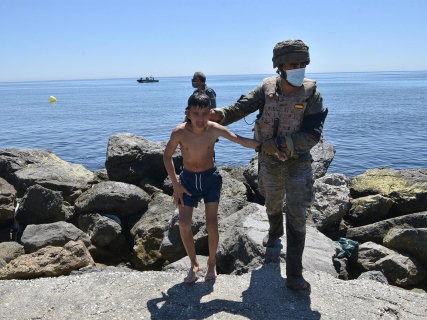

The autonomous city of Ceuta faces this Thursday, July 30 a new migration crisis, the most serious in five years, after the entry of thousands of people through the border with Morocco. An episode of this magnitude had not been recorded since May 2021, when, after Rabat relaxed controls, about 8,000 people managed to access Spanish territory.
In the days prior, a constant increase in arrivals to the Ceuta city had already been detected, with around a hundred migrants daily, coinciding with the recent ruling of the Supreme Court that prohibits “hot returns” of those who reach the shores of Ceuta and Melilla by swimming.
At noon on this Thursday, the rate of access skyrocketed and the flow became practically uninterrupted. For several hours, thousands of young Moroccans, along with families and minors, continued entering by sea along the Tarajal pier with floats, and also by land, advancing alongside the border fence, without Moroccan or Spanish security forces managing to stop the passage.
The Government has insisted that there is an agreement with Morocco for the return of “all” who have entered irregularly. However, late in the afternoon, groups of people were still observed crossing the border and throwing themselves into the sea heading towards the Ceuta coast.
While waiting for official figures on the total number of entries, everything points to this being the most serious incident since the crisis of May 2021, when Moroccan authorities reduced surveillance and allowed the access of about 8,000 people between the 17th and 19th.
The 2021 crisis: military deployment and change in Foreign Affairs
That episode occurred in the midst of diplomatic tension between Spain and Morocco, originated by the hospitalization in Logroño of Brahim Ghali, one of the main Sahrawi leaders of the Polisario Front and declared enemy of Rabat. The then Minister of Foreign Affairs, Arantxa González Laya, defended that her reception responded exclusively to humanitarian reasons, due to the serious illness suffered by the Sahrawi leader.
The Moroccan reaction was immediate: Rabat withdrew its ambassador in Madrid, Karima Benyaich, and facilitated the massive arrival of its citizens to Ceuta. The government of Pedro Sánchez then responded with the deployment of the Army and heavy military vehicles to try to stop irregular entries.

The president of the autonomous city, Juan Jesús Vivas (PP), along with the rest of the parties, including the PSOE, demanded the closure of the border crossing and the declaration of a national emergency situation, measures that have not yet been adopted.
Two months after the 2021 crisis, in July of that year, Sánchez decided to dismiss González Laya and appoint José Manuel Albares as the new Minister of Foreign Affairs. The president never admitted that this change was due to a direct demand from the Alaouite kingdom, which held the former minister responsible for Ghali's arrival in Spain.
Turn on Western Sahara and tragedy in Melilla
The friction between Madrid and Rabat continued until March 2022, when the Spanish Government modified its traditional position on Western Sahara and adopted the Moroccan proposal as a reference framework. After this turn, a meeting between Pedro Sánchez and King Mohammed VI served to officially close the diplomatic crisis.
However, the border was once again the scene of a serious incident a few months later. In June 2022, at the Melilla crossing, about 2,000 people of sub-Saharan origin attempted to breach the border fence. The attempt ended in tragedy: 37 migrants died from crushing and asphyxiation on the Moroccan side, after about 400 people became trapped in a dead-end courtyard.
Tarajal and Benzú, the main access routes
The entry points are similar. In 2021, a large part of the migrants swam around the breakwaters of Tarajal and Benzú, while others overcame the border fence. The images showed families, minors, and young people crossing in front of initially very limited Moroccan surveillance.
The 2026 episode began fundamentally by sea. For several days, groups of people tried to reach Ceuta by swimming, using floats, or being rescued by maritime services. On Thursday, the entry changed scale when hundreds and later thousands of people accessed on foot and by water in the vicinity of Tarajal, after the border device was overwhelmed.
In both cases, Ceuta functions as a gateway to Spanish and European territory, although arrival does not automatically allow for transfer to the Peninsula. Once they set foot on Ceuta territory, individuals must be identified and are subject to the corresponding immigration or international protection procedures.
The Supreme Court ruling marks the legal difference
The main novelty of 2026 is a ruling from the Supreme Court released on July 8. The ruling establishes that immediate rejection at the border cannot be applied to people attempting to access Ceuta or Melilla by swimming, because that figure is linked to those who overcome the physical elements of the land border.
Those arriving by sea must go through the ordinary procedure, with identification, legal assistance, and the possibility of requesting international protection. The Government of Ceuta considers that this change has complicated management, while the Interior Ministry accuses human trafficking networks of taking advantage of the ruling to encourage entries. However, it is not proven that the ruling alone explains the mobilization.
In 2021, Spain returned about 4,000 people during the first hours to Morocco through the readmission agreement. In 2026, the process is slower and requires distinguishing how and by what means each person accessed.