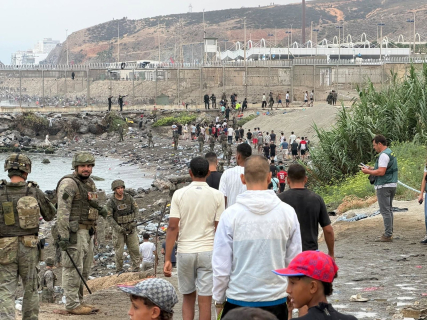

The number of migrants with records in Ceuta remains unknown. The Government has not published a report detailing how many of the people who crossed from Morocco were wanted by Justice, had been previously expelled, or were banned from entering Spain or another European country.
Ceuta leaves a pending filter: search orders and expulsions
The number of migrants with records in Ceuta remains unknown. Security forces must identify those who remain in the city and check if there are arrest warrants, previous expulsions, entry bans, or alerts issued by other European countries against them.
Interior has estimated about 50,000 people who entered Ceuta irregularly since Thursday. By 6:00 PM this Friday, 48,300 had voluntarily returned to Morocco and around 1,700 remained in the autonomous city. Fernando Grande-Marlaska's department has not specified how many were fully identified before returning to the neighboring country.
Interior has not yet provided a report
For now, there is no official figure of people with criminal records, judicial requisitions, or previous expulsions among those who entered during the crisis. It has also not been communicated whether the checks carried out have produced matches in Spanish or European police databases.
The distinction is relevant. Having a previous conviction does not necessarily mean being wanted by Justice. For immediate police action to occur, there must be, for example, a valid arrest warrant, a request for extradition, or an alert indicating what measure the agents should take.
What information appears in the Schengen system?
The Schengen Information System —SIS— allows for the consultation of alerts about people wanted for their arrest, citizens of third countries subject to return decisions, and people who are banned from entering or staying in the Schengen area. Each notice includes instructions for the authorities when they locate the person.
The SIS is not a complete criminal record database. A person may have been convicted in Europe and not appear as wanted if they have already served their sentence and there are no active judicial or administrative measures.
The sentences handed down in community countries can be located through ECRIS-TCN, the European system designed to identify which member state holds criminal information about a non-EU citizen. Its consultation subsequently allows for the request of conviction data through the European Criminal Records Information System.
Fingerprints to verify identities and asylum applications
Identification may also include fingerprinting and its comparison with Eurodac. This European database stores biometric and identity data of applicants for international protection, individuals intercepted after crossing an external border irregularly, and foreigners located in an irregular situation.
Eurodac allows knowing if someone has already applied for asylum or was previously registered in another member state, but it does not function as a general criminal record database.
The process becomes more complex when a person does not carry documentation, uses a different identity from the one previously registered, or claims to be a minor. In those cases, biometric and documentary checks are decisive in establishing their situation.
What happens when an alert appears?
If the identification reveals an active arrest warrant, the person may be arrested and placed at the disposal of the competent judicial authority. When a return decision or a previous entry ban appears, the security forces must determine whether to execute that measure or process a new return.
The Immigration Law allows for the return of those who attempt to enter irregularly and those who return to Spain in violation of an entry ban. However, the return must be agreed upon by the competent governmental authority and, if it cannot be executed within 72 hours, the detention requires judicial authorization.
Individuals subjected to these procedures have the right to legal assistance and an interpreter. If they request international protection, the return is suspended until a decision is made regarding the admission of the application.
The blind spot of voluntary returns
The main unknown affects those who have already returned on their own to Morocco. The Government has not detailed whether the 48,300 voluntary departures were preceded by a complete review, including fingerprinting and consultation of police databases.
If a part returned without having been fully identified, it will be difficult to establish later how many had criminal records, warrants, or entry bans. Therefore, the eventual official balance could be limited to the people who were recorded or who remain under the control of the Spanish authorities.
In the coming hours, the Interior Ministry may provide separate data on detected court orders, previous expulsions, entry bans, asylum requests, and identified minors. Until that breakdown is published, it cannot be stated how many people with records managed to enter nor extrapolate individual cases to the group of newcomers.