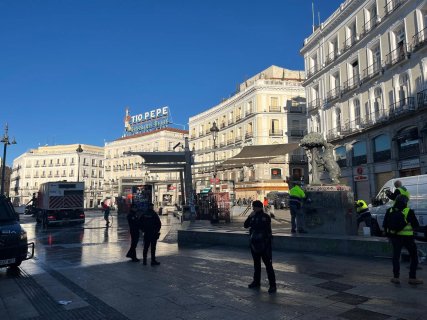

This Tuesday, the municipal cleaning services are working on removing the remains of the camp at Puerta del Sol, whose accesses remain closed to pedestrian traffic and leave "a completely different panorama" after a joint operation by the National Police and the Madrid Municipal Police evacuated at dawn the nearly 300 people who were still gathered in the square.
Since last September 26, Sol had become an epicenter of protest over the housing problem, triggered after the eviction of Maricarmen Abascal -- the 87-year-old woman who died days later in the Hospital Gregorio Marañón--. In the early hours of the morning, it has been confirmed how the camp organized during this time has been completely dismantled.
The area where for almost a month and a half hundreds of tents were grouped, with improvised aisles, food distribution points and information tables, as well as the access to the Sol Metro, now appears almost completely cleared.
Excavators, garbage collection trucks and SELUR vehicles, supported by some 50 municipal workers, have removed after the police intervention the remains of the settlement, including the awnings that until now covered the square and sheltered from the rain those who have remained there during this period.
The cleaning teams have concentrated in the center of Puerta del Sol a large accumulation of tents and belongings, while the pedestrian accesses remain closed. Only some businesses in the surrounding area remain open and the entrance to Renfe and Metro of 'the whale'.
In this context, the capital's 'kilometer zero' offers "a completely different panorama," in the words of Sergio, 28, who this Tuesday arrived at Sol from Villaverde Alto "with the usual traffic," without knowing in advance what he was going to find.
Julen, 19, did not participate in the camp, but he came closer "to see how the matter was" after learning of the eviction. About the scope of the protest, he pointed out that "at first it could indeed have had a media impact, it could indeed have managed to cause impact in politics," to the point that "elections have been called".
Although he agrees that "there was no longer any sense in dragging it out," he maintains that "this surely does not end here," because "problems" like housing "continue and continue".
This perception that the mobilization was changing as the weeks went by is shared by Antonio, 77 years old, who was walking along the barriers surrounding the center of the square. "The movement that there was at the beginning gradually faded away and another kind of people with another kind of demands has remained," he noted, convinced that intervention should have taken place earlier. "This is a square that is full of tourism and that is an image of the city that should not have been allowed," he stressed.
In the vicinity of Sol, near the statue of the bear and the strawberry tree, Gema, a nursery school teacher, was also there. The collective to which she belongs took part in the encampment with "tables to inform" about their "struggle". The nursery teachers decided on Monday that the time had come to leave the square, something that causes Gema "on the one hand, sadness", because she says that they have received "a lot of encouragement", "but on the other hand, there is also a need to continue protesting in other places", she underscored.
For her part, Lisette, 54 years old, trusts that the campers "have achieved what they intended" with their presence in Sol, although she admits that it seems "very good to me that this is cleared."
Several merchants in the area explain that the last month has been especially complicated, since the encampment has caused a notable drop in customers both in the square and in the nearby streets. The mayor of Madrid, José Luis Martínez-Almeida, has quantified the impact of "38 days of occupation" in the Puerta del Sol at "more than 30 million euros in losses for commerce in the area".