Feijóo commits in Galicia to create a vice presidency of the Government devoted to Housing

The PP leader asserts his four absolute majorities in the Xunta in order to offer a Government "without sexism," "without blunders," and without corruption, at a massive rally in Santiago where he calls for mobilization to evict Sánchez from La Moncloa

feijoo rueda galicia

feijoo rueda galicia

Add DEMÓCRATA to Google

Ask FREN

Published

Last updated

6 minutes

Most read

Elecciones 29N · Encuestas

La media de las encuestas

Media a 14 de noviembre de 2026 · 15 institutos

  • PP31,4 %
  • PSOE26,9 %
  • Vox19,1 %
  • Frente Amplio6,4 %
  • ERC2,5 %
01020304050ene 2024jul 2024ene 2025jul 2025ene 2026jul 2026

Media del último estudio de cada instituto en 30 días y su evolución semanal desde el 23J. Partidos con al menos un 2 %.

Todas las encuestas

Elecciones generales del 29 de noviembre · Demócrata

ELECCIONES 29N

¿Cuál es tu pronóstico? 29N

Reparte los 350 escaños del Congreso como creas que quedarán el 29 de noviembre. Puedes cambiar tu pronóstico hasta que cierren los colegios.

0 de 350 escaños

PP
PSOE
Vox
Frente Amplio
ERC
Junts
EH Bildu
PNV
Más partidos
Podemos
BNG
SALF
CC
UPN
Adelante
Aliança
Otros

Protegido por reCAPTCHA de Google: privacidad y condiciones

Pronóstico de DemócrataParticipación abierta, no es una encuesta

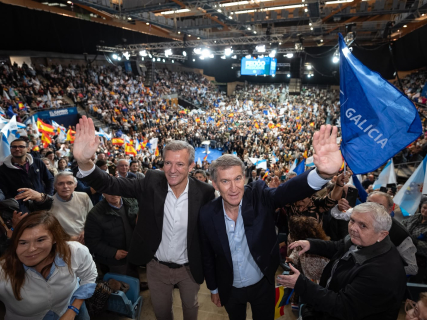
Alberto Núñez Feijóo returned this Saturday to Galicia to assert his experience at the head of the Xunta as the main guarantee of his candidacy for the Presidency of the Government. Before a Multiusos Fontes do Sar packed, in Santiago de Compostela, the leader of the PP has promised an Executive without corruption, without machismo, and without incompetents, and has placed housing among his major electoral commitments: if he reaches La Moncloa, this policy will depend on a vice presidency and his Government will push for the construction of one million homes.

"Spain needs rigor, needs management. I have it and it is called Galicia. That is the endorsement," Feijóo has proclaimed, who has chosen his home region for one of the first major events of the campaign of 29N. It has not been a sentimental visit, although it has also had a bit of coming home. The popular candidate has sought to turn the four absolute majorities he obtained in the Galician elections into a credential of competence to govern Spain, with a message aimed both at his own supporters and at those who still have not decided their vote.

"This campaign will take me all over Spain, but there was a stop that admitted no discussion. I had to come to Galicia," he explained. Amid applause and references to his time in the Xunta, he insisted that electoral victories were not "a gift," but "a contract" with the citizens which, in his view, he fulfilled through management.

The pavilion, packed with supporters and popular officials, accompanied the speeches with applause, chants, and the now usual "¡Oa, oa, oa, Feijóo a La Moncloa!". Alongside the candidate, the president of the Xunta, Alfonso Rueda, and the general secretary of the PP, Miguel Tellado, took the floor, turning the event into a show of strength by the Galician organization.

A Vice Presidency for Housing and a Million New Homes

Feijóo’s most concrete commitment has come as he addressed access to housing, one of the main problems he identifies in Spain. After asking the attendees whether they knew the name of the current minister of the department, he took advantage of the public’s negative response to defend a reorganization of his future Executive.

"With me, housing will be within a vice presidency," he announced, before reiterating the goal of building one million homes.

The proposal, which had already advanced in his interview with Jordi Wild, involves eliminating the current specific ministry and incorporating its powers into a vice presidency with the ability to coordinate other areas of the Administration. The PP argues that the shortage of supply requires action on land availability, planning timeframes, and the financing of new developments.

Its electoral program includes a new Land Law, the reduction of the timeframes for granting licenses, and measures to facilitate the construction of affordable housing. It also includes tax incentives and public guarantees to help young people access their first home.

In Santiago, Feijóo has linked these proposals to an idea he has repeated throughout his address: citizens’ effort must find a response in the institutions. "We need a Government that doesn’t rob you and that gives back to the effort that has its back broken to it," he stated.
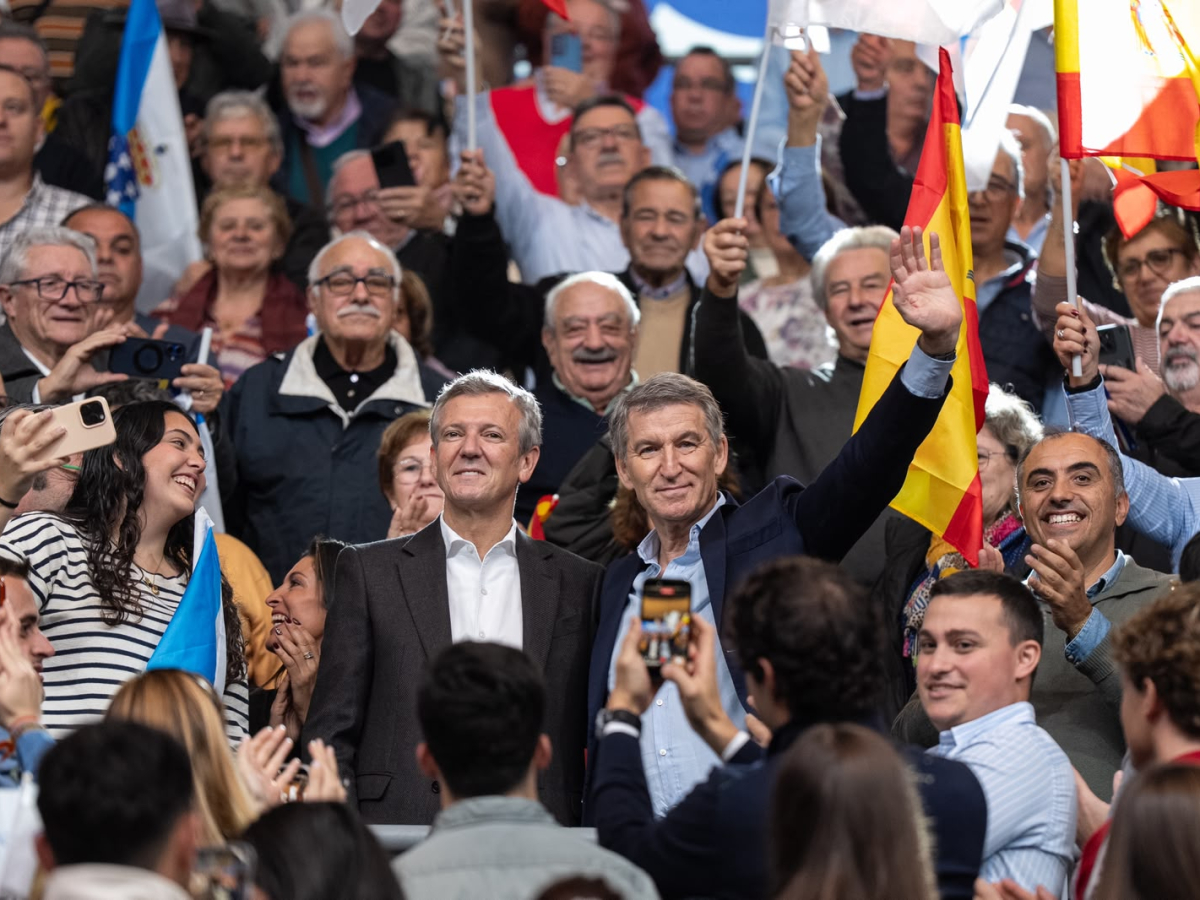
Feijóo with Rueda, this Saturday in Santiago de Compostela. Photo: Ángel García.
Feijóo with Rueda, this Saturday in Santiago de Compostela. Photo: Ángel García. -

A Government "without sexism," "without hacks," and without corruption

The other large part of the speech has been devoted to setting out his project against the record of the socialist Executive. Feijóo has promised that, if he reaches the Presidency, there will be no impunity for those who have committed corruption crimes.

"Whoever has stolen will pay, everything will be found out, there will be no impunity. The change is decency," he assured.

He also took aim at the Government’s management in matters of equality and at the failures of the telematic bracelets intended to monitor male abusers. "There will be no sexism in this Government," he promised, before adding that there will also be no "hacks" like those he attributes to Sánchez’s Executive.

The PP leader has extended his criticisms to migration policy, rail management, and the operation of public services. He reproached the president for boasting about the trains, housing, and immigration during his recent interview with Jordi Wild, despite the problems that, according to Feijóo, the country accumulates.

He was especially harsh when referring to infrastructure, after the rail crisis and the resignation of the Minister of Transport, Óscar Puente. "You can’t just announce the works, you have to do them and you have to maintain them. They don’t shine so much, of course not, but they save lives," he warned.

Feijóo has also defended that future ministers will have to know how the Administration works and be able to manage a budget. In his view, experience is an essential condition for governing and political communication skills are not enough.

"Whoever gives up presenting some budgets gives up governing," he has sentenced.

Galicia as a model for change of Government

The choice of Santiago has not been casual. Feijóo wanted to start the campaign in one of the territories where the PP has a more consolidated organization and where he himself built much of his political career.

"This campaign will take me all over Spain, but there was one stop that allowed no discussion," he repeated to those in attendance, to whom he thanked the support he had received during his years in charge of the Xunta.

His speech has revolved around trust and the word given. "The word of a president has to have value," he defended, before recalling that the four absolute majorities he achieved in Galicia were the result of sustained management.

The candidate has used that experience to offer an Executive which, as he has promised, will be "up to the task" for citizens and will respond to their daily needs. Security, housing, public services and an Administration that works have occupied much of his address.

Tellado hardens attacks on Sánchez and Rueda reclaims the Galician PP

Before Feijóo, Miguel Tellado had raised the political tone of the rally with an intervention focused on getting Pedro Sánchez out of La Moncloa. The PP secretary general has presented the elections of 29 November as an opportunity that goes beyond the change in the Executive.

"There are elections that change governments and elections that change a country," he said, convinced that the PP has an opportunity to close the socialist era.

Tellado has contrasted Feijóo's track record, with four absolute majorities in Galicia and a victory in the 2023 general elections, with Sánchez's, whom he has accused of staying in power through concessions to his parliamentary partners.

His speech included personal attacks on the president and on his wife, Begoña Gómez, regarding the judicial investigations that affect his surroundings. He has come to compare the Sánchez family with the Argentine Kirchners, in one of the hardest interventions of the event.

For his part, Alfonso Rueda has claimed the mobilizing capacity of the Galician PP and has asked his members to get involved in the campaign. The president of the Xunta has defended that Galicia must become "the engine of change in Spain" and has accused the central Government of neglecting the needs of the community.

"We don't want tension, we want to work," he said, before calling for an executive that fulfills its commitments to Galicians.

Rueda has also issued a challenge to the PSOE, which is scheduled to hold an event in the same arena next Wednesday. He has invited the socialists to check whether they are capable of gathering as many attendees as the PP.

A call to Venezuela and to mobilization for 29N

One of the moments of greatest intensity of the rally arrived when Feijóo introduced the situation in Venezuela and called for a "Long live free Venezuela!", received with a strong ovation. The popular leader has expressed his support for the Venezuelan opposition and for María Corina Machado, with whom he had spoken by videoconference on November 5.

The international reference has given way to a closing focused on electoral mobilization. Feijóo has asked attendees not to take for granted the result of 29N and to pass on his message to those who are still unsure.

With the Galician organization fully committed to the event and the public chanting his name, the candidate has presented his experience in the Xunta as proof that he can fulfill his promises in the central Government.

"Change is necessary" has been the message that traveled through a rally in which Feijóo has wanted to offer something more than an alternative to Sánchez: the guarantee, according to his own account, of a Government that knows how to manage and that responds to the effort of the Spanish people.


More key points, information and questions with FREN

AI-GENERATED CONTENT

What is the parliamentary procedure required to create a new vice presidency in the Government of Spain?

No parliamentary procedure is necessary to create a new vice presidency in the Government of Spain. Within the current legal framework, it is up to the president of the Government to decide on this reorganization by royal decree and to propose to the King the appointment of its holder. Neither the Congress nor the Senate must authorize or ratify it.

What the constitutional and legal framework allows

Article 98.1 of the Constitution establishes that the Government is composed of the president, "the Vice Presidents, if any," the ministers, and other members established by law. The expression "if any" means that vice presidencies are optional: there may be one, several, or none.

Law 50/1997, on the Government, includes this possibility and does not establish a fixed maximum number of vice presidencies. Therefore, adding one does not require modifying the law or approving an organic law. These vice presidencies should also not be confused with those of the Board of the Congress, whose election is regulated by the Congress Regulations.

How the position is created and filled

Two decisions must be distinguished: establishing the vice presidency and appointing the person who will occupy it. The process is as follows:

  • Reorganization: the president determines by royal decree the existence of the new vice presidency and its position within the Government structure.
  • Functions: the coordination tasks assigned to it are specified, respecting the competences and limits established by law.
  • Appointment: the King appoints its holder at the proposal of the president of the Government. There is no individual parliamentary vote to confirm vice presidents or ministers.
  • Publication: the corresponding decisions are published in the Official State Gazette, with the effects provided therein.

The instrument is a royal decree, not a royal decree-law. Therefore, it does not require validation: the Congress does not have to subsequently vote to maintain it in force.

Why no new investiture is necessary

Investiture is the vote by which the Congress grants its confidence to the candidate for president. It does not approve a closed list of vice presidents and ministers. Consequently, creating a vice presidency, replacing its holder, or reshaping the Government does not require repeating the investiture.

The investiture majorities — absolute in the first vote and simple in a second, held 48 hours later — do not apply to this reorganization. No parliamentary majority is required to create the vice presidency because there is no authorization vote.

When the Cortes would intervene

Legislative intervention would be necessary if, in addition to adding the position, it was intended to change a regulation established by law. A royal decree cannot contradict or modify a law.

An ordinary reform of the Government Law would follow the legislative procedure: presentation of the initiative, amendments, debate, and approval in the Congress, followed by its referral to the Senate. The general rule would be a simple majority. If the Senate vetoed it, the Congress could override it by absolute majority immediately or by simple majority after two months. Senate amendments would be accepted by simple majority.

In short: creating an additional vice presidency is an organizational decision of the Executive, not a reform that must be approved by Parliament. The Congress retains political control of the Government, but that control does not equate to prior authorization of the new position.

What are the powers and competences of a vice president of the Government according to Spanish legislation?

A vice president of the Government does not have a fixed catalog of material competences merely by holding that office. The central rule of Spanish legislation is that they perform the functions entrusted to them by the president of the Government. This is supplemented by substituting the president in certain cases and, if they also head a ministry, the competences of that department.

1. Position within the Government

Article 98 of the Constitution establishes that the Government is composed of the president, the vice presidents, if any, the ministers, and other members established by law. Therefore, the vice presidency is optional: it may not exist or there may be several. Their holders are appointed and removed by the king, at the proposal of the president of the Government, according to Article 100 of the Constitution.

The status of vice president does not make its holder the general hierarchical superior of all ministers. Article 98.2 assigns the president the direction of the Government's action and coordination of its members, without prejudice to the competence and direct responsibility of each minister.

2. Functions entrusted by the president

Article 3.1 of the Law 50/1997, on the Government states: "The Vice President or Vice Presidents, when they exist, shall exercise the functions entrusted to them by the President."

This is the key to the office. Its content may include coordination of public policies, promotion of actions affecting several ministries, monitoring government priorities, or political representation. However, none of these tasks automatically correspond to every vice presidency: the specific assignment and the provisions organizing the Government must be considered.

3. Substitution of the president of the Government

Article 13.1 of the Government Law establishes that, in cases of vacancy, absence, or illness, the functions of the president shall be assumed by the vice presidents, according to their order of precedence. If there are no vice presidents, the ministers shall assume them according to the order of departmental precedence.

Thus, when there are several vice presidencies, their numbering has a relevant legal consequence: it determines who substitutes the president first. This substitution does not equate to an investiture or appointment as new president.

4. Competences when also a minister

Article 3.2 of the Government Law establishes that the vice president who assumes the headship of a ministerial department shall also have the status of minister. In that case, they accumulate two levels of action: vice presidential functions and ministerial powers.

The latter include, according to Article 4, developing the Government's action in their department, exercising regulatory authority in the corresponding matters, and performing other competences assigned by the rules. A vice presidency without a ministry does not automatically receive those departmental powers.

5. Collegiate participation and limits

As a member of the Government, the vice president participates in the Council of Ministers and may be part of or preside over delegated commissions when so provided. Additionally, Article 8 of the Government Law assigns the vice president the presidency of the General Commission of Secretaries of State and Undersecretaries; failing that, it corresponds to the Minister of the Presidency.

In short, to know what a specific vice presidency can decide, its entrusted functions, organizational rules, and, if applicable, received delegations must be examined. The title alone does not allow assuming competences reserved for the president, the Council of Ministers, or another minister.

What results did the PP obtain in the last Galician regional elections and how many absolute majorities has Feijóo achieved?

In the last Galician regional elections, held on February 18, 2024, the PP obtained 40 seats and 47.36% of the votes, with Alfonso Rueda as candidate, and retained the absolute majority. Meanwhile, Alberto Núñez Feijóo achieved four consecutive absolute majorities in Galicia: in 2009, 2012, 2016, and 2020. The distinction is important: the 2024 victory was the PP's fifth consecutive absolute majority, but not Feijóo's fifth. (Galiciaé, 11/14/2026)

The PP's result in 2024

The 40 deputies obtained by the PP exceeded by two the minimum of 38 needed to reach an absolute majority in a Parliament of 75 members. Therefore, the result allowed Rueda to maintain a majority on his own, without needing support from another party to reach that number of seats. This electoral figure should not be confused with estimates from subsequent polls. (Demócrata, 09/26/2026)

The distribution of seats resulting from those elections was as follows, with four candidacies represented and the PP above the sum of the other three. (Demócrata, 09/26/2026)

  • PP: 40 deputies, enough to retain the absolute majority. (2024 Result)
  • BNG: 25 deputies, the second largest group by number of representatives. (2024 Result)
  • PSdeG: 9 deputies, the third parliamentary representation. (2024 Result)
  • Democracia Ourensana: 1 deputy, completing the 75 seats of the Chamber. (2024 Result)

After those elections, the Parliament of Galicia elected Alfonso Rueda president of the Xunta on April 11, 2024. This is the institutional consequence of the result: the February regional election led to his investiture to continue leading the Galician Government. (Xunta, 04/11/2024)

Feijóo's four absolute majorities

Feijóo's regional electoral record includes four consecutive victories with absolute majorities. In all of them, he reached at least the 38 deputies that mark that threshold; his sequence of seats was 38, 41, 41, and 42. (RTVE, 11/12/2026)

  • 2009: 38 seats. It was his first absolute majority and coincided with the PP's recovery of the Xunta. (RTVE, 11/12/2026)
  • 2012: 41 seats. He obtained his second absolute majority and increased his previous result by three deputies. (RTVE, 11/12/2026)
  • 2016: 41 seats. He repeated the number of representatives from 2012 and achieved his third absolute majority. (RTVE, 11/12/2026)
  • 2020: 42 seats. He reached his fourth absolute majority and his highest number of deputies in Galician regional elections. (RTVE, 11/12/2026)
How to interpret both records

It is advisable to separate the candidate's record from that of his party. If the question is how many absolute majorities Feijóo achieved as a regional candidate, the answer is four. If asked how many the Galician PP chained from 2009 to the 2024 elections, the answer is five: the previous four and the one obtained by Rueda. (Demócrata, 01/14/2026)

In short, the data that answers your first question is 40 deputies in 2024; the one that answers the second is four absolute majorities by Feijóo. These are two related records due to the PP's continuity in the Xunta, but correspond to different candidates in the last regional election. (Demócrata, 01/14/2026)

Play

Test your knowledge with FREN!

How much do you know about this topic? Answer the following 3 questions.

What administrative structure has Feijóo promised to create in housing if he comes to government?

Question 1 of 3

How many homes has Feijóo promised to build if he becomes president?

Question 2 of 3

What aspect of his career does Feijóo use as a guarantee for his candidacy for the Presidency of the Government?

Question 3 of 3