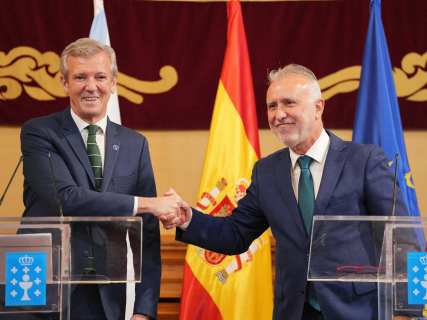

The Xunta and the central Government have closed this Thursday, in a meeting chaired by the Galician president, Alfonso Rueda, and the Minister of Territorial Policy, Ángel Víctor Torres, the transfer to Galicia of the competences regarding initial work authorizations for foreign people and of aerodromes and helipads considered non-essential.
After the meeting of the Joint Commission for Transfers, Rueda and Torres have appeared jointly to detail the agreements reached. The minister has specified that the transfer relating to work permits will enter into force on March 1, 2027, while the management of aerodromes and helipads will pass to the Xunta as of January 1.
Once the transfer becomes effective, the Galician Administration will take charge of the processing and management of the initial work authorizations for foreigners, both on their own account and on others’ account, provided that the activity takes place in Galicia. It will also assume permits for seasonal work, collective management of hiring in origin in labor-related aspects, and the checking of certain requirements associated with authorizations related to socio-labor and socio-training ties.
For its part, the State will retain competences over the applicable regulations, international relations, the guidance of job offers toward specific countries, and residence and work authorizations that fall outside this transfer, among other responsibilities.
To make possible the new distribution of competences, five vacant civil servant positions will be added, distributed among the four Galician provinces: two in A Coruña and one in Lugo, Ourense and Pontevedra. According to sources from the Xunta, the transfer will be accompanied by 14 square meters of administrative facilities and by an economic allocation of 150,000 euros.
Non-commercial aerodromes and helipads
With regard to non-commercial aerodromes and helipads, the State will contribute 9,200 euros to accompany the transfer. In total, 40 installations will be affected, which will maintain their current ownership, but whose planning will fall under the Xunta.
Of those 40 infrastructures, 36 are publicly owned and are intended for essential services such as fire-fighting, medical transport or maritime rescue. The other four are private and are used for activities mainly sporting, such as flight schools or general aviation operations.
With this change, the autonomous community will take on tasks such as approving construction and modification projects for these facilities, as well as their planning instruments and instruments for ordering and defining the boundaries of their service areas. It will also be responsible for authorizing the construction, modification, and opening to air traffic, always prior to requesting the mandatory air safety reports established by state regulations.
The State will continue to carry out functions linked to its competencies regarding airports of general interest, control of airspace, air transit and transport, aeronautical meteorological services, and the registration of aircraft, as well as those related to aeronautical safety and inspection.
No transfers during Feijóo’s term
These new transfers add to those agreed in April of last year regarding coastal management, the first that Galicia received since 2008, after almost 17 years without new powers (during the period of Alberto Núñez Feijóo as president, none materialized). The community assumed full responsibility for coastal management in July 2025, after complex negotiations and following the endorsement of the Constitutional Court (TC) of the regional law.
In the case of the competencies that are being closed now, both administrations agreed from the start that they should move forward, although there were moments of occasional disagreement and the Xunta came to criticize the slowness of the process in certain phases.
Good rapport between Torres and Rueda
Santiago de Compostela has been the setting for the closing of these transfers through the Joint Transfer Commission, in which representatives of both parties participate, including the Minister of the Presidency, Diego Calvo. In addition, Rueda and Torres held a bilateral meeting.
After the formal session of the Commission, both leaders have appeared together before authorities such as the president of the Parliament, Miguel Santalices, and MPs from PP, PSdeG, and BNG, among others, showing good political and institutional rapport.
Torres has recalled the signing of the transfer of the management of the coastline last year, just before undergoing an operation for cancer, for which Rueda “wished him luck” and which “went well.” The minister has highlighted the relevance that the Executive of Pedro Sánchez gives to “shared governance” and has put the number of transfers agreed with different communities at 38 “since the beginning of this legislature,” three of them with Galicia.
AP-9: "POSITIONS ARE COMPLEX FOR REACHING AN AGREEMENT IN THE SHORT TERM"
Torres has also referred to a “fourth transfer” on the horizon, which he did not expressly mention in his initial intervention, but about which he was asked later by the media: the transfer of the AP-9 to Galicia, the subject of a negotiation that began almost in parallel with the electoral call of November 29.
At odds with the law approved in Congress after the agreement between PSOE, BNG and Sumar, the Galician Government requested the convening of a bilateral commission to “clarify and resolve the differences” with the central Executive regarding this rule.
“Positions are complex to reach an agreement in the short term, but I am convinced that there will be willingness so that at a certain moment we can coincide,” the minister said, who emphasized that the Government agreed to open that dialogue before going to the Constitutional Court.
Beyond the evolution of this possible transfer, conditioned by the 29N elections but with the legal teams, he said, even while working, Torres has defended that they have been “some years of magnificent relationship with the Xunta” and has insisted that the cession of competences is “a path toward the best management of the public.”
Talent Attraction Office with 50 jobs
For his part, Rueda has asserted his commitment to “useful” self-government and has reiterated that he does not measure the importance of self-government “by the amount of competences, but by their usefulness.” As an example, he cited the initial work permits for foreigners, which he considers “essential to provide a fundamental service for retaining and attracting talent in an orderly manner.”
Along these lines, he has emphasized that coordination between the Xunta and the State will have to continue to be “maximum,” given that the Galician Administration will handle work permits, while the central Government will continue managing residence ones “simultaneously.”
"From here we will deploy whatever is necessary in order to be able to exercise these competences under the best conditions," he has assured, before going on to say that "immediately" an Office for Attracting Talent will be set in motion, with 50 jobs and a presence in the seven Galician cities.
This new body will integrate the offices of the 'Plan Retorna', which serve people with Spanish nationality who want to settle in Galicia to "make a new life". The Office for Attracting Talent will also provide coverage for those who do not have that nationality.