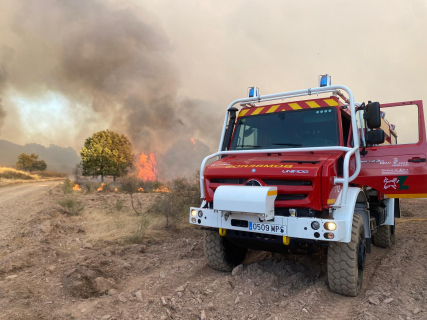

Spain continues to be attentive this Thursday to several wildfires of great magnitude that keep hundreds of firefighting and emergency personnel mobilized in different parts of the country. Although the fire in Guadalajara, the most serious of the summer, is evolving favorably, authorities remain very attentive to other large active hotspots in Castilla-La Mancha, the Community of Madrid, Zamora, and Andalusia, in a context marked by extreme heat and a very high risk of new fires.
Concern also remains about the meteorological situation. According to the latest data from the European Copernicus system, so far in 2026, 123,000 hectares have burned, and 22 large wildfires have been recorded, a figure higher than the average of the last decade. The State Meteorological Agency (AEMET) maintains a very high or extreme fire danger for these days in much of the Peninsula and the Balearic Islands.
Guadalajara: the most serious fire of the summer evolves favorably
The fire declared in La Mierla, in the Sierra Norte de Guadalajara, continues to be the most important in the country by affected area. Estimates place the burned area above 30,000 hectares, and the firefighting operation continues to work to consolidate its stabilization after several days of intense activity.
The evolution of the last hours has allowed for some optimism to be recovered, although authorities maintain a significant deployment to prevent reproductions favored by high temperatures and wind. This Wednesday, the President of the Government, Pedro Sánchez, visited the affected area along with the President of Castilla-La Mancha, Emiliano García-Page.
Toledo and Madrid: a fire that affects two communities
Another of the fires that keeps the attention of emergency services is the one originated in Almorox (Toledo), which has also ended up affecting the Community of Madrid. The evolution of the flames forced the adoption of protective measures for the population, with evacuations and confinements in the vicinity of Villa del Prado, in addition to the mobilization of a large operation in which the Military Emergency Unit (UME) participates.
The firefighting efforts continue due to the complexity of the terrain and meteorological conditions that continue to hinder the definitive control of the fire.
Zamora: the Rábano de Aliste fire reaches level 2
The last major concern is in the province of Zamora. The Junta de Castilla y León declared during the night the Potential Severity Index (IGR) 2 in the forest fire declared in the municipality of Rábano de Aliste, a category that is activated when there is a possibility that the fire poses a serious threat to population centers or may require protective measures for people and property.
The fire originated at 19:34 hours on Wednesday and raised its severity level at 22:30 hours. In the extinction efforts, about twenty ground resources are working, including five environmental agents, five ground crews, seven fire trucks, four bulldozers, and two ELIF or BRIF brigades. For the moment, the causes of the fire remain under investigation and the Junta has not provided an estimate of the affected area.
Huelva maintains another of the main active fires
In Andalusia, the fire declared in El Cerro de Andévalo (Huelva) remains active and continues to be one of the main sources of concern in the country. The proximity of the flames forced the complete evacuation of the town of Villanueva de las Cruces, with around 380 neighbors evacuated preventively while the extinction efforts continue.
The deployed teams are working to halt the advance of the fire, favored by high temperatures and the dryness of the vegetation.
The AEMET maintains a very high risk of new fires
Beyond the large fires already declared, the authorities insist that the episode of extreme heat keeps a good part of the country in a situation of high risk. The Ministry for Ecological Transition and the AEMET warn that high temperatures, low humidity, and wind favor both the spread of active fires and the emergence of new hotspots.
Therefore, emergency services are urging to exercise extreme caution and avoid any activity that may cause a forest fire while these weather conditions persist.