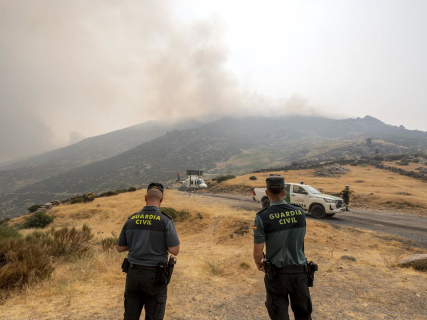
Roads cut off by the fires in Spain: all the closed routes in Madrid, Toledo, Ávila, and Castellón

The wildfires that remain active in different parts of Spain continue to force the closure of numerous roads in Madrid, Toledo, Ávila, and Castellón. The General Directorate of Traffic (DGT) recommends checking the status of the roads before traveling and avoiding trips through the affected areas.

2 minutes

fotonoticia 20260727141253 1920

fotonoticia 20260727141253 1920

Add DEMÓCRATA to Google

Ask FREN

Published

Last updated

2 minutes

Most read

The wildfires affecting the center and east of the Peninsula continue to condition traffic in several autonomous communities. The evolution of the flames maintains traffic restrictions on dozens of roads to ensure the safety of the population and facilitate the work of the firefighting teams.

The DGT reminds that the list of affected roads may vary throughout the day depending on the evolution of each fire, so it recommends checking the traffic status before undertaking any travel.

Roads closed in Madrid

The Community of Madrid concentrates the largest number of restrictions due to the fire affecting the western sierra. At this moment, the following roads remain closed:

  • M-501, M-512 and M-855, in Navas del Rey.
  • M-507 and M-540, in Villa del Prado.
  • M-510, in Valdemorillo.
  • M-521, in Quijorna.
  • M-531, M-537 and M-539, in Robledo de Chavela.
  • M-533, in Zarzalejo.
  • M-541, in Pelayos de la Presa.
  • M-548, in Cenicientos.
  • M-957, in San Martín de Valdeiglesias.

Roads closed in Toledo

The restrictions also continue in the province of Toledo, especially in the vicinity of the fire declared in Almorox.

The closed roads are:

  • CM-5001, in El Cornicabral.
  • CM-5002 and TO-1375, in El Real de San Vicente.
  • CM-5005, CM-543 and TO-1451, in Escalona.
  • CM-5006 and CM-5053, in La Iglesuela del Tiétar.
  • CM-5100, in San Román de los Montes.
  • TO-1364 and TO-1368, in Castillo de Bayuela.
  • TO-1385, in Almendral de la Cañada.
  • TO-1560, in Almorox.

Roads closed in Ávila

The fire affecting the province of Ávila maintains restrictions on several roads near Cebreros, Burgohondo, and other municipalities.

The affected roads are:

  • AV-502, AV-503, AV-504, AV-512 and AV-562, in Cebreros.
  • AV-901 and AV-902, in Burgohondo.
  • AV-904, in Guisando.
  • AV-P-703, in Casillas.
  • AV-P-705, in Mijares.
  • CL-501, in Santa María del Tiétar.
  • N-403, in the vicinity of Las Cruceras.

Roads closed in Castellón

In the province of Castellón, the fire declared in La Vall d'Uixó continues to affect traffic in the vicinity of the Sierra de Espadán.

The closed roads are:

  • CV-200, in Aín.
  • CV-203, in Caudiel.
  • CV-205, in Tales.
  • CV-215, in l'Alcúdia de Veo.
  • CV-219, in Eslida.
  • CV-223, in Nules.
  • CV-2261 and CV-230, in La Vall d'Uixó.

The DGT recommends checking the traffic status before traveling

The authorities remind that the advance of the fires may force the opening or closing of new roads throughout the day.

For this reason, the General Directorate of Traffic advises consulting the updated information before starting any trip and to always follow the indications of the emergency services and security forces.

More key points, information and questions with FREN

AI-GENERATED CONTENT

What is the process for the DGT to decide the closure and reopening of roads due to emergencies such as forest fires?

The information available in the consulted sources does not go into the operational detail needed to describe, step by step, how the DGT decides the closure and reopening of roads in emergencies such as forest fires. The sources only explain, in general terms, how laws with the rank of law are approved in Spain (decree-laws and bills), but do not include specific traffic management protocols for fires. Therefore, it is not possible to provide a precise description, based on documentation, of the internal procedure of the DGT for these specific cases.

What can be said from a legal-political point of view

Although there is no specific data on the DGT protocol, there is information on the general framework of how these types of matters are regulated in Spain, which usually rely on laws or regulatory norms approved by the executive power.

The sources explain that the Government can resort to the decree-law in situations of "extraordinary and urgent need." A decree-law is a norm with the rank of law directly approved by the Government and that comes into force immediately after its publication in the BOE, although it must later be submitted for validation by the Congress within a maximum period of 30 days. This instrument is used, among other cases, to respond to emergencies or disasters when it is necessary to act quickly and provide urgent legal coverage to certain measures.

On the other hand, the bill is the ordinary way by which the Government regulates matters within its competence that require the rank of law. The procedure is longer and more participatory: the Council of Ministers approves the bill and sends it to the Congress, where it is processed with debates, amendments, votes in committee and plenary, and subsequently, intervention by the Senate before sanction and publication in the BOE.

Applied to your question, this means that:

  • General criteria and the distribution of competences (who can order closures, which bodies are responsible for executing them, coordination with civil protection, etc.) are normally established in laws and regulations that have followed one of these procedures (or similar).
  • In situations of great emergency, the Government could use a decree-law to introduce exceptional traffic management or civil protection measures, if deemed necessary, within constitutional limits.

Limits of the available information

Beyond this generic framework on how norms are approved, the consulted sources do not provide data on key issues of your question, such as:

  • Which specific service (traffic management centers, provincial headquarters, etc.) validates the closure or reopening of a section affected by a fire.
  • How the decision is exactly articulated between DGT, Traffic Civil Guard, regional emergency services, road owner (State, autonomous community, provincial council, city council), and civil protection.
  • What technical thresholds (minimum visibility, proximity of flames, risk to infrastructure, instructions from the extinguishing command) are applied as decision criteria.
  • How these decisions are documented internally, beyond signage on the ground or public communication through traffic information channels.

Since there are no specific normative or administrative data on these aspects in the sources, it is not possible to reconstruct the real process without making assumptions. And, according to the rules under which I work, I cannot invent or complete with external knowledge what is not explicitly recorded in the available information.

Specialization scope of this tool

This tool specializes in topics of politics, parliamentary activity, regulations, and executive power decisions (such as the use of decree-laws or bills), especially in the Spanish context. The questions I can best answer, supported by the available information, are for example:

  • How a law or decree-law affecting road safety or emergencies is processed.
  • What type of competences the State has versus autonomous communities in traffic and road safety matters, provided there is accessible normative or parliamentary text.
  • How emergency management on roads has been or could be regulated by law.

On the other hand, internal operational protocols (such as the exact detail of how the DGT decides road closures in a specific fire, which hierarchical levels intervene, or what software applications are used) are usually in manuals or specific technical instructions, which are not included in the sources I have access to in this context.

If you are interested in the more legal-political approach (for example, which laws or decrees define competences in traffic and civil protection, or how a decree-law would be used to manage a major emergency), I can try to delve into that part as long as there are referenced normative or parliamentary texts.

What legal instruments does the Government use to regulate emergency management on roads, such as fires or floods? How is competence divided in traffic and road safety matters between the State and the autonomous communities? In what cases can the Government approve a decree-law to respond to a disaster and what control does Congress have afterwards?

What are the competences of the Directorate General of Traffic in managing road emergencies in Spain?

The Directorate General of Traffic (DGT), an agency of the Ministry of the Interior, plays a central role in managing road emergencies on the road network where the State retains traffic competence. Its functions are based on traffic regulations and royal decrees organizing the Ministry of the Interior and the DGT itself. They cover prevention and planning, operational traffic management during an emergency, coordination with other services (Traffic Civil Guard, 112, Civil Protection, autonomous communities, and city councils), as well as public information.

General framework of competences

Traffic regulations assign to the State, through the DGT, competence over the organization, regulation, management, and control of traffic on interurban roads under its responsibility, as well as road safety in a broad sense. On this legal basis, the DGT assumes functions in road emergencies that can be grouped into three main blocks: prevention and planning, real-time traffic management, and inter-administrative coordination and citizen information.

Prevention and planning of road emergencies

In the preventive field, the DGT has competences to:

  • Plan traffic management in foreseeable risk situations: special traffic operations (holidays, long weekends, mass events), adverse weather episodes (snowfalls, heavy rains, wind), or specific campaigns (trucks, motorcyclists, weekend travel).
  • Design and approve specific traffic action plans, which are integrated or coordinated with civil protection plans (for example, for snowfalls, forest fires, transport of hazardous materials, or multiple accidents).
  • Analyze accident rates and risk points to propose preventive measures (dynamic speed limits, restrictions on certain vehicles, alternative detours).
  • Issue operational instructions and circulars directed to Traffic Management Centers and the Traffic Civil Guard regarding actions in incidents and emergencies.

Operational traffic management in emergencies

During a road emergency (serious accident, incident with hazardous materials, traffic collapse, severe weather phenomenon), the DGT assumes operational functions directly related to circulation:

  • Real-time traffic monitoring and management through Traffic Management Centers, which monitor the network via cameras, counting stations, and other sensors.
  • Adoption of regulatory measures: lane or road closures, mandatory detours, temporary restrictions on certain vehicle types (heavy, articulated), direction changes, enabling additional or reversible lanes.
  • Establishment of temporary and dynamic speed limits adapted to road conditions and the emergency.
  • Coordination of actions on the road with the Traffic Civil Guard, which executes on-site the regulation and control orders issued from the Traffic Management Centers.
  • Management of winter road conditions regarding circulation (prohibition of vehicles without chains, restrictions based on road service level, etc.), in coordination with road owners and maintenance services.

Coordination with other bodies and territorial levels

Managing a road emergency requires coordination among several administrations. In this area, the DGT has competences in:

  • Cooperation with 112 services and Civil Protection: real-time information exchange about accidents, closures, and road conditions, as well as integration of traffic management into emergency plans (state, regional, and local).
  • Coordination with the Traffic Civil Guard, also dependent on the Ministry of the Interior, for on-road execution of regulation measures, access control, detours, and support to health and rescue services.
  • Relations with autonomous communities with traffic competences (mainly Catalonia and the Basque Country) for managing emergencies affecting shared networks or long-distance routes. In these cases, each administration acts within its scope but with information exchange and decision coordination.
  • Collaboration with provincial councils and city councils, owners of many secondary roads and urban roads, for traffic adjustments, signage, and access management when a road emergency affects urban roads or vice versa.

Public information and crisis communication

Another key competence of the DGT in road emergencies is informing the public. Through variable message panels on roads, the official website and apps, and driver information channels, the DGT:

  • Disseminates real-time alerts about accidents, closures, detours, and hazardous conditions.
  • Issues recommendations for alternative routes, less congested times, and special traffic rules.
  • Reinforces road safety campaigns linked to risk situations (driving in rain or snow, large travel movements, etc.).

In summary, the DGT is not an emergency service in the health or rescue sense, but it is the state authority that orders and manages traffic on most of the interurban network and integrates into civil protection and emergency systems to ensure circulation adapts to the situation, facilitate emergency services intervention, and minimize accidents and mobility impact.

What differences exist between the competences of the DGT and those of the Generalitat of Catalonia or the Basque Government in road emergencies? How is a DGT Traffic Management Center organized and what role does it play during a multiple accident on a highway? In which state civil protection plans does the DGT participate and what specific functions does it assume in each?

What legal requirements must be met for authorities to order the closure of public roads in case of fires?

In Spain, the closure of roads, paths, or streets due to fires is mainly supported by civil protection, forestry, and traffic regulations. There is no single article that states "how" to close a road, but rather a set of rules: civil protection and traffic authorities can restrict circulation when there is a serious risk to people, property, or the environment, always with criteria of necessity, proportionality, and for the strictly necessary time. Usually, the measure is articulated through civil protection plans (state, regional, and local) and does not necessarily require a formal declaration of a national interest emergency.

Basic regulatory framework

The state framework is mainly based on:

  • Civil protection: Law 17/2015, of July 9, of the National Civil Protection System (text of Law 17/2015), which sets the bases for emergency management and enables movement restrictions in serious risk situations.
  • Forest fires: State Civil Protection Plan for Forest Fire Emergencies, approved by Agreement of the Council of Ministers of October 24, 2014 (State Fire Plan), which foresees road closures as a basic operational measure.
  • Forests and fires: Law 43/2003, of Forests (Forests Law), amended by Law 21/2015 (Law 21/2015), which allows limiting vehicle circulation on forest tracks and high fire risk areas.
  • Fire reinforcement: Royal Decree-law 15/2022, of urgent measures on forest fires (RDL 15/2022), which tightens preventive obligations and strengthens emergency planning, including access closures.
  • Traffic and road safety: consolidated text of the Law on Traffic, Motor Vehicle Circulation, and Road Safety, approved by Royal Legislative Decree 6/2015 (Traffic Law), and the General Traffic Regulations, approved by Royal Decree 1428/2003 (Traffic Regulations), which empower traffic authorities and road owners to close or divert traffic for safety reasons.

Which authorities are competent?

Depending on the type of road and emergency level, several authorities may intervene:

  • Civil protection authority (state, regional, or local), according to Law 17/2015 and the State Fire Plan. In forest fires, the civil protection plan director (generally from the autonomous community, or the State in national interest emergencies) can order closures.
  • Road owner and traffic authority: the Ministry of Transport or the autonomous community on roads under their competence, and the DGT or regional traffic services, can close roads for road safety reasons under the Traffic Law and the Traffic Regulations.
  • City councils: as traffic authority on urban roads and local civil protection responsible, can agree on closing streets, municipal paths, and accesses to residential areas, coordinated with territorial plans.
  • Forestry and environmental bodies: applying the Forests Law and Law 21/2015, autonomous communities can limit or prohibit circulation on tracks and forest areas especially sensitive to fire.

Cases and material requirements for closure

The decision to close a road in case of fire requires:

  • Existence of a serious, imminent, or potential risk to life or integrity of people, essential property, or the environment. This risk is identified in civil protection plans and technical evaluations by extinguishing services.
  • Basis in a civil protection plan (state, regional, or local) specific to forest fires or other risks, such as the State Fire Plan, which foresees activation levels, intervention zones, and measures like evacuations, confinements, and access closures.
  • Appropriate traffic instrument: when it concerns roads and streets open to general circulation, closure is articulated through orders or resolutions of the traffic authority, under the Traffic Law and the Traffic Regulations.

Guarantees and limits of the measure

Although it is a broad power in emergencies, the legal system imposes several guarantees:

  • Justification: the decision must be based on technical reports from civil protection, firefighters, or forest agents that justify the risk and the need for closure.
  • Proportionality: the least burdensome restriction should be chosen (e.g., partial detours, limitation to certain vehicles, section closures) compatible with safety.
  • Limited duration: the restriction is maintained only while the risk persists and must be lifted as soon as conditions allow.
  • Coordination and communication: civil protection plans require the plan director to coordinate with the DGT, road owners, security forces, and local authorities to avoid contradictions and ensure information to the population.
  • Publicity and citizen information: dissemination via variable message panels, media, and official networks is part of emergency management obligations.

Is a formal emergency declaration necessary?

To close roads, a formal declaration of "national interest emergency" under Law 17/2015 is not essential. Activation of the corresponding civil protection plan in alert or emergency phase by the autonomous community or city council suffices, provided the described risk conditions exist. The state declaration of national interest expands coordination and resources, but the power to restrict traffic already exists at lower emergency levels and is commonly exercised in large forest fires, preventive evacuations of residential areas, or highway closures threatened by fire, under the general rules of civil protection, forestry, and traffic.

Who practically decides which roads are closed in a specific large forest fire and how are the DGT, autonomous community, and city councils coordinated? What resources can citizens or companies affected by a road closure that they consider disproportionate or poorly justified file? How do regional civil protection plans regulate alert levels and evacuation and access closure orders in forest fires?

Play

Test your knowledge with FREN!

How much do you know about this topic? Answer the following 3 questions.

Which autonomous communities have roads closed due to the fires mentioned in the news?

Question 1 of 3

What is the main reason for the road closures in the affected areas?

Question 2 of 3

What do the authorities advise drivers planning to travel in the areas affected by fires?

Question 3 of 3

Hola, soy Fren. ¿Cómo te ayudo?