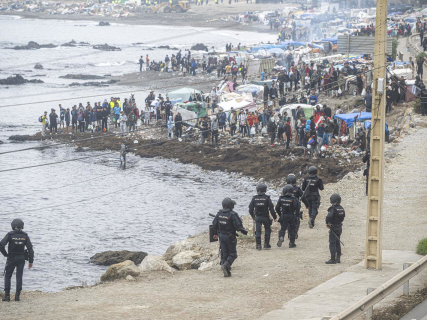

The judge of the National Court María Tardón is investigating a meeting held on July 28, 2026 between the consul of Spain in Tangier and Gonzalo Sanz, then chief of staff of the delegate of the Government in Ceuta, just 48 hours before the massive entry of Moroccan citizens into the autonomous city. The magistrate is trying to determine what information the Spanish authorities had before the events of July 30 and 31, and whether there were warnings that were not translated into measures to reinforce border surveillance.
As reported this Sunday by El Independiente, citing sources close to the investigation, the parties appearing in the proceedings could request the statement of the diplomatic representative to clarify the contents of the meeting and to find out whether he conveyed information about movements that were taking place on the other side of the border. The possibility of summoning the consul arises after a National Police inspector revealed to the judge that he received instructions to enable a special lane that would allow the diplomat to cross from Morocco to Ceuta on an urgent basis, an action that the agent described as unusual.
The statement was made last Thursday, when three police officials appeared as witnesses in the proceedings investigating the management of the migration crisis. The inspector explained that he received the order in the afternoon of July 28 and that he passed along the instruction to the head of the Immigration Unit, with the knowledge of his superiors. The consul crossed the border in a diplomatic vehicle, was received by Gonzalo Sanz and returned to Moroccan territory that same afternoon using the extraordinary crossing that had been enabled for his trip.
A special lane and the rumor of a warning about the massive entry
One of the aspects that has drawn the attention of the investigators is the exceptional nature of the device organized to facilitate the transit of the diplomatic representative. The inspector who received the instruction assured Tardón that officials usually use ordinary crossings, while special lanes are normally reserved for vehicles such as ambulances or buses. "It’s very rare to have to enable a lane for someone", the agent said, who also acknowledged that nobody explained to him the reason for the urgency and that he also did not request clarification.
In response to the prosecutor’s questions, the official stated that among the police officers posted at the border there was talk that the consul had traveled to Ceuta to warn about a massive entry of people from Morocco. However, he clarified that he had no direct knowledge of that alleged warning and that he could only confirm the rumors he had heard from his colleagues. Therefore, it is not established that the meeting was intended to alert about the events that would occur two days later, an issue that the investigation must clarify.
The head of the border post offered a less exceptional explanation for the opening of the lane. During his appearance he said that the authorities can speed up the transit of diplomatic representatives and that there is some flexibility in the use of border crossings. This account contrasts with the inspector’s perception of the person who received the order, although both testimonies agree on the existence of the movement and on the use of a specific access.
Police commanders say they did not receive alerts from the CNI
The investigation into the consul’s visit is being carried out in parallel with proceedings aimed at reconstructing what information the Delegation of the Government received before the massive entry and how it passed it on to those responsible for the police device. The testimonies gathered on Thursday have revealed discrepancies regarding communications between intelligence services, government authorities, and the commanders in charge of border security.
The regional head of Operations of the National Police in Ceuta stated that the Delegation of the Government did not convey to his unit any warning from the National Intelligence Centre (CNI) about the risk of a large-scale arrival. The official was on vacation during part of the previous days and did not take part in the meetings held at the Delegation, although he explained that those meetings did address the increase in migration pressure. For his part, the head of the border post stated that he also received no official or unofficial information about a specific CNI alert.
The situation contrasts with the testimony of another inspector, who stated that he had received and printed the “extreme risk” alert on July 29 at 21:09 hours, originating from the CENIF, the National Center for Immigration and Borders. Despite this, he maintained that he received no instructions to modify the usual device and that he lacked the authority to increase personnel on his own initiative. The officer in charge of the border post also pointed out that any reinforcement had to be ordered by the police superiors or by the Delegation of the Government, an instruction, according to his statement, that did not come to be carried out.
The agents compared this situation with the response to the migration crisis of May 2021, when reinforcements were deployed and specific orders were issued to control access. One of the commanders was especially critical of the July 2026 actions and declared: “We made it very easy for them. Nothing was done.” He also recounted that, during the hours before the massive entry, they had received warnings about unusual gatherings of people in the Moroccan town of Castillejos and that he observed Moroccan personnel directing groups toward the border breakwater. These claims form part of the police testimonies that the investigating judge will have to assess.
The former Government delegate will testify as an investigated party on November 18
The new revelations come after Tardón cited as an investigated party the former Government delegate in Ceuta, Miguel Ángel Pérez Triano, for November 18 next. The judge examines possible responsibilities within the framework of a case involving a suspected crime against the peace and independence of the State, although the status of investigated party does not mean that criminal responsibility has been established.
Pérez Triano, who resigned last September 28, thus becomes the first investigated party in proceedings that also analyze the warnings received by the Delegation of the Government. His former chief of staff, Gonzalo Sanz, assured the judge that he informed his superior of the warnings relayed by a member of the CNI on July 29, a version that the former delegate denied. Sanz also provided 19 messages exchanged with Pérez Triano, the relevance of which will have to be determined during the investigation.
The magistrate has also requested documentation of the intelligence services after the Government agreed to declassify reports related to the events of July. She has also agreed to gather information about the anomalies that affected operational communications during the crisis and the call recordings received by the Guardia Civil. Tardón has made it clear that, for the moment, there are no objective elements that would allow it to be stated that cyberattacks, digital sabotage, or other deliberate technological interferences took place, although he considers it necessary to check the origin of those incidents.
The possible statement by the consul of Spain in Tangier would add a new piece to the reconstruction of the hours prior to the crisis. The investigation must determine whether the Spanish authorities received sufficient warnings, who had knowledge of them, and why additional prevention measures were not adopted. For the time being, the diplomatic visit of July 28 is supported by police testimony, but it is still not known for certain what was discussed during that meeting and whether it had any relation to the mass entry that would take place two days later.