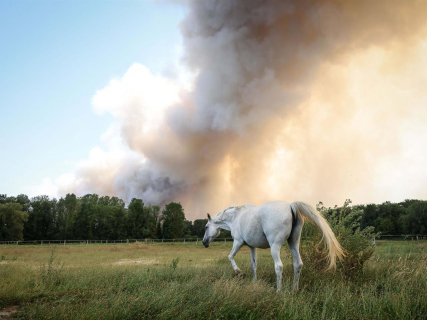

The forest fire in Gironde, in the southwest of France, has become one of the largest environmental and civil emergencies recorded in the country in recent years, after ravaging more than 30,000 hectares and forcing the evacuation of about 167,000 people from the areas most exposed to the advance of the flames.
The magnitude of the evacuation reflects the seriousness of an emergency that no longer only affects forest areas, but also inhabited centers, infrastructure, roads, tourist facilities, and residential areas scattered in a territory especially vulnerable due to accumulated dryness and the presence of large masses of vegetation.
The fire exceeds 30,000 hectares
The flames have scorched more than 30,000 hectares, an area that accounts for the speed with which the fire has advanced and the difficulty of containing it in an adverse meteorological context. In fires of this dimension, the perimeter can extend for kilometers and force firefighting teams to divide efforts between protecting populations, opening lines of defense, monitoring roads, and direct attacks on active fronts.
The work of firefighters is conditioned by a wide, dry terrain with abundant vegetation fuel, where any change in wind can reactivate seemingly stabilized hotspots or push the flames towards areas that until that moment were considered less exposed.
167,000 people out of their homes
The evacuation of 167,000 people represents one of the most striking elements of this emergency, both due to the volume of the affected population and the logistical complexity involved in orderly evacuating neighbors, visitors, elderly people, families with minors, tourists, and residents of isolated homes.
The authorities have had to enable exit routes, reception centers, assistance devices, and traffic controls to avoid congestion on the roads near the fire. In this type of operation, the priority is to evacuate before the smoke reduces visibility, before the roads become compromised, and before the advance of the fire leaves those who remain in their homes without a margin for reaction.
An emergency marked by wind and dryness
The evolution of the fire largely depends on the behavior of the wind, humidity, and temperature, three factors that can transform the risk map in a few hours. Although emergency teams manage to stop a front during the night or at times of lower thermal intensity, a rise in temperatures or a change in the wind can complicate the situation again.
The problem is not just to extinguish the visible flames. In a large-scale fire, it is also necessary to monitor hot spots, embers, reproductions, and secondary foci that can appear far from the main front. Therefore, even when the intensity decreases, authorities usually maintain evacuations until they have guarantees that the perimeter will not grow again towards inhabited areas.
Protection of municipalities and infrastructures
The emergency response focuses on protecting threatened municipalities, keeping essential roads open for intervention teams, and preventing the fire from reaching critical infrastructures. In an area with dispersed population, tourist areas, and secondary roads, coordination is especially important because each evacuation movement must be compatible with the passage of fire trucks, ambulances, police vehicles, and heavy machinery.
French authorities are also working to keep the population informed, prevent premature returns to evacuated areas, and reduce exposure to smoke, which can affect both neighbors directly threatened by the flames and municipalities located several kilometers from the front.
The human impact of the fire
Beyond the burned hectares, the Gironde fire leaves an immediate consequence on the lives of thousands of families who have had to leave their homes without knowing when they will be able to return or in what condition they will find their houses, farms, businesses, or belongings.
The uncertainty is one of the hardest burdens of these emergencies. Evacuations save lives, but they also force a sudden interruption of routines, work, care, travel, and economic activity. For many people, the wait in reception centers or in relatives' homes becomes a mix of relief at being safe and anguish at not yet knowing the real extent of the damages.
A warning about large European fires
The Gironde fire once again shows the destructive capacity of large wildfires in Europe, especially when drought, heat, wind, and large masses of vegetation fuel coincide. France, Spain, Portugal, Italy, and Greece face increasingly complex emergencies every summer, with fires that advance faster, generate more intense smoke columns, and force larger-scale evacuation decisions.
The management of these episodes is no longer limited to extinction. It also requires forest prevention, land planning, evacuation protocols, infrastructure protection, coordination between administrations, and adaptation of emergency systems to increasingly extreme scenarios.
The priority: that no one returns without authorization
As long as the fire remains active, authorities insist that the evacuated population must not return to the affected areas until they receive express authorization. Returning too soon can put neighbors at risk, hinder the work of emergency teams, and block roads that must remain clear for firefighting resources.
The Gironde fire remains an open emergency, with more than 30,000 hectares burned and 167,000 people evacuated. The figure summarizes the scale of the disaster, but does not exhaust its impact: behind it are empty towns, cut-off roads, teams working tirelessly, and an entire region waiting for the wind to allow the wound to begin to close.