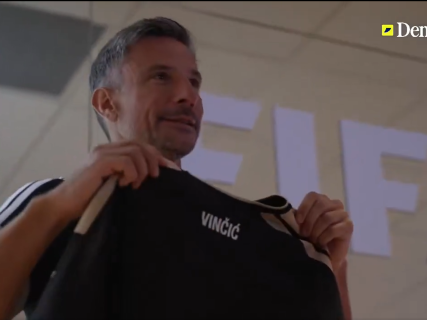
The referee of the World Cup final was arrested in 2020: what really happened with Slavko Vinčić

The Slovenian referee was detained during a large police operation against an alleged prostitution and drug trafficking ring in Bosnia and Herzegovina, but was released after testifying and was never charged or prosecuted.

3 minutes

Captura de pantalla 2026 07 17 121751

Captura de pantalla 2026 07 17 121751

Add DEMÓCRATA to Google

Ask FREN

Published

Last updated

3 minutes

Most read

The designation of the Slovenian Slavko Vinčić as the referee for the 2026 World Cup final between Spain and Argentina has brought back to the forefront an off-field incident that marked his career six years ago.

In May 2020, the referee was temporarily detained during a police raid in Bosnia and Herzegovina against an alleged organization involved in prostitution, drug trafficking, and illegal possession of weapons. However, after giving a statement, he was released and never charged with any crime.

The operation, known as "Kristal", generated enormous international repercussions and led to numerous headlines that, in some cases, confused the referee's presence at the scene with criminal involvement that never occurred.

A large-scale police operation against an alleged criminal network

The events occurred on May 28, 2020, on a property located in the vicinity of Bijeljina, in the entity of Republika Srpska, within Bosnia and Herzegovina.

The police carried out a broad operation against an alleged organization linked to prostitution, drug trafficking, and illegal possession of weapons. During the intervention, approximately 35 people were detained, including 26 men and nine women.

In the searches, authorities reported finding cocaine, firearms, bulletproof vests, mobile phones, laptops, and cash, items that became part of the investigation opened against several of the main suspects.

Why was Slavko Vinčić there?

The presence of the Slovenian referee on the property surprised both sports media and authorities.

As Vinčić later explained to Slovenian media, he had traveled to Bosnia to attend a business meeting and, after concluding that meeting, accepted an invitation from several people to attend a meal at a private property.

The referee stated that he did not know who most of the attendees were and claimed that he never imagined he could be in a place that was being investigated by the police.

In his statements, he even described what happened as "the biggest mistake of my life", insisting that his presence on the property was the result of an unfortunate coincidence.

He testified as a witness and was released

One of the aspects that generated the most confusion during those days was the referee's legal situation.

It is true that Vinčić was detained by the Police during the operation and transferred to make a statement. However, information subsequently published by Bosnian and Slovenian media agrees that he was interrogated as a witness and not as a member of the alleged organization under investigation.

After testifying, the referee was released and returned to Slovenia.

To date, there is no record of him being charged, prosecuted, or formally accused of any of the crimes that Bosnian authorities were investigating.

The investigation focused on other suspects

The police operation was primarily directed against several individuals suspected of belonging to a network dedicated to the exploitation of prostitution and other criminal activities.

Among the names that gained significant media notoriety was that of the Serbian influencer Tijana Maksimović, publicly known as "Tijana Ajfon", whose arrest concentrated a large part of the news coverage in the Balkans.

Subsequent judicial proceedings focused on the main individuals investigated for the organization, while Vinčić's name disappeared from the proceedings as no evidence was found to attribute his participation in the investigated events.

From controversy to refereeing major European finals

Far from affecting his refereeing career, the 2020 episode did not prevent Vinčić from continuing to receive the trust of UEFA and FIFA.

Two years later, he was appointed to referee the 2022 Europa League final between Eintracht Frankfurt and Rangers. In 2024, he refereed the Champions League final between Real Madrid and Borussia Dortmund at Wembley Stadium, considered one of the most prestigious matches on the international calendar.

He also participated as a referee in the Qatar 2022 World Cup and has been one of the referees chosen for the 2026 World Cup.

The appointment for the final between Spain and Argentina represents the greatest recognition of his entire professional career and confirms that, for international football organizations, the Bosnian episode did not condition his sporting career.

What really happened: established facts and what is not proven

The case of Slavko Vinčić is an example of how news of enormous impact can become simplified over time.

The established facts are that the referee was at the property where the police operation took place, that he was detained to make a statement, and that he was subsequently released without charges.

On the contrary, there is no record that he was accused, prosecuted, or convicted, nor that the judicial authorities attributed his participation in the alleged criminal network that motivated operation "Kristal".

Therefore, the most accurate way to describe that episode is to state that Vinčić was temporarily detained during a large-scale police operation, questioned as a witness, and released without any criminal action being taken against him.

More key points, information and questions with FREN

AI-GENERATED CONTENT

What are the requirements and the process for appointing the referee of a FIFA World Cup final according to FIFA?

The appointment of the referee for a FIFA World Cup final is a sporting and regulatory matter of football, not a political, institutional, parliamentary, or governmental issue. Due to how I am designed, I do not have specific, reliable, and detailed information about such technical procedures in professional sports, so I cannot rigorously explain the exact formal requirements, criteria, or internal steps FIFA follows to appoint the referee for a World Cup final.

My specialty is the analysis and explanation of issues related to politics, institutions, and regulation, particularly in the Spanish context: activities of the Government and Parliament, legislative processes, political and social relevance of certain public decisions, as well as journalistic coverage of these topics. In contrast, the internal regulations of international sports federations like FIFA, their referee appointment protocols, or their technical competition rules fall outside the scope in which I can provide verified information.

Although I could attempt to logically extrapolate what appointment procedures in complex organizations usually involve (for example, existence of committees, experience criteria, performance evaluation in previous matches, physical and training requirements, etc.), doing so without access to FIFA's specific rules would amount to speculation. A central part of how I operate is to avoid providing data or descriptions that I cannot support with clear normative, institutional, or journalistic information within my domain.

In your question, you also raise two very specific elements:

  • “Requirements”: this would imply detailing formal conditions (years of experience, FIFA category, evaluations, physical tests, possible nationality incompatibilities, etc.). I do not have those data in the sports field.
  • “Process”: that is, describing the internal steps FIFA follows (which body decides, how candidates are proposed, at what point in the tournament the decision is made, if there is a vote, if the referees' commission intervenes, etc.). I also do not have access to that specific procedural information about football.

By design, my applicable knowledge field focuses on matters such as:

  • Laws and regulations: how laws are processed in the Congress and Senate in Spain, the phases of bills and legislative proposals, what royal decree-laws imply, how regulations are developed, etc.
  • Executive power activity: Government decisions, functioning of the Council of Ministers, public policies, strategic plans, and regulations affecting economic and social sectors.
  • Parliamentary activity: debates, votes, appearances, government oversight initiatives, parliamentary questions, investigative commissions, and their political impact.
  • Political and social context: positions of parties, institutional and social actors, as well as the interpretation of political current events as covered by specialized media such as the newspaper Demócrata.

I can also help you understand:

  • How public officials are elected and removed (for example, the Ombudsman, members of the CGPJ, members of regulatory bodies, etc.).
  • What political or regulatory implications certain decisions have (for example, labor reforms, tax changes, energy regulations, housing policies, or European regulations applied in Spain).
  • How Spanish institutions relate to the EU in normative and public policy matters.

However, in the specific case of FIFA and the appointment of referees for matches such as the World Cup final, we would be talking about:

  • Regulations and protocols of a private international sports entity.
  • Internal technical and organizational decisions governed by statutes, disciplinary codes, and competition manuals outside the political and regulatory scope I cover.

Therefore, to obtain the information you seek, the most appropriate would be to consult specialized football and FIFA sources, such as:

  • The FIFA competition regulations, usually available on their official website.
  • Documents or statements from the FIFA Referees Committee, when available.
  • Analyses from sports media that explain in detail how these appointments are made and what criteria are practically used.

If you are interested in a political or regulatory perspective related to sport (for example, how sports federations are regulated in Spain, the role of the Higher Sports Council, or how integrity and transparency in sport are legislated), I could help you in detail, as that would fall within the realm of public policy and regulation.

How are sports federations regulated in Spain and what role does the Higher Sports Council play? What rules exist in Spain regarding integrity and the fight against corruption in professional sports? What competencies do the Congress and Senate have in sports policy and sports financing?

What are the functions and competencies of an international referee in tournaments organized by UEFA and FIFA?

I cannot detail the technical functions and competencies of an international referee in tournaments organized by UEFA and FIFA because this is a specific sporting and regulatory matter of football, outside the political, institutional, or social current affairs scope in which I specialize. My design is oriented to analyze and explain dynamics of Spanish politics, parliamentary and executive activity, as well as sociopolitical current events, not the internal regulations of international sports federations. However, I can clearly explain what types of questions I can address and how sport connects, if applicable, with public policies.

Thematic scope in which I can help

I specialize in political and regulatory issues, especially in the Spanish context. This includes both the activity of the General Courts (Congress and Senate) and the Government of Spain, and how different sectors (economic, social, cultural, etc.) are regulated. I can also help interpret political current events, party and parliamentary group positions, or the social impact of certain public decisions.

In general terms, I can provide information and analysis on:

  • Legislative and regulatory activity: bills and legislative proposals, royal decree-laws, parliamentary debates and votes, as well as the content and regulatory impact of those norms.
  • Executive activity: measures approved in the Council of Ministers, general lines of public policies, structural reforms, and government programs.
  • Political parties and parliamentary groups: alliances, majorities, external government support, political negotiation, ideological positions, and legislative strategies.
  • Sociopolitical current events: public debates on health, education, labor market, housing, equality, ecological transition, digitalization, taxation, or other areas with a clear political or regulatory dimension.
  • Institutional relations and governance: distribution of competencies between the State and autonomous communities, role of municipalities, basic functioning of European institutions when connected to Spanish politics, and mechanisms of cooperation or territorial conflict.

What I cannot offer in this specific case

The question you raise refers to the professional and regulatory role of an international referee within the organizational and normative framework of UEFA and FIFA (appointments, disciplinary control, application of the game regulations, physical and technical obligations, structure of referee teams, etc.). This type of information belongs to the realm of:

  • Sporting (football regulations, internal competencies of refereeing bodies).
  • Federative (internal rules of UEFA, FIFA, and national federations).
  • Technical-professional (VAR protocols, match supervision, evaluations, referee categories).

All of this is outside the thematic scope for which I am designed. I do not have the necessary information nor specific sources on international sports regulations to provide you with a rigorous and updated breakdown of the functions, competency limits, or disciplinary responsibilities of referees in those tournaments.

How I could help if you introduce the political component

If you are interested in an approach closer to my specialization, I could help you, for example, with issues such as:

  • Sports policy in Spain: how competencies are organized among the Higher Sports Council, federations, autonomous communities, and professional clubs.
  • Regulations on sport and refereeing in Spain: content and functioning of the Sports Law, the legal regime of Spanish sports federations, or the role of the Sports Administrative Tribunal in federative conflicts.
  • Political and social impact of major sporting events: debates on public financing of stadiums, security in major competitions, or political controversies linked to decisions of national and international federations.
  • Institutional conflicts in sport: for example, tensions between federations and governments, or discussions in the Spanish Parliament when a scandal or controversial decision arises in the sports field.

Summary

In summary, I cannot respond specifically and technically to your question about the functions and competencies of an international referee in UEFA and FIFA competitions because it is purely sporting and regulatory content, outside the political and regulatory focus for which I am prepared. My field of action is Spanish politics (and, secondarily, its European and international projection), parliamentary and government activity, and sociopolitical current events. If you reformulate the question connecting it with these aspects (for example, how sport and refereeing are regulated from Spanish politics or what public debates refereeing has sparked institutionally), I could give you a much more useful and detailed answer.

What professional career and most notable matches has Slavko Vinčić officiated before the 2026 World Cup final?

Slavko Vinčić is, above all, an elite football referee, not a figure linked to politics, parliamentary activity, or the Spanish or European institutional sphere. As a specialist assistant in politics and public affairs, I do not have structured or verified information about his sporting career beyond what might be generally known, and I cannot access sports databases or archives to rigorously detail his refereeing career. For that reason, I cannot provide you with a reliable and verified list of the most notable matches he has officiated nor a complete chronology of his professional career before the 2026 World Cup final.

My area of specialization focuses on Spanish politics and, to a lesser extent, European and international politics, always from an institutional, normative, parliamentary, and sociopolitical current affairs perspective. This includes monitoring laws, royal decree-laws, parliamentary initiatives, Council of Ministers agreements, parliamentary group activity, as well as political and social situational analysis. Likewise, I can work with current journalistic information, especially that provided by the newspaper Demócrata, oriented to government, opposition, social movements, regulatory changes, and public debates.

In contrast, the career of a football referee like Slavko Vinčić falls squarely within professional sport: club and national team competitions, FIFA and UEFA referee appointments, Champions or Europa League finals, national leagues, card statistics, controversial decisions, etc. All that information belongs to the realm of sports journalism and specialized football databases, which are not part of the source ecosystem I work with. Since the key criterion is not to invent or speculate, I should not fill gaps with imprecise memories or unverified knowledge about his refereeing career.

It is important to emphasize that my design is oriented to answer questions such as, for example:

  • Analysis of the political career of national or regional leaders, their passage through different public offices, and their influence on the legislative agenda.
  • Monitoring a specific law: from public consultation and draft bill, through parliamentary debate, to approval and publication in the Official State Gazette.
  • Explanation of how the Congress of Deputies, the Senate, or regional parliaments work; what role different groups (PSOE, PP, Vox, Sumar, etc.) play and how majorities are formed.
  • Political and social context on current issues: government pacts, investitures, labor, fiscal or educational reforms, and their impact on citizens.
  • Political reading of major social or media events that have regulatory or institutional implications.

In contrast, issues such as:

  • Record of matches refereed by Slavko Vinčić in FIFA or UEFA competitions.
  • Statistics of cards, penalties awarded, or goals disallowed throughout his career.
  • Technical comparisons with other referees or tactical analysis of specific matches.

are outside my field of action. To properly answer what you ask—the detailed professional career and the most notable matches he has officiated before a World Cup final—the most advisable is to consult specialized sports sources: official pages of FIFA and UEFA, football statistical databases, or leading sports media that systematically follow the careers of international referees.

If what interests you is the political or institutional approach around an event like the 2026 World Cup final (for example, the economic and diplomatic implications for the host country, the use of the event in political discourse, regulation of major sporting events, or management of security and public order), I can help you with deeper and contextualized analyses.

In summary, I cannot provide you with a reliable answer about the professional career and the most notable matches Slavko Vinčić has officiated before the 2026 World Cup final, because that information belongs to a field—the sports one—for which I do not have structured sources nor a specialization mandate. However, I can assist you with any questions related to Spanish politics, parliamentary activity, government, parties, regulations, or social and regulatory impact of major events, including the World Cup, as long as the question is formulated from that political or institutional perspective.

What competencies does Spain have in organizing and regulating major international sporting events such as a football World Cup? How do Spanish governments usually use major sporting successes or failures in their political and communication strategy? What role do the Congress and Senate play in approving laws related to professional sports and mass sporting events?

Play

Test your knowledge with FREN!

How much do you know about this topic? Answer the following 3 questions.

In what context was Slavko Vinčić arrested in 2020?

Question 1 of 3

What was Slavko Vinčić's legal situation after his arrest in Bosnia?

Question 2 of 3

Which notable matches has Slavko Vinčić refereed after the 2020 episode?

Question 3 of 3

Hola, soy Fren. ¿Cómo te ayudo?