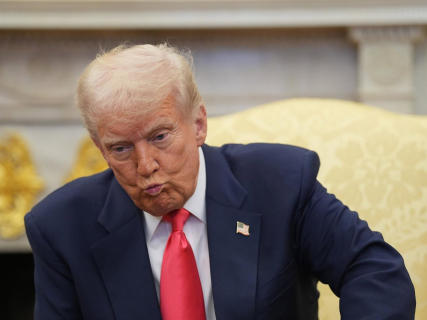
United States bombs Iran in retaliation for the downing of an Apache helicopter

The United States Central Command assures that it is an operation of "self-defense" after the loss of a helicopter near the Strait of Hormuz

2 minutes

fotonoticia 20260608214150 1920

fotonoticia 20260608214150 1920

Add DEMÓCRATA to Google

Published

Last updated

2 minutes

Most read

The United States has launched a new military offensive against Iran after a US Army Apache combat helicopter was shot down in the vicinity of the Strait of Hormuz. The United States Central Command (CENTCOM) confirmed the start of the bombings this Tuesday and defined them as a "self-defense" operation in response to what happened with the aircraft.

According to the official US version, the attacks began by order of President Donald Trump on Tuesday afternoon. CENTCOM stated that the operation constitutes a "proportional" response to what it described as an Iranian aggression against US forces deployed in the region.

The incident that triggered the retaliation occurred near the coast of Oman. An AH-64 Apache helicopter crashed while on a patrol mission in one of the most sensitive maritime areas on the planet. The two crew members were rescued alive and are out of danger, according to US military authorities.

Differences over the causes of the incident

Although the US administration has linked the bombings to an Iranian action against the helicopter, the investigation into the exact causes of the incident remains open.

Associated Press reported, citing a US official, that the Apache may have collided with an Iranian drone before crashing into the sea. The agency points out that it is still unclear whether this collision was accidental or intentional. Official communications from the Pentagon and CENTCOM currently maintain that the investigation is ongoing.

This difference is relevant because some of Trump's initial public statements directly pointed to Iran having shot down the aircraft, while other US officials have avoided closing the investigation.

A new escalation in the Middle East

The US bombings once again raise tensions in the Middle East at a particularly delicate moment. The region has been experiencing months of clashes and episodes of instability that have affected both regional security and maritime traffic in the Persian Gulf.

Iran has warned that it will respond to the US attacks, and various international media report new actions against United States military installations in the region. However, Washington insists that the operation has a limited scope and does not seek an open war with Tehran.

For the moment, neither the United States nor Iran have offered a definitive assessment of damages or possible casualties resulting from the bombings. The situation continues to evolve and the authorities of both countries maintain permanent monitoring of events.

More key points, information and questions with FREN

AI-GENERATED CONTENT

What is the status of the official investigation into the downing of U.S. aircraft in the region?

To date, official investigations into recent incidents involving U.S. aircraft in the region (mainly the Middle East and the Red Sea) remain open and without conclusive public reports. In the most serious cases, the responsibility for the investigation lies with the Pentagon and the U.S. Central Command (CENTCOM), and, when appropriate, with the armed forces of allied countries (such as Kuwait or Iraq). The available information mainly comes from official statements and press leaks, which mention “friendly fire” in some incidents and attacks by pro-Iranian actors in others, but without final technical documentation published. In Ukraine, so far, there are no official investigations into the downing of U.S. aircraft in the sources consulted.

F-15E Incident in Kuwait and the “Friendly Fire” Version

The best-documented episode in official sources is the loss of three U.S. F-15E fighters on Kuwaiti territory. According to the broadcaster Onda Cero, the U.S. Central Command (CENTCOM) attributed the shootdown to friendly fire from Kuwaiti air defenses, which allegedly mistook the aircraft for a threat in a context of maximum regional tension. The Chairman of the U.S. Joint Chiefs of Staff, Dan Caine, publicly confirmed the loss at the Pentagon but emphasized that he could not provide more details because the investigation was still open.

Meanwhile, Kuwaiti authorities announced their own internal investigation into the functioning of their air defense systems and protocols for identifying allied aircraft. In this case, therefore, there is a dual official path: CENTCOM's operational and technical investigation and Kuwait's national inquiry. Final reports or detailed technical conclusions have not been made public so far, beyond the general thesis that it was a “misidentification error” and not enemy fire.

Shootdowns and Aircraft Losses in the Gulf and Strait of Hormuz

The Spanish newspaper Demócrata has covered a series of incidents in the Persian Gulf and the Strait of Hormuz, which have mainly affected U.S. drones and an Apache helicopter. In articles such as “United States Bombards Iran in Retaliation for the Downing of an Apache Helicopter” (June 10, 2026) and “U.S. Launches Attacks on Iranian Drone Bases After One of Its Aircraft Was Downed” (June 1, 2026), it is detailed that the Pentagon and CENTCOM are leading the investigation into the loss of a high-value drone (over 200 million dollars) and the attack on said helicopter.

According to these reports, Iran, through the Islamic Revolutionary Guard Corps, claims to have shot down several U.S. drones (including four drones on May 28, 2026) and even an A-10 and an F-15, while Washington has officially acknowledged only the loss of a large reconnaissance drone and keeps the investigation into the Apache open. CENTCOM states it is analyzing telemetry data, satellite images, and, when possible, debris from the aircraft, but has not published a definitive report on the precise cause of each shootdown or on ultimate responsibility. Iranian sources, for their part, have not yet provided technical evidence for their more ambitious claims.

Red Sea: Drone Incidents and the Downing of an F/A-18

Two separate lines of investigation converge in the Red Sea. On one hand, international media report that Iran claimed to have shot down a U.S. military drone in its airspace on May 31, 2026, an incident about which Washington has only responded that “the investigation remains open” and has not confirmed the shootdown. In this area, the investigation is coordinated by CENTCOM with the U.S. Air Force and agencies such as the U.S. Maritime Authority, but no official conclusions have been disclosed.

On the other hand, the U.S. Navy is investigating the crash of an F/A-18 Super Hornet fighter into the sea from the aircraft carrier Harry S. Truman while performing evasive maneuvers against Houthi missiles, according to the newspaper ABC in this report. The ship remains operational, and it has only been publicly stated that control of the tow was lost during the maneuver, without further details on possible technical or human failures. The investigation is being conducted within the Navy itself, with no preliminary reports made public.

Kurdish Region of Iraq and Absence of Cases in Ukraine

In Iraqi Kurdistan, local authorities and the Iraqi Media Security Cell (dependent on the Ministry of Defense) are investigating a series of drone attacks against energy facilities and a drone shot down near Erbil airport, where U.S.-led coalition troops are present. According to Demócrata (information from 07/14/2025), pro-Iranian militias are unofficially pointed to as possible perpetrators, but there is not yet an official report closing the case or formally attributing responsibility.

Regarding Ukraine, the sources consulted indicate that there is no public information on official investigations related to the downing of U.S. aircraft in the current war context. Reports focus on Russian and Ukrainian drones and planes, not U.S. aircraft, so there is no record comparable to those opened in Kuwait, the Gulf, or the Red Sea.

General Assessment of the Status of Investigations

In summary, the official investigations underway are still in the technical and evidence-gathering phase, without definitive public reports. In the case of the F-15Es in Kuwait, the dominant narrative is “friendly fire,” but without complete expert details. In the Gulf and Hormuz, Washington acknowledges specific losses and responds militarily to Iran while keeping investigations open; in the Red Sea and Iraqi Kurdistan, investigations are conducted by the U.S. Navy and Iraqi and Kurdish authorities, also without published final conclusions. This means that, for now, the public only has access to partial official versions and political statements, not to the complete technical reports that usually take months or years to finalize.

What are the powers of the President of the United States regarding military operations abroad according to U.S. legislation?

Powers of the U.S. President in Military Operations Abroad

Initial Summary

In the U.S. legal system, the president has broad powers to order the use of military force abroad, but these powers are formally limited by Congress and the Constitution. The Constitution names the president Commander in Chief of the Armed Forces, while granting Congress the power to declare war, fund it, and regulate the military forces. Since 1973, the War Powers Resolution attempts to limit the president's unilateral deployment of troops, requiring notification to Congress and limiting the duration of operations without legislative authorization. In practice, however, expansive interpretations of executive power and broad authorizations for the use of force have allowed presidents to conduct many military operations abroad with relatively indirect congressional oversight.

Basic Constitutional Framework

The U.S. Constitution distributes powers over the use of force in a fragmented manner:

President: Article II designates him as Commander in Chief of the Armed Forces. On this basis, it is understood that:

• He can direct military operations once forces have been authorized or deployed.
• He has the capacity to react quickly to attacks or imminent threats (self-defense, rescue of citizens, embassy protection, etc.).
• He exercises operational and strategic control over the Pentagon, sets rules of engagement, and decides daily military planning.

Congress: Article I grants it the power to:

Declare war formally.
Raise and support armies and maintain a navy.
Regulate the armed forces and approve rules on their organization and discipline.
Authorize and fund military campaigns through spending laws and specific authorizations.

In theory, the president should not initiate prolonged wars without congressional authorization, but the constitutional text is sufficiently ambiguous that, in practice, operations without formal declarations of war have multiplied.

War Powers Resolution of 1973

To try to limit presidential initiative after the Vietnam War, Congress passed the War Powers Resolution (WPR) in 1973. Its central elements are:

Consultation obligation: the president must, “to the extent possible,” consult with Congress before introducing armed forces into hostilities or situations where participation in hostilities is imminent.
48-hour notification: once troops are deployed in combat, a written report must be sent to Congress within 48 hours detailing the legal basis, scope, and expected duration of the operation.
60/90-day time limit: without an Authorization for Use of Military Force (AUMF) or a declaration of war, forces must be withdrawn within 60 days, extendable by 30 more for orderly withdrawal.
Power to end operations: Congress can demand withdrawal through a joint resolution.

Several presidents have questioned the constitutionality of the WPR and often interpreted it flexibly, for example arguing that certain limited air operations do not constitute “hostilities” for the purposes of the deadlines.

Congressional Authorizations and the Practice of AUMFs

In practice, the key mechanism that both limits and expands presidential powers are the Authorizations for Use of Military Force (AUMF). Congress approves an AUMF that:

• Identifies enemies, objectives, and sometimes geographic zones.
• Authorizes the president to use “all necessary and appropriate force” to achieve them.
• Does not always include precise time limits.

When an AUMF exists, the president has broad discretion to decide when, where, and how to employ force within that framework: choosing theaters of operations, types of military means (drones, special forces, airstrikes), intensity levels, or alliances with other states. Congress retains the power to restrict or revoke the authorization, as well as to cut funding, but doing so is usually politically costly.

Operations Without Specific Authorization

The president can also order certain military operations abroad without an AUMF or declaration of war, based on his powers as Commander in Chief and the need to protect national interests. This group would include:

• Specific hostage rescue operations or protection of diplomatic personnel.
• Limited strikes against specific targets in response to immediate attacks or imminent threats.
• Very limited missions in time and scale that the Executive does not consider “hostilities” in the strict sense of the WPR.

These actions remain formally subject to notification obligations and congressional budget oversight, but the legal boundary between “limited use of force” and “hostilities” has been a permanent source of controversy.

Political, Legal, and International Controls

Although the president has a central role in military operations abroad, his power is not absolute. Congress can:

• Condition or deny funds for certain campaigns.
• Impose substantive restrictions through laws (for example, prohibitions on deploying combat troops in certain countries).
• Open investigations and hearings that exert political pressure.

Additionally, federal courts can review specific aspects (fundamental rights, detentions, scope of AUMFs), and the Executive is also formally bound by international law (UN Charter, international humanitarian law), although practical application depends on political decisions.

In summary, according to U.S. legislation and practice, the president has very broad leeway to initiate and conduct military operations abroad, especially when supported by a current AUMF, but this capacity is intertwined with constitutional controls by Congress and formal limitations established by the War Powers Resolution, whose effective compliance has been a constant source of institutional debate.

How many similar military operations has the United States authorized in the Middle East in the last ten years?

U.S. Military Operations in the Middle East in the Last Decade

Concise Answer

There is no single, official, and closed count of how many “similar” military operations the United States has authorized in the Middle East in the last ten years, partly because Washington combines declared wars, broad air campaigns, targeted counterterrorism missions, drone operations, and naval deployments without all receiving the same legal status. Still, analytically it can be said that over the last decade there have been several large continuous campaigns (against the Islamic State in Iraq and Syria, support to the coalition in Yemen, periodic operations in Syria against Iran and its militias, military presence in Iraq after the formal end of the combat mission, and naval actions in the Red Sea and Persian Gulf). If one also considers targeted drone or missile strikes against groups like Al Qaeda, ISIS, or militias linked to Iran, the number of discrete operations rises to several hundred, although without a complete public record. There is no official data allowing one to say, for example, “The United States has authorized X operations” in this period, and any closed figure would be speculative.

Why There Is No Single Clear Number

In the U.S. case, the term “military operation” can refer to very different realities: from a large multinational campaign with its own name and congressional mandate, to a single drone strike ordered by the president based on existing authorizations for the use of force. Moreover, the U.S. government does not always publicly announce every action, and part of the activity in the Middle East remains classified or is communicated in aggregate form, especially in the counterterrorism realm. This makes it difficult to compile an exhaustive list and means that, rather than talking about an exact number, it makes more sense to describe the major operational frameworks active in the region over the decade.

Main Campaigns and Operational Frameworks in the Last Decade

1. Operations Against the Islamic State (Iraq and Syria)

In the last ten years, the most continuous and visible U.S. effort in the Middle East has been the fight against the Islamic State (ISIS/Daesh) in Iraq and Syria. Under a large umbrella operation—with rotating mission names and commands— the U.S. has carried out thousands of air sorties, drone strikes, deployment of special forces on the ground, and support to allied armies and militias (Iraqi Army, Kurdish forces, among others). Although this campaign is legally articulated as a single global “operation” against ISIS, within it countless specific tactical operations have been authorized (precision strikes, support missions, advising and accompanying), impossible to quantify without access to detailed internal military documentation.

2. Intervention and Support in Yemen

During the Yemen war, the United States has provided over these years logistical, intelligence, and arms support to the coalition led by Saudi Arabia and the United Arab Emirates. Added to this are direct operations against Al Qaeda in the Arabian Peninsula (AQAP) through drones, special forces, and selective strikes. Each of these attacks constitutes an operation in an operational sense but is usually grouped into large counterterrorism frameworks that extend over time, without detailed public accounting.

3. Syria: Strikes Against the Regime and Pro-Iranian Militias

Besides the campaign against ISIS, the U.S. has carried out significant targeted operations in Syria: bombings against regime facilities following chemical weapons use, and periodic strikes against bases and depots of militias linked to Iran in response to attacks on U.S. or allied troops. Each of these episodes is announced as an ad hoc executive decision, supported by authorizations for the use of force and self-defense, but they are not always integrated into a single formally named operation. Taken together, they form a chain of military actions that, again, are counted in dozens or hundreds of strikes, not in a few isolated operations.

4. Continued Presence in Iraq

Although Washington declared its conventional combat mission in Iraq over, it has maintained a mission of advising, training, and support to the Iraqi government. This presence entails the capacity to respond militarily to militia attacks and to participate in joint operations against remaining ISIS cells. For counting purposes, this mission is usually considered a single stabilization and support operation, but its internal functioning involves a multitude of missions and military actions authorized over time.

5. Naval Operations in the Persian Gulf and Red Sea

At sea, the U.S. Fifth Fleet has maintained for years patrol and security operations in the Persian Gulf, the Strait of Hormuz, and more recently in the Red Sea and adjacent areas, aiming to protect commercial traffic and deter threats from Iran or other armed actors in the region. These activities range from escort and presence operations to interceptions, drone and missile shootdowns, or strikes against launch platforms, each constituting a specific operation within a permanent naval mission.

Conclusion: Approximate Range and Limits of Information

If the analysis is limited to the major missions or operational frameworks in the Middle East (campaign against ISIS, support in Yemen, operations in Syria, presence in Iraq, naval activity in the Gulf and Red Sea, plus targeted actions against specific organizations and militias), one can speak of several main strategic operations in the last decade, around half a dozen major axes. However, if the question refers to “operations” in a tactical sense—each drone strike, each bombing, or each specific mission—the number clearly rises to hundreds of actions, probably more, for which there is no exhaustive public list. Since there is no open record consolidating and summing all these actions, it is not possible to provide an exact total figure without speculation.

Play

Test your knowledge with FREN!

How much do you know about this topic? Answer the following 3 questions.

What triggered the United States military offensive against Iran mentioned in the news?

Question 1 of 3

What did US authorities state about the condition of the Apache helicopter crew?

Question 2 of 3

What aspect regarding the causes of the Apache helicopter incident remains unclear?

Question 3 of 3

Hola, soy Fren. ¿Cómo te ayudo?