What's happening with Madrid's Low Emission Zones? The origin of the controversy, the Supreme Court ruling, and how the restrictions stand

The judicial annulment of the old ordinance has reopened the debate on fines and the legality of traffic restrictions, although the LEZs remain in force after the approval of a new municipal regulation

2 minutes

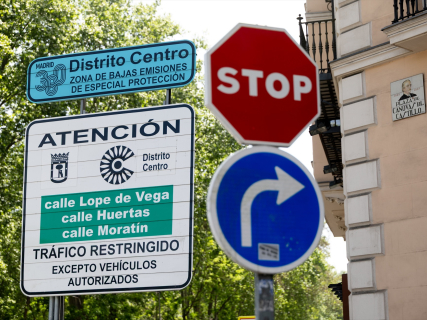
EuropaPress 7461937 cartel zona bajas emisiones centro ciudad 22 abril 2026 madrid espana

EuropaPress 7461937 cartel zona bajas emisiones centro ciudad 22 abril 2026 madrid espana

Add DEMÓCRATA to Google

Ask FREN

Published

Last updated

2 minutes

Most read

The Low Emission Zones (ZBE) of Madrid have once again become the center of political and judicial debate after the Supreme Court upheld the ruling that annulled several essential articles of the previous Sustainable Mobility Ordinance. The resolution has caused a wave of doubts among drivers, especially regarding the validity of fines imposed in recent years and whether traffic restrictions are still in force. The answer is yes: the ZBEs continue to operate, albeit under new regulations approved by the City Council of José Luis Martínez-Almeida.

What are Low Emission Zones?

ZBEs are urban areas where the circulation of certain vehicles is restricted based on their pollutant emission level, identified by the DGT environmental sticker. Their objective is to reduce air pollution and improve air quality, an obligation that state legislation imposes on municipalities with more than 50,000 inhabitants.

In Madrid, the system is structured through a ZBE that covers practically the entire municipal area and two Special Protection Low Emission Zones (ZBEDEP): Distrito Centro and Plaza Elíptica, where restrictions are more severe due to high pollution levels.

What has happened in the courts?

The origin of the controversy dates back to a ruling by the Superior Court of Justice of Madrid (TSJM), which annulled several essential provisions of the Sustainable Mobility Ordinance, considering that the City Council did not adequately justify the economic impact of the restrictions or their proportionality. The City Council appealed the decision, but the Supreme Court dismissed the appeal, thus making the ruling final.

The judicial resolution does not question the environmental objective of the low emission zones, but rather the way in which they were regulated in the previous municipal ordinance.

The City Council's response

Even before the Supreme Court definitively ruled on the appeal, the City Council approved the Ordinance 2/2026, which modifies the mobility regulations to correct the deficiencies pointed out by the courts and provide new legal coverage for traffic restrictions. The new regulation came into force last April and maintains both the general ZBE and the special protection zones of Distrito Centro and Plaza Elíptica.

The municipal government maintains that the ruling only affects the previous regulation and that current restrictions continue to be fully applicable as they are based on a different ordinance.

The debate over fines

The greatest controversy now centers on the penalties imposed under the annulled regulation. Motorists' associations maintain that the finality of the ruling obliges the City Council to review and annul all fines that are not yet final, understanding that they were issued on a legal basis declared null. Some organizations estimate that millions of fines could be affected.

The City Council, for its part, defends that the fines imposed since the new ordinance came into effect maintain full validity and that the nullity of the previous regulation does not automatically imply the annulment of all sanctions already processed. The definitive scope of this discussion will depend on the judicial resolutions issued on the appeals currently underway.

And now what

As of today, the Low Emission Zones remain fully operational in Madrid. Vehicles without an environmental sticker continue to be subject to the access limitations provided for in the current regulation, and the cameras maintain control of access with the corresponding imposition of penalties when applicable. The difference is that these restrictions are no longer based on the ordinance annulled by the courts, but on the new regulation approved by the City Council Plenary in March 2026.

More key points, information and questions with FREN

AI-GENERATED CONTENT

What parliamentary procedures must the new Sustainable Mobility Ordinance follow for its possible future modification or approval?

The processing of a Sustainable Mobility Ordinance is a municipal competence and follows a procedure specific to local entities, different from that of a state law. With the available information, only the steps for processing laws in the General Courts are recorded, not the specific details of the internal procedure of city councils to approve or modify specific ordinances. Therefore, it is not possible to describe with legal precision the municipal procedures of that particular ordinance, but it is possible to contextualize how the Spanish parliamentary procedure for the approval of regulations generally works and how it differs from the local level. No further information is available in the consulted sources about the specific procedure for municipal ordinances.

1. Difference between state laws and municipal ordinances

In the Spanish legal system, laws are approved by the General Courts (Congress and Senate) and published in the BOE; ordinances are rules approved by the plenary sessions of city councils and published in provincial or regional official bulletins, as appropriate. The consulted sources describe in detail the process of a state law, but not the processing regime of specific ordinances. Therefore, any explanation about the detailed municipal procedure (technical reports, municipal commissions, specific public information phases, deadlines, and regional or state controls) cannot be specified here without resorting to speculation.

2. Outline of the processing of a state law (for comparison)

Based on the available information, a state law follows, in a very simplified way, the following phases:

First, the presentation of the initiative. It can be a bill (presented by the Government) or a bill proposal (presented by deputies, parliamentary groups, the Senate, regional assemblies, or a popular legislative initiative). This phase conceptually corresponds to the moment when it is decided to promote a new regulation or its modification.

Second, in the case of bill proposals, the consideration by the Plenary of the Congress takes place, which decides whether to admit the initiative for processing. At the municipal level, a similar political decision usually exists (although regulated by local regime legislation), but the sources do not provide that detail for ordinances.

Subsequently, the Congress Board assigns the initiative to a committee so that a specialized body works on the text. Then the amendment phase opens, in which parliamentary groups can propose changes to the articles. This moment is key for the political negotiation of the normative content.

Once the amendments are presented, a committee debate is held, where the text and amendments are discussed, and a report is prepared. That report then goes to the Congress Plenary, which debates and votes on the final text, including the proposed changes that have been maintained. This vote determines if the regulation passes the first chamber.

After passing the Congress, the text is sent to the Senate. There it can be approved without changes, amended, or even vetoed. If there are amendments or a veto, the text returns to the Congress, which has the final say: it can accept or reject the amendments and, in the case of a veto, lift it with certain types of majority (absolute or simple majority, depending on the case). This bicameral interaction is typical of state legislation and does not exist as such at the municipal level.

Finally, once definitively approved by the General Courts, the law goes to the sanction and promulgation phase. The King sanctions and promulgates the law, which is published in the Official State Gazette (BOE). The entry into force occurs on the date set by the law itself or, if not indicated otherwise, 20 days after its publication.

3. Limitations regarding the specific municipal ordinance

The question specifically refers to the new Sustainable Mobility Ordinance, which is a municipal regulation and, therefore, is governed by local law (local regime and municipal organic regulations). However, the consulted sources do not contain details of the procedure applicable to its modification or the approval of a new ordinance in the future (for example, initial and definitive approval phases in the City Council Plenary, public information periods and neighborhood claims, mandatory technical and legal reports, nor possible subsequent controls before the contentious-administrative jurisdiction).

Furthermore, it is a matter of municipal scope and my specialization focuses on state-level politics and normative activity in Spain (central Government, General Courts, main parties, and parliamentary and executive monitoring at the national level). When the issue goes down to the procedural detail of a specific city council (such as the exact processing of a specific ordinance), there is not enough verified information in the sources I have access to offer a rigorous description of each procedure.

For all these reasons, it is only possible to offer this general comparative framework and warn that, to know precisely the steps that the Sustainable Mobility Ordinance must follow in a specific municipality (approval, modification, or repeal), it would be necessary to directly consult the applicable local regime regulations and, above all, the organic regulation and the agreements of the city council processing said ordinance. No further information is available in the consulted sources.

What powers does the mayor of Madrid have regarding urban mobility according to current legislation?

The mayor of Madrid is the highest political and executive authority of the City Council and, therefore, the main authority in urban mobility within the municipal area, although many of his decisions are made through the Governing Board and the competent departments. His powers derive mainly from Law 7/1985, Regulating the Bases of the Local Regime, Law 22/2006, on Capitality and Special Regime of Madrid, and the transport regulations of the Community of Madrid. Additionally, municipal mobility ordinances specify and distribute these functions among the mayor, the Governing Board, and the delegated councilors, always within the framework of those superior laws.

1. General framework: mayor as municipal executive body

Law 7/1985, Regulating the Bases of the Local Regime, establishes that the government and municipal administration correspond to the City Council, composed of the mayor and councilors (Law 7/1985). In its Article 21, which remains in force, the law defines the mayor as president of the corporation and attributes to him, among others, the following general functions:

Direct the government and municipal administration.
Direct, inspect, and promote municipal services and works.
Exercise the leadership of the Municipal Police.
Issue edicts and enforce the agreements of the City Council.
– Sanction infractions of municipal ordinances and grant licenses, unless a law reserves them for the Plenary or the Governing Board.

All these attributions are general in nature but directly impact urban mobility, traffic, and transport within Madrid.

2. Special regime of Madrid: strengthening the mayor's role

Law 22/2006, on Capitality and Special Regime of Madrid, adapts the general scheme to large cities and, in particular, to the Madrid City Council (Law 22/2006). This law emphasizes that:

– The mayor is one of the executive bodies of political and administrative direction, along with the Governing Board and councilors with government responsibilities.
– His main powers are the promotion of municipal policy and the direction of other executive bodies, as well as the superior direction of the municipal administration.

In practice, this means that the mobility strategy (mobility plans, major changes in traffic, urban public transport, environmental restrictions, etc.) is politically defined under the mayor's direction, although it is managed through the mobility department and the Governing Board.

3. Municipal competences in transport and how they are channeled through the mayor

At the regional level, Law 20/1998, on the Organization and Coordination of Urban Transport in the Community of Madrid, and its amendments, establish what corresponds to municipalities. According to this law, municipalities are generally competent for the regulation, management, inspection, and sanctioning of urban public passenger transport services within their municipal area (Law 20/1998). It also recognizes municipal capacity to:

– Decide the form of management of urban transport services (direct management, concession, public company…).
– Grant certain authorizations and urban transport licenses (for example, taxi licenses, after the 2022 reform).
– Approve ordinances regulating urban passenger transport services, respecting state and regional regulations.

Since the mayor directs the municipal government and the management of services, these competences are concretized in political and administrative decisions promoted or signed by the mayor himself, either directly or through delegations to the Governing Board or councilors of the mobility area.

4. Supramunicipal coordination and limits

Law 5/2009, on the Organization of Road Transport and Mobility, introduces an important limit: when plans, acts, or resolutions of city councils related to mobility or transport go beyond the strict scope of the municipality or seriously distort the movements of other municipalities, a binding prior report from the competent regional department is required if another municipality complains (Law 5/2009).

This implies that, although the mayor of Madrid has broad decision-making capacity in mobility within the city, his decisions that significantly affect metropolitan mobility are subject to a coordination framework with the Community of Madrid and other municipalities, especially through the Regional Transport Consortium.

5. Municipal police, sanctions, and mobility ordinances

According to Article 21 of Law 7/1985, the mayor exercises the leadership of the Municipal Police and the sanctioning power for infractions of municipal ordinances. In mobility matters, this translates into:

– Political direction of the municipal police body regarding traffic regulation and control, monitoring compliance with traffic and parking rules, and urban road safety.
– Imposition of sanctions for infractions of mobility and traffic ordinances, usually through the instructing bodies and services dependent on the municipal administration.

The municipal mobility ordinances (such as the Sustainable Mobility Ordinance of Madrid) develop the details: low emission zones, parking regulation, circulation of bicycles and personal mobility vehicles, loading and unloading, etc., and internally distribute what is approved by the Plenary, what by the Governing Board, and what by resolution of the mayor or delegated councilors. No further information is available in the consulted sources about the specific content of that ordinance.

How many times has the Sustainable Mobility Ordinance of Madrid been modified or challenged in the last decade?

With the available information, the Sustainable Mobility Ordinance (SMO) of Madrid has had in the last decade three major regulatory modifications (2021, 2022, and 2026) and at least one central challenge that has led to several relevant judicial rulings (TSJM in 2024 and Supreme Court in 2026). The original ordinance dates from 2018, but most of the changes and litigation occurred afterward, mainly linked to Low Emission Zones (LEZ). Additionally, in 2024 a new modification was opened in a public consultation phase, which has not yet materialized as an approved change. Complete data to count all minor appeals is not available, but these major milestones are clearly identified.

Main regulatory modifications

1) Approval of the 2018 SMO (not a modification, but the starting point). The municipal website records the Sustainable Mobility Ordinance approved in 2018 as the regulatory framework for circulation, parking, and the first low emission zones, with progressive restriction of vehicles without environmental labels (classification A) and the development of Madrid Central as a precedent of the current LEZs (City Council link).

2) 2021 Modification (Ordinance 10/2021). According to the municipal note on the 2024 prior consultation, the SMO “10/2021” was the major reform of September 2021, which turned Madrid into a full city Low Emission Zone and articulated Madrid LEZ and the special protection zones Centro and Plaza Elíptica (note 10/03/2024). That same note recalls that this modification is the one currently under judicial review.

3) 2022 Modification. External legal summaries indicate that Ordinance 12/2022 introduced adjustments in transitional provisions mainly related to cleaning and urban waste and their interaction with parking and road uses, framed within the SMO. It is a more technical reform but counts as the second relevant modification in the decade.

4) Comprehensive reform of 2026: Ordinance 2/2026. Following judicial problems with the 2021 version, the City Council Plenary approved in March 2026 a new mobility ordinance (Ordinance 2/2026), which “modifies the mobility regulations to correct deficiencies pointed out by the courts and provide new legal coverage to traffic restrictions,” maintaining the general LEZ and the special protection LEZs of Centro and Plaza Elíptica (analysis in Demócrata; judicial report). This is the third major modification of the mobility scheme since 2018.

5) Modification in process (2024, not yet approved). On October 3, 2024, the City Council submitted a public consultation on a new SMO modification to “continue improving air quality,” justified by a new TSJM ruling of September 17, 2024, which found insufficiencies in the economic impact report incorporated in 2021 (same note). Since it is only a consultation, it cannot yet be counted as an approved modification.

Challenges and rulings affecting the SMO

In the contentious-administrative sphere, the most solid information identifies a main challenge to the 2018–2021 SMO, promoted by Vox against the plenary agreement of September 13, 2021, which modified the 2018 ordinance to deploy Madrid's major LEZ. This challenge generated at least two judicial milestones:

  • TSJM ruling (09/17/2024): the Madrid High Court annuls several essential provisions of the 2021 SMO related to the delimitation and operation of the LEZs, considering the economic impact and proportionality of the restrictions insufficiently justified, as reported by both the City Council and Demócrata coverage (information on the appeal).
  • Supreme Court order (April 2026): the Supreme Court dismisses the City Council's appeal against that ruling, so the partial annulment of the 2021 ordinance becomes final. Demócrata highlights that politically, the City Council responded with the approval of the new Mobility Ordinance (2/2026), which “practically nullifies” the ruling regarding the future LEZ regime (Supreme Court order and analysis of LEZ and fines).

No complete inventory of all appeals filed by environmental associations, motorists, or other actors is available in the consulted sources, so it is not possible to provide a total figure of “challenges” beyond this major procedure culminating in 2024–2026. The 2024 municipal note confirms that the judicial review of 2021 and 2024 forced strengthening economic reports and rethinking the legal design of the LEZs.

Numerical summary and cautions

Summarizing verifiable data for the last decade (approx. 2016–2026):

  • Approved regulatory modifications: at least three (major reform of 2021, technical modification of 2022, and comprehensive reform of 2026 on LEZ and regulated parking).
  • Central judicial challenge: at least one major contentious appeal against the 2021 modification, resolved with TSJM ruling (2024) and Supreme Court order (2026).

There may be other appeals or minor adjustments not documented in the consulted sources. In any case, the core of the recent history of the SMO focuses on these three reforms and the contentious cycle 2021–2026 that forced rewriting the regulation of Low Emission Zones in Madrid.

How exactly does the access regime for A vehicles change with Mobility Ordinance 2/2026 compared to 2021? Which specific articles of the 2021 Ordinance were annulled by the TSJM in 2024 and for what technical reasons? What political support and opposition votes did the approval of Mobility Ordinance 2/2026 receive in the Madrid City Council Plenary?

Play

Test your knowledge with FREN!

How much do you know about this topic? Answer the following 3 questions.

What did the Supreme Court do regarding the previous Sustainable Mobility Ordinance of Madrid?

Question 1 of 3

Which vehicles are still subject to restrictions in Madrid's Low Emission Zones?

Question 2 of 3

What does the Madrid City Council claim about the fines imposed since the new ordinance came into effect?

Question 3 of 3

Hola, soy Fren. ¿Cómo te ayudo?