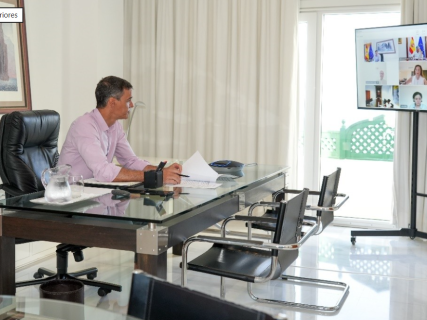
What happens with Pedro Sánchez's legs? The photo from Moncloa that raises doubts about his swimsuit and his flip-flops

The image disseminated by the Government during the president's vacation leaves the lower part of his body poorly defined and has raised questions on social media: is it a photographic effect, a retouch, or simply is it not clear what he is wearing?

4 minutes

Captura de pantalla 2026 08 08 125409

Captura de pantalla 2026 08 08 125409

Add DEMÓCRATA to Google

Ask FREN

Published

Last updated

4 minutes

Most read

There are photographs that tell a story and others that generate a question. The latest image distributed by Moncloa of Pedro Sánchez during his vacation in Lanzarote belongs to the second category.

The president appears at the La Mareta residence, where he spends part of his summer vacation, but there is a detail that has particularly caught attention: the area of the legs appears poorly defined compared to the rest of the image.

And the question has started to circulate: what is Sánchez wearing from the waist down?

Speculations point to two possibilities as simple as they are summery: swimsuit and flip-flops. There are also those who wonder if the image has been retouched to hide the president's footwear or clothing.

But here it is advisable to separate what is seen from what is interpreted.

There is no confirmation from Moncloa that the photograph has been manipulated to hide Sánchez's clothing. Nor has it been publicly explained why the lower part of the image has that appearance.

With the disseminated photograph, it is not possible to determine with certainty whether the president is wearing a swimsuit, shorts, sandals, or flip-flops.

What can be verified is that the image leaves that area with much less definition.

Is Sánchez wearing a swimsuit?

The possibility would not be extraordinary at all.

La Razón reports that Pedro Sánchez has been photographed on previous occasions during his vacation in Lanzarote in beachwear. In fact, there are images published in previous years in which he appears in a green swimsuit by the sea, near La Mareta.

The La Mareta residence, moreover, is located by the coast and has outdoor spaces and access to the sea. The president usually uses this National Heritage site as a vacation destination.

Therefore, if Sánchez were in a swimsuit at the time of the photograph, it would not be an especially striking circumstance.

What has sparked curiosity is that the image distributed by Moncloa does not allow for clear verification.

And the flip-flops?

The same happens with the footwear.

The photograph does not offer enough detail to identify it with certainty. There is, therefore, no basis to assert that Sánchez was wearing flip-flops, although it cannot be ruled out based on the image.

To know if there is a deliberate retouching, one would need to have the original camera file or technical information that would allow for a comparison of the photograph before and after its processing.

Without that material, any claim about a supposed erasure of the legs would be an interpretation.

And that nuance is especially important in an institutional photograph.

Moncloa and the images of the vacations

The photograph also gains interest due to the context.

Sánchez spends his vacation at La Mareta, a residence of National Heritage located in Lanzarote that the presidents of the Government have used at different times.

Presidential vacations always generate attention, but this year the political situation adds another element.

The Government faces a stage marked by the Ceuta crisis, the diplomatic conflict with Italy over border controls, and the pressure from the opposition for several ministers to appear before the Cortes.

In that context, the images of Sánchez during his days of rest have a greater impact than a private photograph of any citizen would have.

And the official distribution of an image also turns the posed shot into material susceptible to public analysis.

A purely photographic issue

The explanation may be much less mysterious than what social media suggests.

Digital photographs undergo different processes from the moment they are taken until they reach the media: resolution reduction, compression, format conversion, cropping, or image adjustments.

A zone located in the background, in shadow, or with movement can lose definition in a particularly visible way.

The official gallery of Moncloa itself publishes photographs of the president in different sizes and formats. (La Moncloa)

That does not prove that the specific image of Sánchez's legs is a consequence of compression.

But it also does not allow us to conclude that there has been a deliberate erasure.

To reach that conclusion, it would be necessary to compare the original file with the distributed photograph.

The precedent of Zapatero

The curiosity about the summer photographs of a president has precedents.

One of the most remembered episodes related to presidential vacations in Lanzarote was that of José Luis Rodríguez Zapatero, who also used the island as a vacation destination.

In 2017, the Unified Association of Civil Guards denounced the conditions in which some agents in charge of his escort served during the former president's vacation: it pointed out the existence of posts without shade and without restrooms, publishes the diariodelanzarote.com)

The episode demonstrates to what extent presidential vacations can end up generating news that goes far beyond the rest of the head of the Executive.

In Sánchez's case, the images of La Mareta have provoked similar debates on different occasions.

In 2021, for example, media outlets published photographs of the president during his vacation in Lanzarote and even questioned the treatment of some images related to his physical appearance. (Moncloa)

The mystery is, for now, in the photograph

The issue of Sánchez's legs may seem anecdotal, but it fits into a known phenomenon: images of presidents during their vacations quickly become political and viral material.

A photograph taken during a citizen's break may go unnoticed. The same image when the president of the Government appears takes on another dimension.

In this case, the interest is concentrated on a very specific detail.

The photograph disseminated by Moncloa shows Sánchez during his vacation, but does not clearly allow distinguishing what he is wearing on the lower part of his body.

From there arise the questions about the swimsuit and the flip-flops.

What cannot be stated, at least with the available data, is that Moncloa has deliberately erased his legs.

There is also no official confirmation that the president was dressed in a certain way.

So, for now, the most rigorous answer is also the simplest: the photograph does not allow knowing. And perhaps that is precisely the reason why poorly defined legs have ended up becoming one of the small photographic mysteries of this political summer.

According to the newspaper La Razón, Sánchez's swimsuit, on the other hand, would not be any novelty: there are already previous images of the president using it in the vicinity of La Mareta. 


More key points, information and questions with FREN

AI-GENERATED CONTENT

What are the functions and powers of the Prime Minister according to the Spanish Constitution?

The Prime Minister, according to the Spanish Constitution, is the body that directs the Government's action and the State's domestic and foreign policy, coordinates the other members of the Executive, and assumes the main political responsibility before the Cortes Generales. Their functions and powers are scattered throughout the Constitution, especially in articles 97, 98, 99, 100, and 112 to 116, and are always exercised within the framework of parliamentary political responsibility.

1. Direction of general policy and Government action (art. 97 CE)

Article 97 establishes that the Government directs domestic and foreign policy, civil and military administration, and the defense of the State, and exercises executive function and regulatory power. Within this collegiate body, the Prime Minister holds the directing function:

  • Guide the general policy of the Government in all areas (domestic, foreign, economic, social, defense, etc.).
  • Set the guidelines for the actions of the different ministries and coordinate their execution.
  • Ensure coherence of governmental action, avoiding contradictions between departments.

Although article 97 refers to the Government as a whole, constitutional practice and later references identify the Prime Minister as the center of that political direction.

2. Composition of the Government, appointment and dismissal (arts. 98, 99 and 100 CE)

Article 98 regulates the basic structure of the Government, composed of the Prime Minister, vice presidents if any, ministers, and other members established by law. Regarding the Prime Minister:

  • They are the head of the Executive within the collegiate body that is the Government.
  • They determine the internal organization of the Government (number of vice presidencies and ministries, distribution of portfolios), according to what is provided by law.

The appointment of the Prime Minister is governed by article 99:

  • After each renewal of the Congress or in cases of Government dismissal, the King proposes a candidate for Prime Minister, after consultation with representatives designated by political groups.
  • That candidate must obtain the confidence of the Congress through an investiture vote (absolute majority in the first vote or simple majority in the second).
  • Once confidence is obtained, the King formally appoints them as Prime Minister.

Article 100 provides that the other members of the Government are appointed and dismissed by the King, at the proposal of the Prime Minister, which grants the latter decisive competence in the appointment and dismissal of ministers and in the reshaping of the Executive.

3. Impulse, coordination and relationship with the King

As head of the Executive, the Prime Minister:

  • Proposes to the King the appointment and dismissal of vice presidents and ministers (art. 100).
  • Directs and coordinates the meetings of the Council of Ministers, setting the agenda and the legislative and regulatory pace.
  • Exercises the Government's political initiative before the Cortes Generales by presenting bills and requesting general policy debates, under the Government's position in the parliamentary system.

Their relationship with the King is also articulated through the figure of the countersignature (art. 64 CE), although this provision does not refer only to the Prime Minister: the acts of the King are countersigned by the Prime Minister and, where appropriate, by the competent ministers, thus assuming political responsibility for those acts.

4. Political responsibility before the Cortes (arts. 112-114 CE)

The Prime Minister is politically accountable before the Congress of Deputies:

  • According to article 112, they can raise the question of confidence on their program or a general policy statement. If confidence is not obtained, the Government must resign.
  • Article 113 provides for the motion of censure, which must be constructive (proposing an alternative candidate for the premiership). If approved, the Prime Minister ceases and the motion's candidate is appointed Prime Minister.
  • Article 114 regulates the effects of denial of confidence and approval of a motion of censure: in both cases, the Government must present its resignation to the King.

5. Dissolution of the Chambers and calling of elections (art. 115 CE)

Article 115 grants the Prime Minister the power to propose the dissolution of the Congress, the Senate, or the Cortes Generales as a whole, which implies calling elections. This decision is made by the King, but only at the proposal of the Prime Minister, under the conditions and temporal limits set by the Constitution (not during a state of emergency nor within certain minimum timeframes).

6. Role in states of alarm, exception and siege (art. 116 CE)

Article 116 regulates states of alarm, exception, and siege as constitutional crisis situations. In all cases, the Government, under the direction of the Prime Minister:

  • Declares the state of alarm by decree, giving immediate notice to the Congress.
  • Requests authorization from the Congress to declare or extend states of exception and siege, under the terms set by the organic law that develops the provision.

In these situations, the Prime Minister directs the Executive's action to manage the crisis, always under the parliamentary control established by article 116 itself.

What practical differences exist between the question of confidence and the motion of censure regarding the Prime Minister? What temporal limits does the Constitution set for the Prime Minister to propose the dissolution of the Cortes Generales? How is the investiture procedure of the Prime Minister detailed in article 99 of the Constitution developed?

What procedures and requirements are necessary to access and use the La Mareta residence as Prime Minister?

La Mareta is not an "à la carte" residence that can be requested through open public procedures, but a State property managed by Patrimonio Nacional and made available to the Prime Minister and foreign leaders by political and organizational decision. The real requirement to use it as a place of rest or work is to hold the office of Prime Minister (or be a State guest) and for the Moncloa Presidency to agree on that use with Patrimonio Nacional and the Interior Ministry. There are no forms, licenses, or public fees for the Prime Minister: maintenance costs and much of the stay expenses are covered by the state budget and are subject to parliamentary control. Physical access to the residence is highly restricted and subject to very strict security protocols, including recent measures such as the confiscation of mobile phones from those who meet there with the Prime Minister.

Nature and official purpose of La Mareta

According to the analysis by the newspaper Demócrata, La Mareta is a residence located in Costa Teguise (Lanzarote), built by King Hussein of Jordan, donated to Juan Carlos I, and later incorporated into Patrimonio Nacional to "receive foreign leaders and serve as an official residence" of the Spanish State. This is explained in the comparative report on European leaders' vacations published by Demócrata in this analysis.

Patrimonio Nacional, according to Law 23/1982, is a public entity dependent on the Presidency of the Government responsible for managing State assets linked to the Crown and high institutional representation. This function is recalled in several recent resolutions, for example in an agreement on Royal Sites published in the BOE (Patrimonio Nacional agreement) and in other agreements such as the one related to the Royal Collections Gallery (BOE resolution).

Decision on use by the Prime Minister

Information from Demócrata shows that the use of La Mareta by Prime Ministers is decided politically, not through a public regulated procedure. Pedro Sánchez has made La Mareta one of his usual vacation destinations, along with Las Marismillas, according to the cited Demócrata analysis. Each summer it is simply announced that the Prime Minister begins his vacation there, as reported in the chronicle of his arrival on August 1, 2026, in this news.

No specific regulation detailing "requirements" or "procedures" for the Prime Minister to use La Mareta has been found in the consulted sources. Everything points to:

  • Material requirement: being Prime Minister (or official State guest).
  • Decision: internal agreement between the Presidency of the Government and Patrimonio Nacional on dates and use of the complex.
  • Management: Patrimonio Nacional is responsible for maintenance; Interior and Defense for transport and security.

This logic is reinforced by the fact that there is no "accommodation invoice" for the Prime Minister: the fixed maintenance cost and part of the variable expenses are charged to public budgets, as Demócrata recalls in the comparative article.

Expense control and contracts related to La Mareta

The use of La Mareta has generated intense parliamentary scrutiny, which helps better understand how its administrative use is structured:

  • In the Congress, Vox asked about the "award by the Government, through Patrimonio Nacional, of two minor contracts to condition the official residence of La Mareta without public tender," according to the initiative accessible in this Congress document.
  • They also questioned the "justification of the deployment of 95 State Security Forces personnel during the Prime Minister's vacations at La Mareta," recorded in this parliamentary question.
  • In the Senate, the Popular Group has requested details of "expenses for food, drink, and cleaning supplies" for La Mareta in 2024 and 2025 (Senate question), as well as invoices from 2020-2023 (invoice request 2020-2023) and 2024-2025 (invoice request 2024-2025), as well as improvement works since 2019 (works at La Mareta).

These initiatives confirm that there is no "usage fee" for the Prime Minister, but a public spending system subject to parliamentary control. The opposition has politically criticized this model, as shown by the PP note that describes the stays as "luxury vacations with all-inclusive regime."

Physical access and security requirements

Another key dimension of the "access requirements" is security. The latest information from Demócrata details that those who access the residence to meet with the Prime Minister must hand over their mobile phones at the entrance, as part of a reinforced security and communications protection device, linked even to the background of the Pegasus case, according to this security information.

The device includes:

  • Access controls with National Police and Civil Guard.
  • Perimeter surveillance and temporary cameras.
  • Navigation restrictions near the residence, as detailed by Demócrata citing Maritime Captaincy in the same news.

During their stay, the Prime Minister maintains institutional activity: for example, videoconference meetings on the Ceuta crisis held from La Mareta, reported in this political chronicle. That is, the residence functions as an operational extension of Moncloa, which justifies comparable security measures.

What is not publicly known

No further information is available in the consulted sources about a detailed and public regulation that sets, for example, formal criteria for a Prime Minister to choose La Mareta over other destinations, limits on family accompaniment, or internal rules for the use of facilities. Everything points to these rules being internal (Patrimonio Nacional, Presidency, Interior) and not published in the BOE or official journals.

In summary, access and use of La Mareta as Prime Minister depends on the status of head of the Executive and internal decisions of the Government and Patrimonio Nacional; the only "visible" requirements externally are the security devices applied to the premises and anyone who must enter it.

What has the Government responded in Congress and the Senate about the exact costs of Sánchez's stays at La Mareta? What differences exist between La Mareta and other Patrimonio Nacional residences like Las Marismillas regarding political use and expense control? What specific criticisms have PP and Vox made about security and police deployment around La Mareta?

Which political parties currently form the Government and how many seats does each have in the Congress of Deputies?

Currently, the Government of Spain is a coalition Government formed by two parties: the Spanish Socialist Workers' Party (PSOE) and the coalition Sumar. In the Congress of Deputies, the most recent information from Demócrata places the PSOE at 121 seats and Sumar at 26 seats, which amounts to 147 deputies out of 350 for the two parties that make up the Executive. The rest of the groups (PP, Vox, and other formations) are in opposition or as external parliamentary allies but are not part of the Government.

Parties that make up the Government

The current Executive is the result of the 2023 investiture agreements and is configured as a left-wing coalition:

  • PSOE: the majority party of the Government, with Pedro Sánchez as Prime Minister. It is the backbone of the Council of Ministers, controlling most of the portfolios.
  • Sumar: minority coalition partner, a grouping of several parties to the left of the PSOE (such as IU, Más Madrid, Comuns, etc.) that holds several portfolios in the Council of Ministers (Labor, Health, Culture, Social Rights, Youth and Childhood, among others), as reported in various political analysis pieces in Demócrata, for example about Sumar's weight in the Government and on social networks (investiture partners thermometer or the ranking on which minister has more digital power, reviewing the 22 Cabinet members, including those from Sumar: digital power ranking of ministers).

Several news items emphasize that it is a PSOE–Sumar coalition Government, with ministers from both "sides" and an internal dynamic of constant negotiation on the legislative agenda, as recalled, for example, in chronicles about the rental decree crisis or tensions over the "social shield" promoted by Sumar (rental decree and new social shield).

Number of seats of each Government party

The latest explicit references from Demócrata quantifying the seats of the Government parties are as follows:

With these elements, and without any mention in later information of new losses or seat changes affecting the Government groups, the most updated parliamentary snapshot from Demócrata is:

  • PSOE: 121 seats in the Congress of Deputies.
  • Sumar: 26 seats in the Congress of Deputies.
  • Total Government (PSOE + Sumar): 147 of the 350 deputies in the Chamber.

Context: why these numbers matter

These figures explain why, as detailed in Demócrata's parliamentary arithmetic analysis, the Government only directly controls 147 seats, while the right-wing opposition (137 from PP, 33 from Vox, and 1 from UPN, a total of 171 seats) sets the "threshold" the Executive must surpass in each vote (legislature analysis). Hence, PSOE and Sumar need to constantly add support from other groups —ERC, EH Bildu, PNV, BNG, Canary Coalition, Podemos, and, when it accompanies, Junts— to pass ordinary laws and, with greater difficulty, organic laws or Budgets, as also highlighted in the piece on the 2026 legislative plan (2026 Annual Regulatory Plan).

In summary, today the Government is formed only by PSOE and Sumar, with 121 and 26 deputies respectively. The rest of the parties that supported Pedro Sánchez's investiture —ERC, Junts, EH Bildu, PNV, BNG, Canary Coalition, and, in some cases, Podemos— are key parliamentary allies but do not form part of the Council of Ministers and, therefore, are not considered Government parties in the strict sense.

How exactly are the Government's 147 seats distributed among the different groups and subparties that make up Sumar? Which parties and how many seats does each of the external parliamentary allies supporting PSOE and Sumar have? How has the number of seats of PSOE and Sumar evolved from the start of the legislature until today due to resignations, group changes, or replacements?

Play

Test your knowledge with FREN!

How much do you know about this topic? Answer the following 3 questions.

Where does Pedro Sánchez spend part of his summer vacation according to the news?

Question 1 of 3

What detail in Pedro Sánchez's photograph has generated doubts and speculations?

Question 2 of 3

What has Moncloa officially stated about the possible manipulation of the photograph?

Question 3 of 3

Hola, soy Fren. ¿Cómo te ayudo?