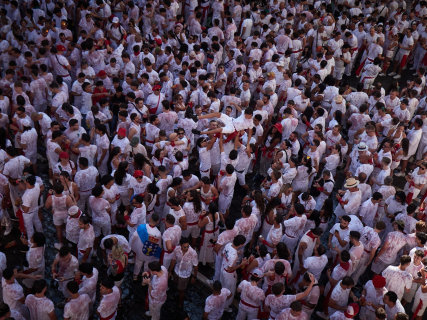
Who launches the San Fermín 2026 Chupinazo: two Navarrese Emergency health workers light the fuse in Pamplona

Clint Jean Louis Fernández and Araceli Sergio Aguilera represent the Sub-directorate of Emergencies of Navarra, chosen by popular vote to open the Sanfermines 2026 from the balcony of the Pamplona City Hall. The citizen election system was implemented in 2016.

3 minutes

EuropaPress 7648606 momentos previos chupinazo san fermin 2026 plaza ayuntamiento julio 2026

EuropaPress 7648606 momentos previos chupinazo san fermin 2026 plaza ayuntamiento julio 2026

Add DEMÓCRATA to Google

Ask FREN

Published

Last updated

3 minutes

Most read

Pamplona opens this Monday, July 6, the Sanfermines 2026 with a Chupinazo of marked health recognition. The fuse of the rocket announcing the festivities will be lit by Clint Jean Louis Fernández and Araceli Sergio Aguilera, representing the Subdirectorate of Emergencies of Navarra, the candidacy chosen by the citizens of Pamplona to inaugurate the festivities from the City Hall balcony.

The event will take place, as tradition dictates, at 12:00 PM from the Pamplona City Hall. Fernández and Sergio will be in charge of uttering the festive formula —“Iruindarrak, pamplonesas, pamploneses, ¡Viva San Fermín! Gora San Fermín!”— before officially starting nine days and 204 hours of festivities.

A tribute to the health device for the bull runs

The choice of the Subdirectorate of Emergencies of Navarra has an evident symbolic weight: to recognize the role of the health teams that work throughout the year and, in a particularly visible way, during the San Fermín bull runs. The candidacy was proposed by the Peña La Escalerica de San Fermín with the aim of making visible the deployment of emergencies and urgent care that is activated during the festivities.

According to the Pamplona City Council, this device includes five mobile ICUs, the health coordination of the 112, and care in out-of-hospital emergency centers, with the aim of guaranteeing an immediate response to any emergency during the Sanfermines.

Jean Louis Fernández has been designated as the institutional representative of the Subdirectorate of Emergencies, which he has directed since 2023, while Araceli Sergio Aguilera, a nurse in the Tafalla mobile ICU, was chosen by internal vote among the active staff of the subdirectorate itself.

How it is chosen who launches the Chupinazo

The current selection system combines an initial screening in the General Board of the Sanfermines and a subsequent citizen vote. The entities that make up the Board present candidacies and, if there are more than five proposals, the Board selects the five that advance to the final phase. Then, a popular vote is opened among these candidacies.

In 2026, the five finalist candidacies were the Navarrese Pelota Federation, the Platform of Women against Sexist Violence, the Subdirectorate of Emergencies of Navarra, the Women researchers of the Navarrese R&D+i System, and the Coral Santiago de la Txantrea.

People over 16 years of age registered in Pamplona can vote. The City Council provides three methods: in-person voting at the Civivox network, telephone voting through 010, and online voting on the municipal website. Only one vote per person is allowed, with identification by DNI.

The winning candidacy: 3,775 votes

The Sub-directorate of Emergencies of Navarra won the popular vote with 3,775 votes, 32.15% of the 11,740 votes cast. In second place was the Platform of Women against Sexist Violence, with 2,857 votes and 24.33%, followed by the Coral Santiago de la Txantrea, with 2,629 votes and 22.39%.

The majority of votes were cast online: 10,157, 86.51% of the total. The Civivox network registered 1,236 in-person votes and 010 collected 347 votes.

Since when has it been chosen by popular vote

The popular voting system to choose the person or entity in charge of launching the Chupinazo was implemented in 2016. That year, the chosen one was Jesús Ilundáin Zaragüeta, “El Tuli”, promoter of the chant before the running of the bulls, who became the first launcher chosen by citizen vote.

Since then, the model has consolidated a participatory formula to decide who lights the fuse of the festivals. However, the City Council itself recalls that there were no Sanfermines in 2020 and 2021 due to the covid-19 pandemic and that popular voting was not applied in the following two editions either.

The participation in 2026 is the third highest since the system was implemented, behind 2025, when 20,045 votes were reached, and 2018, with 12,213.

More key points, information and questions with FREN

AI-GENERATED CONTENT

What is the exact process followed by the General Board of the Sanfermines to select the candidacies before the popular vote?

The selection of candidacies by the General Board of San Fermín (commonly called the General Board of the Sanfermines) is a two-step process: first, the entities of the Board propose candidacies and the Board itself makes an internal screening up to a maximum of five; then, those candidacies go to the popular vote. This scheme is established in the municipal bases and is repeated every year with small calendar adjustments, as can be seen in the 2025 and 2026 calls from the Pamplona City Council. A single “regulation” in the form of an ordinance has not been found publicly, but the official notes describe quite precisely how the Board acts.

1. Who can submit candidacies and within what deadline

According to the bases sent by the City Council to the Board's groups, only the entities that are part of the Board can submit candidacies, not individual citizens nor the candidates themselves. This structure is explained in recent calls from the City Council, for example in the note “Open until May 22, the deadline to submit candidacies for the launch of the Chupinazo 2026” (link).

The process starts with an agreement of the Board itself and the sending of bases by the City Council to the groups, as reflected in this municipal communication and in this announcement of the process start. In 2026, for example:

  • From May 11 to 22: deadline for Board members to submit candidacies, via General Registry or Municipal Tele-Registry (official note).
  • May 27: Board meeting and internal vote to choose up to five finalist candidacies.

2. Requirements and exclusions set in the bases

The municipal bases establish very specific criteria about what can be proposed:

  • Candidacies must be persons or entities that have distinguished themselves by their contribution to the city “in the social, academic, scientific or cultural fields” and aligned with “democratic and coexistence values” (Pamplona City Council).
  • Representatives, entities or groups of a political, union, business or religious nature are excluded. In 2025, for example, the candidacy of BSH workers was rejected by the technical commission precisely for not fitting these criteria (2025 detail).
  • Self-nominations are not accepted, nor candidacies that were proposed in the previous edition; those that did not win must wait at least one year to present again (2026 call).
  • The proposing entity must have the express authorization of the person or entity candidate.

These bases are inserted within the general framework of festive regulations (San Fermín 2026 proclamation, link, and regulations compiled at sanfermines.net), and are framed within the “popular Sanfermines” model described in other municipal communications (Board meetings).

3. How the General Board votes and how the five finalists are chosen

Once the deadline is closed and candidacies that do not meet the bases are filtered out, the General Board meets to review all valid proposals and vote internally on which ones proceed to the popular phase.

The examples from 2025 and 2026 show the specific mechanism:

  • In 2025, 21 entities voted among six accepted candidacies, distributing 5, 4, 3, 2, and 1 point among their five preferred options, with a maximum of five selectable candidacies. The sixth was left out (counting detail).
  • In 2026, the present entities issued 41 valid ballots, each also assigning scores from 1 to 5 to five candidacies; after counting, the five with the most points — including the Subdirectorate of Emergencies of Navarra — proceeded to the popular vote (2026 Board result).

This scheme matches the synthetic description published by the newspaper Demócrata: the Board performs “a first screening” and, “if there are more than five proposals, the Board selects the five that proceed to the final phase,” before opening the citizen vote (Demócrata article).

4. Additional context and other references

The described process is integrated into the festive and participation policy of the Pamplona City Council, alongside other devices on security, equality, or democratic memory collected in notes such as the “Declarations approved in the Presidency Commission of Tuesday, June 23, 2026” (link) or in general guides for safe enjoyment of the festivities (visitnavarra.es).

In the consulted databases, other contents not directly related to the General Board of San Fermín also appear, but which are part of the same Spanish informational and political ecosystem, such as chronicles of the selection of the San Fermín 2026 poster (link), the 2025 Chupinazo candidacies already mentioned (link), or pieces from Demócrata about Navarra and festivities, memory of the 1978 Sanfermines, or about other political and social processes in Navarra and the rest of Spain (example).

What functions and competencies does the Subdirectorate of Emergencies of Navarra have according to the regional health regulations?

The Subdirectorate of Emergencies of Navarra, according to the Statutes of the Navarre Health Service-Osasunbidea approved by Foral Decree 171/2015, of September 3, is the specific body of the Primary Care Management responsible for organizing and coordinating out-of-hospital emergency care and, in particular, vital and time-dependent emergencies throughout the Chartered Community. It depends directly on the Primary Care Management and assumes both the management of the human and material resources involved and the functional coordination of all out-of-hospital emergency devices. Additionally, it participates in the planning of continuous and urgent care in Navarra and represents the Department of Health in technical forums on vital emergencies. Recent Foral budget laws recognize this position as a remunerated senior post, reinforcing its strategic character within the Navarre health organization.

Regulatory framework and organizational fit

The main framework is Foral Decree 171/2015, of September 3, approving the Statutes of the Navarre Health Service‑Osasunbidea. In Title IV (Primary Care Management), article 57 lists the Primary Care management bodies and expressly includes the “Subdirectorate of Emergencies of Navarra and Technical Direction of Vital Emergency Care” as a management body (art. 57.a).5).

Article 61, under the heading “Functions of the Subdirectorate of Emergencies of Navarra and Technical Direction of Vital Emergency Care”, specifies its competencies. Moreover, the Foral General Budget Laws of Navarra recognize this Subdirectorate as a management position with specific remunerations: Foral Law 2/2024 (PGN 2024), Foral Law 19/2024 (PGN 2025), Foral Law 35/2022 (PGN 2023), Foral Law 18/2021 (PGN 2022), as well as earlier ones such as Foral Law 19/2011 (PGN 2012), where a Subdirectorate of Out-of-Hospital Emergencies is already mentioned.

Dependency and material scope

According to art. 61.1 of Foral Decree 171/2015, the Subdirectorate of Emergencies of Navarra:

– Acts under the direct dependency of the Primary Care Management.
– Aims to integrate and manage the human and material resources destined to out-of-hospital emergency care for the citizens of Navarra.

Art. 61.2 specifies that this Subdirectorate organically oversees the personnel of the out-of-hospital emergency services (including the Pamplona area and the regional scope such as Tafalla), the healthcare personnel of the 112 emergency coordination center, and the healthcare personnel of the advanced life support ambulances, among other devices. It is, therefore, the hierarchical node grouping the professional teams involved in out-of-hospital emergencies.

Coordination functions of out-of-hospital emergencies

Art. 61 assigns the Subdirectorate of Emergencies a central role in the functional coordination of all out-of-hospital emergency resources. Among its functions (sections 3 and 4) are:

– The functional coordination of out-of-hospital emergency services in the Tudela and Estella Areas.
– Coordination of the advanced life support ambulances in Tudela and Estella.
– Coordination of the medicalized helicopter of the Government of Navarra.
– Coordination of all basic life support ambulances in Navarra, both public and contracted.

All this configures an operational management competence of the entire out-of-hospital urgent transport and care system, ensuring homogeneity of criteria, circuits, and protocols among health areas and between own and contracted resources.

Time-dependent emergencies and external coordination

Art. 61.4 assigns the Subdirectorate of Emergencies the functional coordination of care for time-dependent emergencies, both over future regional emergency services to be organized and over Primary Care Teams and rural emergency services when acting in such emergencies. This makes it the technical reference for pathologies such as infarction, stroke, or cardiorespiratory arrest, where response times are critical.

Additionally, art. 61.5 establishes its participation in the planning of continuous and urgent care in Navarra as determined by the Department of Health. Art. 61.6 entrusts it with the proposal of improvement measures for care in time-dependent emergencies, including actions with bodies and groups outside the Department of Health itself, such as:

– Security forces, lifeguards, and instructors.
– Educators and teachers of public and chartered centers.
– Media.

Finally, art. 61.7 attributes to it the representation of the Department of Health in technical forums on vital emergencies, reinforcing its role as a technical reference body in emergencies and urgencies at the inter-institutional level.

Other consulted regulatory references

Although they do not define additional functions of this Subdirectorate, they are part of the general health regulatory context or have been consulted in the search: Foral Law 20/2017, Foral Law 24/2016, Foral Law 4/2002, Royal Decree 1030/2006, Royal Decree 1397/2007, Order SND/454/2025, as well as other state-level norms and resolutions such as Royal Decree 1775/1985, Royal Decree 1423/1985, Royal Decree 1209/1985, Royal Decree 565/1985, Resolution of December 28, 1984, Resolution of April 30, 2025 (MUFACE), Resolution of January 5, 2022 (MUGEJU), Foral Law 29/2012 (modifies FL 19/2011), Royal Decree 1506/2012, Order SCO/710/2004, Order of March 30, 2000, Order of June 2, 1998, Order of January 18, 1996, Royal Decree 63/1995, Order SCO/710/2004, Royal Decree 1798/2008, Royal Decree 1688/2007, Resolution of July 7, 2004, Order ARM/1173/2010 and the erratum of Royal Decree-law 5/2023.

What were the results of the most recent municipal elections in Pamplona and which parties currently make up the City Council?

The most recent municipal elections in Pamplona were held on May 28, 2023, and gave victory in votes and councilors to UPN, but the City Council is currently presided over by Joseba Asiron, from EH Bildu, following a vote of no confidence against the UPN mayor. The municipal plenary remains formed by the 27 councilors elected in 2023, distributed among UPN, EH Bildu, PSN-PSOE, PP, Geroa Bai, and Contigo-Zurekin. The current municipal government is led by EH Bildu and supported by Geroa Bai and Contigo-Zurekin, with political and budgetary agreements with the PSN.

Results of the 2023 municipal elections in Pamplona

Official data from May 28, 2023, for the Pamplona City Council show the following distribution of 27 councilors and votes:

  • Unión del Pueblo Navarro (UPN): 9 councilors, 30,691 votes, 30.30% (RTVE, Batzarre).
  • EH Bildu: 8 councilors, 27,752 votes, 27.40% (RTVE).
  • PSN-PSOE: 5 councilors, 15,850 votes, 15.64%.
  • Partido Popular (PP): 2 councilors, 8,526 votes, 8.41%.
  • Geroa Bai (GBAI): 2 councilors, 7,654 votes, 7.55%.
  • Contigo-Zurekin: 1 councilor, 5,228 votes, 5.16%.
  • Other candidacies (Vox, PUM+J, Cs) did not obtain representation (RTVE).

Participation was 66.61% according to the breakdown collected by various official and media sources (RTVE, laSexta, Pamplona City Council).

These results made UPN the most voted list, closely followed by EH Bildu, with a fragmented progressive bloc among PSN, Geroa Bai, and Contigo-Zurekin. Various local and national media followed that night the count and the dispute for the Mayor's office (Diario de Navarra, El País, EiTB).

From Ibarrola's investiture to the vote of no confidence

In the constitutive session of the corporation, the UPN candidate, Cristina Ibarrola, was invested mayor as she headed the most voted list. Subsequently, as the newspaper Demócrata recalls, “at the start of the current legislature, Ibarrola was invested mayor of Pamplona by UPN, as she was the head of the most voted list […] However, barely half a year after assuming the Mayor's office, EH Bildu, PSN, Geroa Bai, and Contigo-Zurekin agreed on a vote of no confidence that removed her from office” (Demócrata).

That vote of no confidence, presented at the end of 2023, gave the Mayor's office to Joseba Asiron (EH Bildu). Since then, both official notes from the City Council about budgets and municipal organization and the central Government's own agenda refer to him as mayor. In October 2025, a note about the 2026 accounts explicitly mentions “the mayor, Joseba Asiron Saez” along with his team (Pamplona City Council), and in June 2024 Minister Ernest Urtasun visited “the Pamplona City Council (Navarra)” and held “a meeting with the mayor, Joseba Asiron Sáez” (La Moncloa).

Current composition of the City Council and governing majority

The composition in councilors has not changed since May 28, 2023: there are still 27 councilors with the same party distribution. What changes is the political majority supporting the Mayor's office. The current municipal government is structured around:

  • EH Bildu, which holds the Mayor's office with Joseba Asiron and the main positions of the local executive. Municipal notes place several of its councilors as deputy mayors and area heads (Pamplona City Council, Pamplona City Council).
  • Geroa Bai and Contigo-Zurekin, with councilors in the government team (for example, the Economic Promotion or Social Action councilorship) as detailed in the same official notes.
  • PSN, which does not enter the Governing Board but signs budget agreements for the legislature with EH Bildu, Geroa Bai, and Contigo-Zurekin. In November 2025, the four groups jointly signed the third budget agreement, “which ratifies the content of the political agreement that caused the vote of no confidence and the change of municipal government in December 2023” (Pamplona City Council).

In opposition are mainly UPN (with Cristina Ibarrola as municipal spokesperson, according to Demócrata) and the PP, whose spokesperson in the council, Carlos García Adanero, has repeatedly criticized the PSN's dependence on EH Bildu in city agreements (Demócrata). Vox has no representation in the City Council.

In summary, the results of May 28, 2023, gave quantitative primacy to UPN, but the subsequent sum of EH Bildu, PSN, Geroa Bai, and Contigo-Zurekin reconfigured the majority and placed Joseba Asiron in the Mayor's office, a majority that has been consolidating in plenary votes and budget agreements up to 2026 (Pamplona City Council, Demócrata).

Which parties exactly supported the vote of no confidence that made Joseba Asiron mayor and on what date was it voted? How is the municipal government of Pamplona internally distributed (councilorships and deputy mayorships) among EH Bildu, Geroa Bai, and Contigo-Zurekin? What budget agreements have been signed in this legislature in Pamplona and what key measures have they included?

Play

Test your knowledge with FREN!

How much do you know about this topic? Answer the following 3 questions.

Which entity won the popular vote to launch the San Fermín 2026 Chupinazo?

Question 1 of 3

How many votes did the winning candidacy receive in the 2026 popular vote?

Question 2 of 3

Since what year has the popular voting system been used to choose who launches the San Fermín Chupinazo?

Question 3 of 3

Hola, soy Fren. ¿Cómo te ayudo?