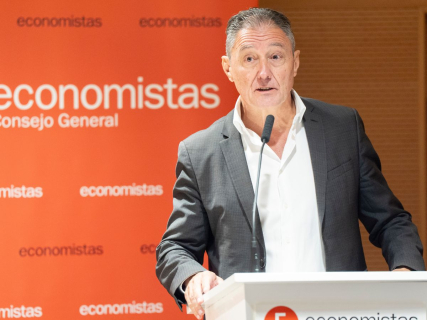

For many, Spain could become the great European hub for textile recycling. José Monzonís, general director of the Textile and Fashion Observatory, does not deny it, although he makes it clear that there is still a long way to go: “Our country still has to make an immense effort in selective collection, in its sorting facilities - for reuse or recycling - and in the treatment of these waste materials, prior to their recycling”.
In this interview with Demócrata, he sets homework for Spain and Europe and warns, without mincing words, of the need to strengthen controls on textile imports. He recognizes that respect for textile garments has been lost and that it is necessary to recover it: “There are fewer and fewer respectable garments in our markets”.
Question: What should Europe improve to face the challenges of recycling in all its phases, including the destination of the resulting fibers?
Response: Textile recycling is an immense challenge for the entire continent due to the sequence of norms, directives, and regulations on the sector that influence each other.
For example, future delegated acts on ecodesign for garments will most likely include obligations on recycled fiber content in textile products marketed in Europe. And, although the most foreseeable scenario is that fibers from different origins - including geographical ones - will be admitted, it is very likely that rates for European SCRAPs will be modulated by prioritizing European post-consumer recycling. Because, without driving demand for recycled fibers from that European post-consumer, everything could remain a house of cards.
So they must marry intelligently some rules with others to promote circularity both from the supply side - through, for example, EPR obligations on brands - and from the demand side - through incentives in taxation, eco-modulation and green public procurement - to incorporate that European post-consumer recycling into Industry.
Q: And what would need to be done in Spain?
R: There is also high uncertainty about which recycling technologies will ultimately succeed in the market. Therefore, financiers are approaching some large investments - I would say, between 100 to 200 million euros - with some caution. And, furthermore, these can be located in one country or another, processing waste from neighboring countries.
In that scenario, it is important that in Spain we try to reasonably reduce the payback period of these first projects through subsidies, that the national regulatory framework for the development of RAP allows SCRAPs to sign long-term waste supply agreements with these projects, and that we enable financing packages with sufficiently long grace periods for their investors to face these current uncertainties.
The bad news is that there is a lot left to do until we go through learning curves and achieve adequate economies of scale. The good news is that all of Europe faces this same scenario, and, therefore, we can position ourselves.
Q: In an interview with Enric Carrera, he commented that Spain lacks infrastructure for textile recycling, do you agree?
R: Our country still needs to make an immense effort in selective collection, in its sorting facilities - for reuse or recycling - and in the treatment of these waste materials in a way prior to their recycling. Together with RE-VISTE, we have initiated a study to evaluate the projects, investment, and cadence necessary to achieve a reasonable objective for the selective management of these textile waste materials over ten years. We expect to have it by the end of this year.
And, as for recycling plants, our manufacturing industry has a lot of experience in mechanically recycling post-industrial textile waste (mainly from cotton-rich blends). In this we are European leaders, we are expanding -within and outside Europe- and it is a good opportunity. In turn, we have manufacturers of this machinery who are international benchmarks.
Q: Regarding the recycling of those post-consumer waste?
The step being taken now is how to recycle post-consumer waste and, among these, multi-composition fabrics -with two or more fibers- through, for example, chemical processes to obtain fibers with virgin or almost virgin qualities. In this field, we must highlight, on the one hand, our excellent textile technology and research centers and, on the other, that the Spanish fashion sector has a great capacity for international attraction of new projects. We are seeing this. The challenge is to build a robust circular ecosystem from our strengths with humility, prudence, and ambition.
Q: ‘Nearshoring’ is being applied to production, how can it also be applied to recycling (and by recycling I mean all its phases, including the final destination of products)?
The European textile industry imports about 80% of its fibers from Asia; therefore, recycling in Europe brings us resilience. For decades we have witnessed a wide delocalization towards Asia of the Western upstream industry. And not only textile but in multiple sectors.
We must recycle in Europe and we must seek the best formulas so that those resulting raw materials also feed - and mainly - European value chains. We should try to "appropriate" most of the added value from those waste materials in their recycling processes with objectives of resilience, competitiveness, and reindustrialization. But, to do so, it is also necessary that we face some challenges. And, among others, administrative simplification, energy infrastructure, and energy costs.
Q: What do you mean by European value chains?
A: Well, to succeed in this European circularity, we must boost proximity production much more. It is also the moment; since we know that global supply chains are being reconfigured to some extent. Since COVID we have learned that companies, as well as countries, must manage their risks differently. Efficiency is also giving way to resilience and, where applicable, to strategic security.
For example, the textile ecosystem is related to other strategic ecosystems for Europe in infrastructures ("geotextiles"); agri-food; health, defense and protection (PPE); or automotive, aeronautics, navigation and space, to name but a few examples. Hence, the European Commission included textiles as one of the 14 strategic ecosystems in 2021 (after COVID).
But the local manufacturing industry cannot survive without also serving the more conventional textile sectors such as fashion, decoration and home products that require geographically distributed supply chains.
Q: Where should we tend then?
Let's take an example: in recent data from the ECA - European Cotton Association - 25% of these high-quality fibers were manufactured in Europe - assuming only 40% of their recent needs - while the remaining 75% was exported, not only to the nearby Mediterranean basin, but also to Southeast Asia, from where a portion returns transformed.
The long-term vision on which we should build European circularity is to control the production of secondary raw materials in Europe, strengthen local industry on circularity and technology, and bet more on proximity with a greater boost to shorter, more resilient, and sustainable value chains.
Large Western fashion brands are gradually shifting some of their production centers to locations close to their markets. This gives them agility, flexibility, and greater reliability. To this is added -logically- their smaller carbon footprint. Something increasingly introduced into the European "DNA".
Now, for example, we seek to also enhance other native fibers such as wool which, in Spain, lost quality due to ovine crossbreeding.
Q: How to bet on it?
R: Some time ago I heard that the European textile manufacturing industry will be innovative, technological and, if applicable, multi-localised - close to its served markets - or it simply will not exist. But more than 95% of this industry are SMEs. Therefore, the challenge is to make them grow. For this, a framework must be generated that facilitates their innovation, local competitiveness and reinvestment of profits. In three words: curiosity, commitment and trust.
So we should assume a great commitment to this industry as a key to resilience and, where appropriate, strategic autonomy. And promote its transformation with circularity, new technologies - through AI, digitalization and automation & robotization - and productive capacities. It is perhaps possible that, for example, progress in automated garment manufacturing may pave part of the way for us.
In another interview for the Observatory, Christel Delberghe commented that Europe was facing "a massive influx of products that do not comply with regulations". Translating that statement to recycling, how can we get the low cost companies from distant countries to commit to recycling?
R: It is not just about these agents committing to recycling. Beyond this, the president of EURATEX, Mario Jorge Machado, stated a few days ago that the weekly closure of factories is dismantling strategic ecosystems for defense, health, and mobility on the continent, after three consecutive years of negative production, turnover, and employment figures, and suffocated by energy costs, regulatory burdens, and competition from Asian platforms.
We have been demanding greater control over textile imports for years. We now ask that the same RAP obligations be required of any importer and, also, digital platform that acts as such in practice. And we hope that the future European Customs Authority will promote strict border control of imports. Any textile garment marketed in Europe will also have to comply with certain ecodesign requirements. And it will have to come accompanied by a digital product passport that, we hope, will contribute decisively to this supervisory task. We have a lot at stake.
Q: Do you dare to paint a scene?
R: We democratize fashion. Others are vulgarizing it. Like that. Nowadays, the textile garment is not respected enough. We have to do it again. But, at the same time, there are fewer and fewer respectable garments in our markets. And, of course, this will impact future European circular textile ecosystems.
But, beyond this, we must understand that China competes for the dominance of global value chains. And that platforms like SHEIN or TEMU -beyond how questionable their current products may be in design, safety, manufacturing, and sustainability- are initial pilots of something much more strategic: to consolidate the dominance of Chinese ecosystems over fashion from raw material production to the final consumer. In other words, after a deep learning process in manufacturing, technology, markets, and design, now it's time to disintermediate Western brands as well. And these B2C models take advantage of loopholes in WTO trade rules prior to this last great technological leap.
Spanish brands are an international benchmark in inspiration, accessibility, affordability, diligent respect, and, increasingly, sustainability. But they are not exempt from that existential threat, and that could mean hundreds of thousands of additional jobs at stake across our continent.
As José Luis Nueno, professor at IESE, states, we will surely see new players following this model.
Q: The European Commission considers China a cooperative partner and, at the same time, a systemic rival....
R: China is today a boiling pressure cooker. Overproduction, technological development, cutthroat internal competition, and often almost unlimited financing generate an atmosphere of extremely high pressure. And its escape valve is the enormous capillarity of its exports.
Yes, before, competing for that domain of global value chains could be a strategic decision as a country, now it is a necessity. And that can only mean one thing for Europe: asymmetry. From China we must copy, replicate and improve, that is, learn from its successes and, where we can, advance disruptively. But we cannot continue importing vulnerabilities.
Q: What differentiates Spain from other countries in the textile sector, making it seen as the potential recycling hub in Europe? Perhaps that the industry has not been relocated as much as in other places?
R: Our manufacturing industry, the scientific-technological knowledge we have been accumulating and, of course, the strong international push of our fashion brands. We have already discussed it. But, in addition, our geographical position plays an important role. If our identity is in Europe and our vocation is America and, although to a lesser extent, the Indo-Pacific, our mission is in the Mediterranean and, therefore, in the African Continent with which we share borders.
If textile consumption has shifted towards Southeast Asia in this first third of the 21st century, we cannot forget that Africa's rapid population growth will make it the second most populous continent in the world by the middle of this century.