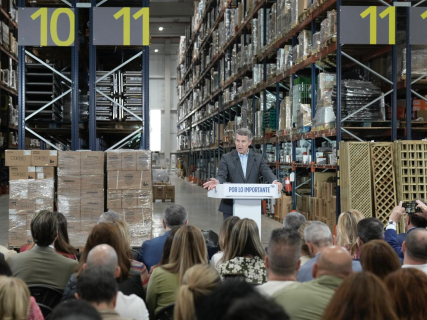

The president of the People's Party, Alberto Núñez Feijóo, took advantage this week of a visit to facilities of Comafe, the Madrid cooperative of hardware stores located in Getafe, to present a decalogue of urgent actions designed to address the current deficit in Spanish infrastructure.
Diagnosis of a system in crisis
With the support, information, and study of specialists in quality, supervision, and technicians in roads, railway network, water facilities, ports, and airports, among other sectors, Feijóo began by asking how it is possible that we collect taxes like a Nordic country and manage like a third-world country.
The popular leader made this statement based on a previous diagnosis, emphasizing that "we are in one of the worst moments of the 47 years of democracy," for which he has taken into account events such as the blackout of April 28 of last year, the persistent delays on the railway network, the cuts and suspensions of this same network, the poor condition of the roads, the lack of an electrical grid to approve newly built homes —which cannot be delivered due to lack of electricity— or the state of our dams, of which, according to the Association of Civil Engineers, more than 50% require critical maintenance for safety.
Feijóo assured that these are not abstract data, but facts that show "very serious shortcomings and continued failures, which occur in everyday moments". Moments that affect the young person who has to use Cercanías to go to study; the professional who travels by AVE and responds to a work schedule; or the driver who uses their vehicle and checks how the lack of road maintenance ends up harming their business.
The PP's ten proposals
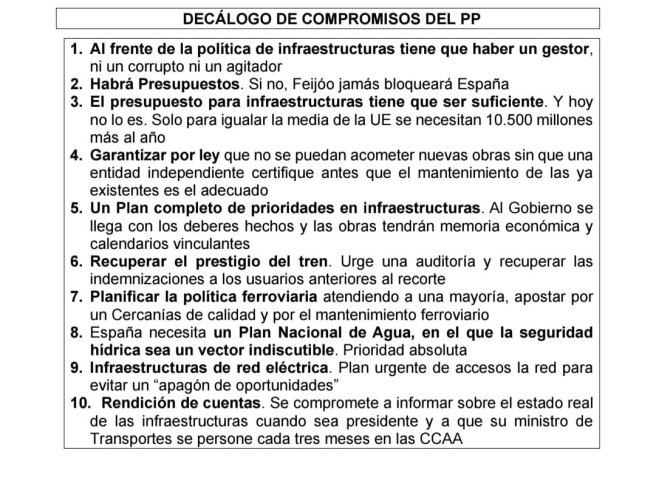
At this point, and as an alternative to the current infrastructure policy of the Government of Pedro Sánchez, the leader of the Popular Party commits to undertaking ten major actions, to which Demócrata has had access.
Measures that include appointing an independent infrastructure manager surrounded by high-level technicians, not second-tier politicians; for General Budgets to design a national plan; for allocating a larger budgetary volume to infrastructure investment items; for the creation of an independent unit to certify the maintenance status of these. Likewise, also for the restoration of the train's prestige, audits, concrete plans, and execution schedules; a national water plan, new electricity grid infrastructures, and, finally, accountability before Parliament and the autonomous communities.
For Núñez Feijóo, it is of extraordinary importance that the manager of Spanish public infrastructures (1) is not “neither a nightclub bouncer nor an absentee escort in Adif”.
“We need —he said— more ministers who do not dedicate themselves to insulting on social networks and who spend more time managing transport networks”. The president of the PP resorted to the announcement by minister Óscar Puente, who assured that we were in the best historical moment for the AVE and that it would soon reach 350 km/h, to contrast it with the tragic accident in Adamuz and Barcelona, as well as with the 1,000 limitations on the railway network and 50% more derailments since 2018, without any contribution of risk analysis for the liberalization of the train with the arrival of new private companies.
Criticism of budget management
He added, in this regard, that what is unacceptable is that the Ministry of Transport has closed the exercise of Next Generation funds, in 2025, with 60% of European aid unexecuted.
Feijóo maintains (2) that, without General Budgets, it is impossible to make a country project, because, otherwise —he maintains—, it is managed with patches and improvisations. Furthermore —he indicated—, (3) a sufficient budget is necessary, since, at the moment, Spain is, according to Eurostat, the third country with the lowest public investment. Hence, it is a priority to invest about 10 billion euros more per year to match the EU average.
In fourth place, the top leader of the PP commits to the creation of an independent entity that guarantees by law that no new works can be undertaken without this body first certifying that the maintenance of existing infrastructure is adequate.
In fifth place, the popular infrastructure program comprises a complete plan of priorities, listening to the autonomous communities and integrating economic reports and binding calendars into its development. "It cannot happen," he stressed, "like the Extremadura train, which has not arrived for a decade and never arrives."
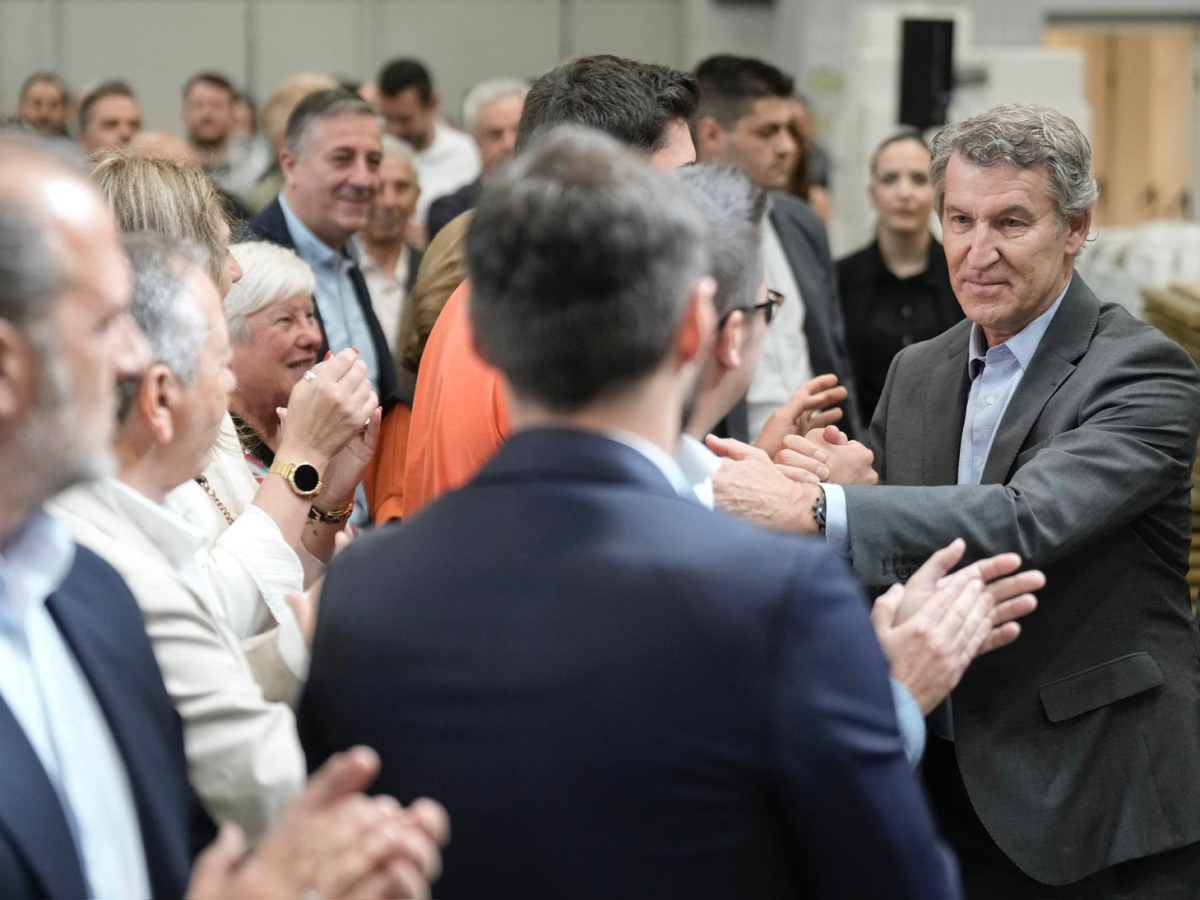
The focus on the railway and water
For the sixth point of the plan, the PP wants to recover the prestige of the train in Spain, given that, since February of this year, and as a consequence of the Adamuz accident, the AVE has lost 30% of its users. That is why an audit and the recovery of compensation for late arrivals are urgently needed, a measure that the Sánchez Executive suspended.
Planning railway policy and influencing the maintenance of Cercanías —with 1.5 million passengers a day; in Madrid alone, 13 million euros have not been invested, with 240% more incidents since 2019— are key actions —Feijóo pointed out— "to reverse the fact that Spain is, as Eurostat also points out, the third country in the EU with the least railway investment".
The eighth point of the decalogue bets on unseen infrastructure, such as water supply. “Between 20% and 25% of water is lost in Spain —affirms Feijóo—. Water is not recycled. Treatment plants do not work. And that is why —he defends— a National Water Plan is needed, to, among other reasons, increase water security and not boast so much "about being the champion of climate change, while there is a lack of water to tackle desertification”.
"In Spain there is water, but it must be managed —notes the president of the Popular Party— to achieve territorial balance, for families and industries, and in pursuit of good supply and maintenance".
Energy, housing, and accountability
The electricity grid infrastructures, with urgency of access to the grid to avoid a “blackout of opportunities”, constitute the ninth point of the decalogue, with the objective that, "Spain, being the fourth economy in the European Union -stresses the PP-, is not a country where industrial projects cannot be developed due to a lack of sufficient electricity grid".
“It is the case of thousands of newly finished homes —Alberto Núñez Feijóo recounted— that cannot be delivered due to lack of power. And there it is urgent to prioritize new access points”, he pointed out.
Finally, and to close this decalogue, the PP praises accountability. At this point, the opposition leader commits to giving explanations in the Congress of Deputies to report on the real state of infrastructures in Spain, with concrete data on the railway network, Cercanías, the AVE, roads, airports and the electricity grid, as well as with informative meetings every three months with the autonomous communities to report on the territorialized execution schedules.
In their opinion, the best operational framework for the development of this decalogue must be accompanied by an attractive and project-driving administration, with concrete measures such as "the expansion of depreciation freedom to favor the investments that companies need; the expansion, likewise, of R&D&I deductions or, the reform of the Law on Contracts with two objectives: less bureaucracy for contracting and more oversight to prevent cases of corruption".

The experts' analysis
Before the presentation of the PP's ten-point commitment, the deputy secretary of Finance, Housing and Infrastructure, Juan Bravo Baena, gave way to a panel of experts in which a diagnosis was made, from various fields, of the real situation of public infrastructure assets.
Starting from a BBVA report, which reveals that infrastructure investments have fallen in Spain by 38% since 2019, the lowest since 1995, the panel had the knowledge of Enrique García López (director of the Technical Department of OCU); Salvador García-Ayllón (architect and civil engineer, doctor in urbanism and infrastructure planning from the Polytechnic University of Valencia); Jacobo Díaz Pineda (president of the Spanish Road Association); Carolina Herrero (manager of the Association of Air Lines, ALA) and María Dolores Asensi (secretary general and director of the Spanish Association of Testing, Inspection and Certification Companies and member of the board of the Madrid employers' association CEIM).
Once the different diagnoses were made, all the speakers agreed on the urgent need to bet on the maintenance and investment in infrastructure.
The deadlines of the Madrid-Málaga AVE
This Thursday, the Junta de Andalucía reproached the Minister of Transport, Óscar Puente, for his management of the railway network, contrasting his actions on the road network after the passage of the storm train with the minister's management, highlighting that the Andalusian institution has reopened 43 roads and has mobilized 283 million euros in emergency works compared to the delay in the recovery of railway connections such as Málaga-Madrid.
Yesterday, the Minister of Transport, Óscar Puente, confirmed that the AVE connection to Malaga will be operational on April 30.
Meanwhile, sources from the Andalusian Executive pointed out that, while the ministry has announced the reopening of said connection "in three different phases", the Junta has acted from the first moment on the ground with a large deployment of resources. In this regard, they have defended that the Government of Juanma Moreno has managed to restore traffic on dozens of regional roads and enable alternative routes on those that still show damage.
Likewise, they have underlined that currently "there are no circulation problems" on the Board's road network, in contrast to the situation of rail transport.