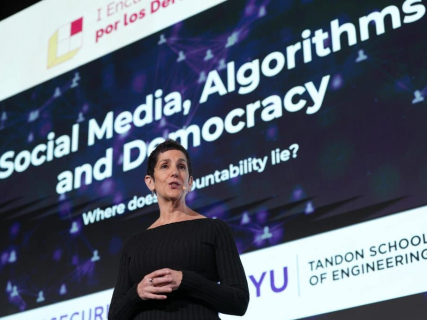

The technological narrative presents digital tools as automatic drivers of societal improvement. For them to truly be so, their existence must be accompanied by a demand for responsibility and regulation from the companies that promote them. This reflection, developed by technology policy expert and former Facebook executive Yael Eisenstat, could summarize the core of the message launched at the I International Meeting for Digital Rights, held in Barcelona on May 13 and 14.
The event, promoted by the Government of Spain and Mobile World Capital Barcelona within the framework of the Digital Rights Observatory, brought together institutional leaders, international experts, academics, and civil society representatives to address the main challenges of the digital environment.
During the meeting, discussions were held on privacy, data protection, artificial intelligence regulation, algorithmic transparency, cybersecurity, disinformation, and the protection of vulnerable groups, with special attention to children and youth in digital environments.
The event served to present the first major survey on social perception of digital rights in Spain, a study that depicts a scenario of citizen concern about the risks of the internet and a clear demand for greater legal and regulatory protection.
Among the participating voices were international specialists such as Yael Eisenstat, Cory Doctorow, Anu Bradford, Frances Haugen, Carissa Véliz, and Carl Öhman, in a meeting that sought to open the digital debate beyond specialized technological environments and bring it closer to the general public.
Spain claims its role in digital rights
The President of the Government, Pedro Sánchez, participated in the meeting with a recorded message in which he defended the need to ensure that citizens' rights are as solid in the digital environment as they are in the physical one, in a context where, as he warned, trust has been profoundly transformed and access to truthful reality is at stake.
Sánchez also claimed Spain's role in this area through initiatives such as the Charter of Digital Rights or the Digital Rights Observatory, and called for citizen participation by recalling the lack of existing information about technologies already present in everyday life.
The Secretary of State for Digitalization and Artificial Intelligence, María González Veracruz; the Minister of Economy and Finance of the Generalitat, Alícia Romero; and the Deputy Mayor of the Barcelona City Council Jordi Valls, also participated in the institutional opening, all of whom agreed on highlighting the growing importance of digitalization in society and the need to guarantee legal security, training, and trust in this new scenario.
Citizenship asks for more digital protection
One of the central moments of the meeting was the presentation of the Survey on social perception of digital rights in Spain, prepared by Fundación “la Caixa”, Red.es and Fundación Hermes, in collaboration with the Universitat de Barcelona.
The study reflects a broad citizen consensus on the need to strengthen legal protection in areas such as privacy and data protection, harassment and hate messages on digital platforms, the deletion of personal information on the internet, or affordable access to the network. It also shows majority support for the existence of non-discriminatory algorithms and human review of automated decisions.

The survey also focuses on the concern about child protection. Practically all respondents consider that minors are little or not at all safe in the digital environment.
The report also reflects concern about disinformation, fraud, identity theft, or harassment on the internet, as well as a widespread perception that large technology companies concentrate too much economic power and too much personal information.
Algorithms, social networks and disinformation
Precisely on this behavior of large technology companies was the presentation by the expert in technology policies and former Facebook executive Yael Eisenstat, who focused her intervention on the impact of algorithms and social networks on democracy, security, and social well-being.
Eisenstat maintained that digital platforms condition which messages are amplified and which are relegated, favoring the dissemination of emotional, sensationalist content, disinformation, and extremist discourses.
She also addressed the development of artificial intelligence and questioned the technological narrative that presents these tools as an automatic improvement for society, defending the need to demand responsibility and regulation from the companies that promote these services.
The expert demanded greater transparency regarding the functioning of algorithms and warned that the platforms themselves are aware of the negative effects they generate, especially on minors.
The focus on childhood and the regulation of the digital environment
In the search for that difficult balance between exploiting digital advances, while curbing their most harmful effects, obviously, minors must be protagonists. To them referred during his intervention the Secretary of State for Youth and Childhood, Rubén Pérez Correa, who defended the need to maintain a constant dialogue with the technological sector to promote tools that protect the digital rights of children and adolescents.
Pérez Correa warned of the importance of clearly defining these rights and of establishing effective protection mechanisms, insisting that regulating digital spaces does not imply limiting innovation or critical thinking.
In this I International Meeting for Digital Rights also participated the activist and writer Cory Doctorow, who analyzed the functioning of large digital platforms and defended a more open and transparent internet, or the professor at the Columbia Law School Anu Bradford, who addressed the regulatory role of the European Union in the global technological scenario.