
The meeting has addressed the astronomical foundations of these phenomena, the historical expeditions to observe them, and the scientific and logistical challenges in view of the upcoming eclipses, highlighting the role of telecommunications engineering
Eclipses are astronomical phenomena that have sparked fascination for centuries, but they also represent unique opportunities for scientific research and technological development. Observing them requires planning, specialized knowledge, and technical means capable of recording and analyzing what happens before, during, and after the phenomenon. All these issues have been addressed in the session 'Eclipses, between awe and discovery: the role of technology and of the telecommunications engineer', organized by the Asociación Española de Ingenieros de Telecomunicación de Madrid (AEIT-Madrid).
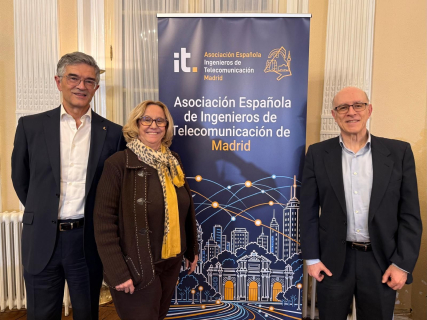
The meeting, presented by Inmaculada Sánchez Ramos, president of AEIT-Madrid, has featured the participation of José Prieto Gallego, a telecommunications engineer and president of the Agrupación Astronómica de Madrid (AAM); and Luis Camarena Checa, board member of the Association. Throughout the session, different types of eclipses, the circumstances under which they occur, and the particularities that make each one an event of special interest for the scientific community have been discussed.
During the opening, Inmaculada Sánchez Ramos highlighted the relationship between astronomy and telecommunications engineering, two fields in which technology plays a fundamental role. In this regard, she stated that "telecommunications engineering has a very broad field of application and astronomy is a good example of how our knowledge and technological capabilities contribute to the advancement of other scientific disciplines".
From historical expeditions to the upcoming eclipses in Spain
One of the blocks of the session was dedicated to reviewing some of the scientific expeditions that, throughout history, have traveled to different parts of the world to observe eclipses. These campaigns have made it possible to study phenomena that cannot be analyzed in the same way under usual conditions and have contributed to expanding knowledge about the sun and its behavior.
José Prieto Gallego explained the particular features of these astronomical events and the necessary conditions for their observation, as well as the different phases that take place during an eclipse. The session also put the focus on the opportunity that the succession of eclipses planned for the coming years represents for Spain, with special attention to the total eclipse of 2027.
"Eclipses are much more than a visual spectacle. They are scientific opportunities that require preparation, rigorous observation, and collaboration between different disciplines. Each phenomenon offers specific conditions that researchers can take advantage of to advance astronomical knowledge," Prieto Gallego explained.
Science, planning, and technology in the face of an exceptional event
The preparation of the observations was another of the central topics of the meeting. The organization of expeditions and associated scientific projects for eclipses involves significant logistical challenges: from choosing the sites and transporting the teams to the availability of the instruments needed and the coordination of the participating professionals.
Likewise, the scientific projects linked to these phenomena and the possibilities they offer for obtaining information of particular value for astronomical research were addressed. Prior planning and the deployment of technical resources are decisive for taking advantage of observation windows, especially when dealing with phenomena of limited duration that require very specific conditions.
Telecommunications engineer, an ally of astronomical research
The event concluded by addressing the relationship between astronomy and telecommunications engineering and the contribution of these professionals to scientific research, through technologies such as communication systems, data processing, and instrumentation.
In this sense, Luis Camarena Checa highlighted the multidisciplinary nature of the profession and its possibilities for application in fields such as astronomy. The meeting ended with a question-and-answer session in which attendees could raise their doubts and share impressions with the speakers.
With this initiative, AEIT-Madrid continues to promote outreach spaces that bring telecommunications engineering closer to different scientific and technological fields.
About the Spanish Association of Telecommunications Engineers of Madrid (AEIT-Madrid)
The Delegation in Madrid of the Spanish Association of Telecommunications Engineers (AEIT-Madrid) was established in 2009 by mandate of the General Assembly of the Spanish Association of Telecommunications Engineers (AEIT), with the aim of completing its territorial model and providing a proximity service to its members in an Autonomous Community that concentrates around 3,000, approximately 40% of the members of the total national.
With the aim of being the reference association for all Telecommunications Engineers who carry out their activity in the Community of Madrid, AEIT-Madrid has among its priority lines of work that of enhancing the socioeconomic relevance of Telecommunications Engineering and its professionals, by intensifying relationships with companies, institutions and universities of the Community, as well as promoting the incorporation and active participation of its members, especially the youngest, and the provision of tools that facilitate their guidance and professional retraining, to promote their recognition in business and institutional fields, as well as in the labor market.