Sustainability of pensions, tax cuts and nuclear energy: Vox’s economic program for 29N

DEMOCRATA has gained access to Vox’s economic program, which includes a zero fee for the self-employed with income below the SMI, the repeal of Sánchez’s labor legislation, and the elimination of the shutdown calendar for nuclear power plants

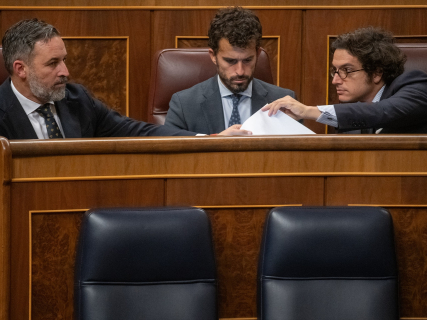
EuropaPress 7809043 presidente vox santiago abascal diputado vox jose maria figaredo conversan

EuropaPress 7809043 presidente vox santiago abascal diputado vox jose maria figaredo conversan

Add DEMÓCRATA to Google

Ask FREN

Published

Last updated

3 minutes

Most read

Elecciones 29N · Encuestas

La media de las encuestas

Media a 11 de noviembre de 2026 · 15 institutos

  • PP31,5 %
  • PSOE26,8 %
  • Vox19,1 %
  • Frente Amplio6,2 %
  • ERC2,5 %
01020304050ene 2024jul 2024ene 2025jul 2025ene 2026jul 2026

Media del último estudio de cada instituto en 30 días y su evolución semanal desde el 23J. Partidos con al menos un 2 %.

Todas las encuestas

Elecciones generales del 29 de noviembre · Demócrata

The letters are already almost on the table. Tonight the campaign begins and the parties will be able to ask for votes openly. Although Vox will hold tomorrow the act of 'opening' in Plaza Colón in Madrid, it will be this afternoon when they reveal their electoral program.

Nevertheless, DEMÓCRATA has had access to the chapter on the economy, energy, and industry. The Santiago Abascal party bets on the tax cut, the repeal of the labor policy of the coalition Government, and the continuation of nuclear power plants. Vox also proposes a zero quota for self-employed workers who earn less than the interprofessional minimum wage (SMI), reducing the IRPF according to the number of children, and approving a national reindustrialization plan.

The document, which includes the main economic lines of the formation for 29N, also includes a review of energy taxation, the elimination of restrictions linked to the European Green Deal, and measures to guarantee the sustainability of the public pension system. Among its commitments are also minimum taxation for areas at risk of depopulation and the recovery of a national nuclear plan that contemplates the construction of new power plants.

Lowering IRPF and VAT and a zero quota for the self-employed

One of Vox's main proposals is to carry out a tax reform that reduces taxes on families, workers, and businesses. In the case of the IRPF, the party proposes simplifying the tax and lowering the rate applicable to each contributor or family depending on the number of children, although the document does not specify the new brackets or the reduction percentages.

It also plans to decrease both the general rate and the reduced rate of VAT, giving priority to essential products and products of first necessity. These measures are added to a cut to the Corporate Income Tax to favor company growth and job creation.

For self-employed workers, Vox proposes eliminating the contributions of those with income below the SMI. Once that threshold has been exceeded, it proposes establishing a progressive quota starting from 50 euros, which would increase depending on income.

Pensions

Regarding pensions, Vox's program defends ensuring "the sustainability of the system" through economic growth, job creation, and improving salaries. Abascal's people consider that a more productive economy will make it possible to finance pensions and improve public services.

Another of the points refers to promoting support measures for families, encouraging births and expanding aid for raising children, with the aim of reversing demographic aging and the decline in births in Spain.

Labor legislation

On the other hand, and in line with the discourse they have maintained throughout the entire pre-campaign, the program includes the repeal of the policies of the "sanchsimo" in labor matters.

The far-right party attributes to these rules a worsening of labor precarity and considers that they have discouraged hiring. In the document this outlet has had access to, it accuses the Executive of having "falsified the temporary employment figures" and of favoring the "union duopoly".

Faced with this situation, the formation advocates "promoting stable employment and decent wages", especially among young people, to facilitate their emancipation and the formation of families.

End of the nuclear shutdown

In the energy field, it highlights the proposal to repeal the closure schedule for Spain's nuclear power plants and ensure the continuity of the installations currently in operation.

In this regard, Vox also defends a national nuclear plan that includes studies to build new power plants. According to the text, those projects that prove viable would be carried out "as quickly as possible".

In the energy chapter, they also advocate a reduction in taxes on electricity for families, businesses and industries, as well as measures to put an end to double energy taxation.

Eliminate the regulatory cap on investment in electric grids and speed up authorizations to build lines, substations and connection points, also appears in the electoral program.

More key points, information and questions with FREN

AI-GENERATED CONTENT

What parliamentary procedures would be necessary to approve the tax reforms proposed by Vox?

To approve tax reforms like those proposed by Vox, the usual route would be an ordinary law, involving both the Congress and the Senate. An absolute majority is not required simply to modify taxes: normally a simple majority suffices, that is, more votes in favor than against. The process would depend on who presented the text and its content; the following explains the procedure without attributing specific measures to Vox.

1. Present a legislative initiative

There would be two main routes:

  • Bill proposal: the parliamentary group could present it with the signature of its spokesperson, accompanied by a statement of reasons and the articulated text.
  • Government bill: if the Government assumed the reform, it would approve the bill and send it to Congress with the necessary background.

The difference matters: a proposal needs to pass the consideration stage, the vote in which Congress decides whether to start processing it. Government bills do not go through this initial filter.

2. Pass the budgetary examination

The Board would publish the proposal and send it to the Government. According to article 126 of the Congress Regulations, the Government can express its opinion and agreement or disagreement when it implies increasing credits or decreasing budget revenues.

This is a particularly relevant point for a tax cut: besides obtaining parliamentary support, this budgetary requirement must be met. After thirty days without an express negative from the Government, the proposal would be ready to be included in the agenda for its consideration.

3. Process and approve the text in Congress

If Congress accepted to process the proposal, the common legislative procedure would begin:

  • Amendments: deputies and groups could propose changes, deletions, or additions. For bills, the initial period is fifteen working days, extendable.
  • Committee drafting: a group of commission members would study the text and amendments and prepare a report.
  • Committee: would debate the articles, vote on modifications, and approve a report.
  • Approval: would correspond to the Plenary, unless the committee acted with full legislative competence, when possible.

The rule would be a simple majority, with the attendance of the majority of members. An organic law would require an absolute majority in a final overall vote, but ordinarily modifying rates, bases, or deductions does not make a tax reform organic.

4. Pass through the Senate

The Senate could approve the text without changes, introduce amendments, or veto it. It would normally have two months; in urgent processing, twenty calendar days.

  • If there were no changes, the parliamentary phase would conclude.
  • If there were amendments, Congress would decide which to accept by simple majority.
  • If there were a veto, Congress could immediately override it by absolute majority or, after two months, by simple majority.

Then would come sanction, promulgation, and publication. The application would depend on the entry into force provided in the law.

5. The alternative of the decree-law

Only the Government could approve it, justifying an extraordinary and urgent need. Congress would have to decide its ratification — to keep it in force — or repeal within thirty days. It could also agree to process it later as an urgent bill, allowing amendments and Senate intervention.

It is not an unlimited shortcut: the STC 73/2017 reminds that it cannot substantially alter the constitutional duty to contribute. Therefore, for a broad tax reform, the ordinary route offers the normal channel for debate and approval; urgency does not eliminate constitutional limits.

What are the competencies of Vox's president, Santiago Abascal, within his party and what political trajectory has he had?

Santiago Abascal has been president of Vox since September 2014 and exercises its main political leadership and public representation. His trajectory began in the People's Party of the Basque Country, continued with responsibilities in the Madrid Administration, and culminated in the founding of Vox and its arrival in Congress in 2019. To understand his competencies, it is useful to distinguish between his presidential functions and the decisions that correspond to the party's collective bodies.

His competencies within Vox

The presidency includes the political representation of the party, the direction of its general strategy, and the coordination of its actions. Abascal leads the national leadership and plays a central role in campaigns, relations with other formations, and political negotiations. However, the located statutory description does not allow attributing to him, without nuances, all the powers of appointment or internal decision-making.

  • Political direction: guides the national strategy and coordinates the electoral and parliamentary priorities of the formation.
  • Representation: acts as the main public interlocutor of Vox before institutions, parties, and organizations.
  • National bodies: heads the National Executive Committee and presides over meetings of the Political Action Committee. The latter intervenes in strategic decisions, such as negotiations to form governments.
  • Organization and execution: promotes decisions and assigns responsibilities, within presidential powers and the agreements of competent bodies.

An example of this directing capacity was the decision to halt talks to govern in Extremadura, communicated after presiding over the Political Action Committee in January 2026 (Demócrata, January 19).

He does not formally concentrate all functions. The General Secretariat is a different position: in May 2025, Ignacio Garriga proposed appointing Montserrat Lluís as deputy general secretary and the National Executive Committee ratified the proposal. This is an example of decisions requiring the intervention of other responsible persons and bodies (Vox statement).

His leadership was renewed at the 2024 Assembly for four years, with more than 90% support. That mandate does not eliminate his subjection to internal rules nor convert collective competencies into personal powers (Demócrata, renewal and Executive).

His political trajectory

  • 1994-2013: stage in the PP. He joined in 1994 and developed his initial career in the Basque Country. He presided over the New Generations of the Basque PP between 2000 and 2005 and belonged to party leadership bodies.
  • 1999-2009: elected positions. He was councilor of Llodio between 1999 and 2007, member of the General Assemblies of Álava between 2003 and 2004, and Basque parliamentarian in two periods between 2004 and 2009.
  • 2006-2013: foundations and public management. He promoted and presided over DENAES, the Foundation for the Defense of the Spanish Nation. He directed the Data Protection Agency of the Community of Madrid between 2010 and 2012 and later was manager of the Foundation for Patronage and Social Sponsorship.
  • 2013-2014: break and creation of Vox. He left the PP in November 2013 due to disagreements with its leadership. He participated in the creation of Vox and was elected president on September 20, 2014.
  • Since 2019: Congress. He has represented Madrid during the XIII, XIV, and XV legislatures. He has been a member of the Permanent Deputation since November 2023.
  • Since 2024: European scope. He presides over Patriotas.eu, a responsibility different from the presidency of the European parliamentary group.

These milestones are recorded in his profile on Demócrata and in the RTVE profile. Overall, his path combines municipal, regional, and autonomous positions, public management, and national party leadership.

What legal requirements must be met in Spain to build new nuclear power plants?

To build a new nuclear power plant in Spain, successive state authorizations, environmental assessment, and territorial and sectoral permits are required. The promoter must demonstrate the safety of the site and design, have sufficient resources, and plan for waste management and decommissioning. The construction authorization alone does not allow loading fuel or operating the reactor.

1. Legal framework and competent authorities

The basis is Law 25/1964, on nuclear energy, especially its article 28. The procedure is currently developed in Royal Decree 1217/2024, which replaced the 1999 regulation. The main authorizations correspond to the Ministry for Ecological Transition and the Demographic Challenge, with intervention from the Nuclear Safety Council (CSN) and consultation with affected autonomous communities.

The CSN report is mandatory and the ministerial decision cannot replace the technical safety verification. The Nuclear Safety Regulation, radiological and physical protection regulations, and binding CSN instructions must also be complied with.

2. Preliminary or site authorization

This authorization recognizes the project's objective and the suitability of the location. It allows applying for construction authorization and initiating only the expressly authorized preliminary infrastructures: it does not yet allow building the complete plant.

The application must justify the needs to be covered and the choice of site. It must describe the technology, supplies, expected waste, radioactive emissions and discharges, and future decommissioning. The assessment must consider the characteristics of the environment and risks that may affect safety.

3. Environmental assessment and public participation

A new plant must pass an ordinary environmental impact assessment, according to Law 21/2013. The procedure includes environmental impact study, public information, and consultations with affected administrations and interested persons.

The nuclear regulation integrates these procedures into the preliminary authorization. Allegations must be evaluated and may require changes; if these generate different significant environmental effects, public information and consultations must be repeated. The environmental impact declaration does not replace the nuclear authorization. Additionally, during construction, a local information committee must operate, with meetings open to the public.

4. Construction authorization

To begin construction, article 22 of the regulation requires technical and economic documentation including:

  • General and execution project, specifications, plans, and schedule.
  • Equipment acquisition program, technical collaboration, and updated economic study.
  • Preliminary safety study, with accident analysis and consequences, organization, and quality assurance.
  • Preliminary risk assessment, radiological impact study, and preoperational environmental monitoring.
  • Preliminary plans for waste and spent fuel management, decommissioning, and life management.
  • Other concessions and administrative authorizations, or accreditation of having properly requested them.

5. Complementary permits and commissioning

Urban and territorial permits, water concessions and discharge authorizations, and permits corresponding to electrical infrastructures must also be obtained. The nuclear authorization does not eliminate these obligations.

During construction, prenuclear tests of equipment and safety systems are mandatory. Their results must be submitted to the Ministry and the CSN before obtaining the operating authorization, initially provisional until satisfactorily completing nuclear tests.

To operate, among other documents, a safety study, internal emergency plan, radiological protection, and updated waste and decommissioning plans are required. The operating holder must be a legal entity dedicated exclusively to managing nuclear plants, with sufficient material, financial, and human resources; supervisors and operators need CSN licenses.

Play

Test your knowledge with FREN!

How much do you know about this topic? Answer the following 3 questions.

What measure does Vox propose for self-employed individuals earning less than the minimum interprofessional wage?

Question 1 of 3

What does Vox's program propose regarding nuclear energy?

Question 2 of 3

How does Vox plan to guarantee the sustainability of the public pension system?

Question 3 of 3