
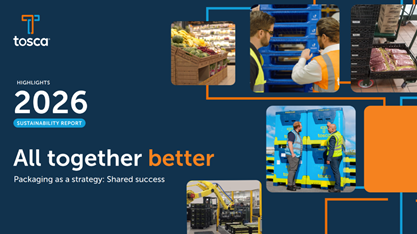
The new report links packaging decisions to automation performance, product protection and logistics efficiency, while highlighting quantifiable environmental and operational improvements
Tosca, the world leader in reusable packaging solutions and shared container management (pooling), has published its 2026 Sustainability Report, in which it proposes a change in the way companies assess transport packaging: stop treating it as a product that is purchased and instead treat it as a strategic component of supply chain infrastructure.
As food supply chains become increasingly automated and face greater economic pressures and regulatory pressures, packaging decisions increasingly affect operational performance. The report examines how reusable packaging can reduce food losses, labor requirements and transportation inefficiencies, while documenting Tosca’s progress toward its global sustainability goals.
"Companies invest significant resources in optimizing equipment, labor and transport, but packaging is still too often assessed primarily by its unit price", said Eric Frank, CEO of Tosca. "This approach overlooks its role in keeping automated lines running, protecting products and transporting goods efficiently. Packaging is an operational resource and must be assessed with the same rigor as the infrastructure surrounding it".
Measuring impact beyond packaging waste
The report highlights how reusable packaging systems and pooling provide quantifiable benefits in customers’ operations. For example:
- Less damage to products and food waste: durable, rigid boxes protect products during handling and transport, reducing damage to fresh products by between 6% and 9% on average. In the case of eggs, Tosca’s reusable packaging reduces damage by more than 50%.
- Lower labor requirements: reusable packaging prepared for display in commercial establishments makes it possible to save 307 hours of work per every 100,000 boxes, compared with corrugated cardboard packaging.
- More efficient transport: better use of loading capacity and a lower number of trips can reduce transport costs by up to 25%, along with the corresponding emission reductions.
- Less single-use packaging waste: Tosca’s reusable packaging solutions have eliminated 2.229 million metric tons of corrugated cardboard packaging from supply chains, removing the corresponding needs for recycling and waste disposal.
Progress toward global sustainability targets
Tosca has reported strong progress in reducing the environmental footprint of its own operations:
- 30% reduction in the intensity of global greenhouse gas (GHG) emissions of Scope 1 and 2 per hour of operation since 2021.
- 46% of the electricity used worldwide came from renewable sources in 2025, compared with 33% recorded in 2022.
- 41% reduction in total waste generated compared with 2024.
The report also highlights Tosca’s investments in circular infrastructure, including the circular pallet CP 1208 (CP 1208 Circular Pallet), manufactured with 100% recycled plastic, as well as the expansion of asset tracking through RFID technology to improve visibility of the supply chain.
After carrying out its first double materiality assessment and a formal assessment of climate-related risks in 2025, Tosca updated its sustainability strategy through 2030, with the aim of reducing absolute Scope 1 and 2 emissions by 42% and Scope 3 emissions versus their respective baseline levels.
"Reducing the footprint of a packaging material is only part of the equation", said Karin Witton, doctor and global Sustainability director at Tosca. "We also need to take into account the food that is lost, the transportation required, and the resources consumed throughout the entire supply chain. Measuring these impacts together helps companies identify where the biggest environmental and operational improvements can be achieved".
Download Tosca’s 2026 Sustainability Report
About Tosca
Tosca is a global leader in reusable plastic packaging solutions and pooling systems, and helps companies eliminate waste and improve the performance of their supply chains.
Through its reusable containers, pallets, packaging for bulk products, and end-to-end pooling services, Tosca helps its customers protect products, improve operational efficiency, and reduce environmental impact.
With customers in more than 60 countries, Tosca remains committed to driving circular supply chains and eliminating waste at every stage.
For more information, visit www.toscaltd.com.