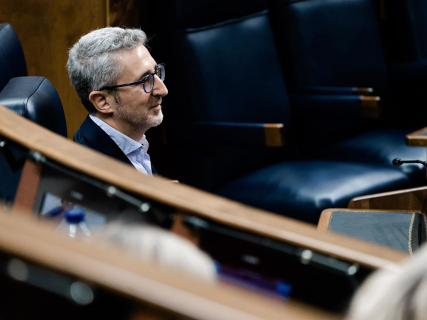

The Minister of Finance, Arcadi España, has urged the PP to act with “responsibility” and to hold a “serious debate” on pensions and taxes. He has acknowledged having “concerns” when he heard Alberto Núñez Feijóo talk about “sacrifices” and when he heard Vox warn that the public system “is going to burst”.
At the same time, he has conveyed a message of “reassurance” to around one million pensioners in the Comunitat Valenciana: “There are messages that are not true that the PP and Vox are putting out and that worry me”.
He made these comments this Friday during an information breakfast of the Fórum Europa Tribuna Mediterránea, where he was introduced by the Minister of Science, Innovation and Universities, Diana Morant. In his remarks, he criticized the fact that the PP and Vox candidates for the Presidency of the Government use the pension system as a political weapon. “There is a saying that goes: words can fool you, facts and behavior, no,” he stressed.
Spain has rejected the “messages that the right is putting out that the model is unsustainable and, therefore, we will have to tighten our belts and make cuts”. He has argued that the reforms approved in recent years with “consensus” in the Spanish economy allow “not only to ensure that they will be revalued in line with inflation”, but also to be “realistic” in the face of “population and generational changes”.
As he has emphasized, “citizens and pensioners in our country know that this Government has not only complied with everything it has said, but has also been improving the system and guaranteeing its sustainability. The two things taken together.” In his view, “others will have to explain and they should do so with transparency what their model for pensions is, in addition to frightening pensioners”. Against that backdrop, he has reiterated a “message of reassurance” about “the solvency of the accounts and the sustainability of the system”.
Taxes and the tax model
As for fiscal policy, the Minister of Finance has said that “a great deal of education” is necessary and has commented that he would have liked to confront the PP on issues such as “who has to pay more or less and be more or less progressive.” However, he lamented that this formation has abandoned “that normal banner of debate between social democracy and conservative and right-wing parties in Europe.” “The statements we hear from the leaders of the PP are not those; it’s taxes, yes or taxes, no,” he reproached.
He recalled that, on the same day the latest Income Tax Campaign began, the leader of the PP, Alberto Núñez Feijóo, “who aspires to be president of the Government, held a press conference against taxes.” “This is not a serious debate,” he insisted.
Criticism of the PP’s economic program and Vox’s proposal
Arcadi España has ironized that the “draftsman of the program—electoral—of the PP in economic matters is—the deputy of Vox José Mª— Figaredo, who put forward a proposal that I’m sure that the PP people who know about the Ministry of Finance will have been left dumbfounded.” “What happens is that they have not criticized him,” he added, referring to Vox’s plan to lower VAT to 18%, reduce social contributions, and review 52,000 million euros in subsidies, among other measures.
Against this backdrop, he explained that the IRPF, “a progressive tax about which we can talk about whatever we want,” but which constitutes “a fundamental pillar of public accounts,” collects around 140,000 million euros. Against that, he set out that Vox’s proposal would mean bringing in “85,000 million euros less for the State, more than all the education spending of all the administrations in the whole of our country and close to 80 percent of healthcare spending.”
“If you say you’re going to make a hole of 85,000 million euros, tell me where you’re going to cut. It’s a downright absurdity,” he warned. He also pointed out that, with that approach, “the people who would be paid the minimum wage would save zero and the people who would be paid a million euros, 212,000 euros.” In his view, “it’s not intellectually honest and it’s not serious with the citizens of our country to talk about taxes if you don’t talk about spending.”
Public services and fiscal responsibility
At this point, the minister has emphasized that Spain has "got used to something that is not usual in other countries on the planet: that when a woman gives birth, it is 3,000 euros, and nobody asks for anything; that when an elderly person has their hip replaced, it is more than 6,000 euros or an operation for a lung or heart transplant, which, incidentally, are carried out in public healthcare practically exclusively on the basis of cost, more than 90,000 euros".
He has also recalled that "when the Guardia Civil helps you because you’ve had a problem on the road or an accident, nobody charges you anything. The salaries of teachers, of doctors, of nurses, of hundreds and thousands of public employees in our country—where does that come from if it isn’t from our taxes?", he asked, to then answer: "The money we pay comes back to us." For this reason, he has called for "a serious debate on income and expenditure" and a genuine "exercise in responsibility".