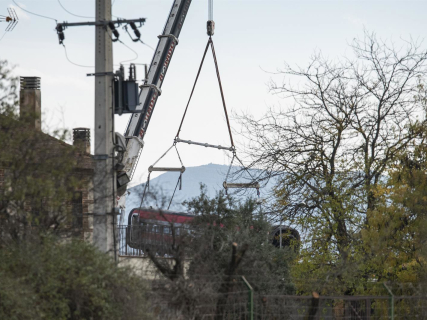
The European Public Prosecutor’s Office opens a new investigation into possible fraud in the funds intended for the security of the AVE Madrid-Sevilla

The investigations, initiated ex officio after the accident in Urda and with support from the UCO, examine the use of European funds to modernize the safety, signage, and communications of the AVE Madrid–Seville. The investigation also affects Adif, the State Railway Safety Agency, and the Court of Auditors

fotonoticia 20261105111519 1920

fotonoticia 20261105111519 1920

Add DEMÓCRATA to Google

Ask FREN

Published

Last updated

3 minutes

Most read

Elecciones 29N · Encuestas

La media de las encuestas

Media a 7 de noviembre de 2026 · 11 institutos

  • PP31,0 %
  • PSOE26,2 %
  • Vox19,5 %
  • Frente Amplio6,6 %
  • ERC2,4 %
  • SALF2,2 %
  • Podemos2,1 %
01020304050ene 2024jul 2024ene 2025jul 2025ene 2026jul 2026

Media del último estudio de cada instituto en 30 días y su evolución semanal desde el 23J. Partidos con al menos un 2 %.

Todas las encuestas

Elecciones generales del 29 de noviembre · Demócrata

The European Public Prosecutor’s Office has opened a new investigation into possible fraud in the use of European funds intended to renew and modernize the security, signaling and communications systems of the high-speed line Madrid-Seville, where on 28 October of the past year the Urda (Toledo) rail accident occurred, leaving 69 dead.

The proceedings have been initiated ex officio and have the support of the Central Operations Unit (UCO) of the Guardia Civil. The inquiries reach the Administrator of Railway Infrastructures (Adif), the State Railway Safety Agency (AESF) and the Court of Auditors, although the procedural status of these bodies and the specific actions being examined by the investigators have not yet been clarified.

The opening of this investigation comes after the European Public Prosecutor’s Office began, in March, examining possible fraud related to European funds intended for maintaining the track in the vicinity of Adamuz (Córdoba), where another rail accident occurred in January that caused 46 deaths. Those proceedings remain ongoing and also count on the collaboration of the UCO.

Funds earmarked for the modernization of the security systems

The new inquiries focus on European resources allocated to the facilities that allow monitoring and supervision of train traffic. Among them are signaling systems, railway protection and communications, the renewal of which forms part of the works carried out in recent years in the Madrid-Seville corridor.

One of the main modernization projects for this infrastructure is the replacement of the LZB control system with the European ERTMS, the commissioning of which has accumulated delays. The new system was still not operational when the Urda accident occurred, after an LZB breakdown forced traffic management to be handled through alternative procedures.

In September 2021, Adif Alta Velocidad awarded three contracts for a total amount of more than €136 million to renew different installations on the line, including those for signaling, telecommunications, train protection, track circuits and switches. Part of these actions was funded using European funds from NextGenerationEU.

The existence of community funding explains the European Public Prosecutor’s Office’s jurisdiction to investigate possible irregularities in its use. However, it has not yet been confirmed which specific contracts form part of the new inquiries, nor whether the investigators have detected breaches in the execution of the works or in the justification of the expenses.

The European Public Prosecutor’s Office was already investigating the maintenance of the road in Adamuz

As DEMÓCRATA reported last October 30, the European Public Prosecutor’s Office and the UCO had kept open an investigation into possible embezzlement of funds intended for the maintenance of the Madrid–Seville line, related to the section where the Adamuz accident occurred.

The European body had confirmed on March 20 the opening of those inquiries, focused on community resources intended for maintaining the road near kilometer 318.7. To move forward with the inquiries, it requested from Adif the corresponding contracts and case files for that railway section.

At the end of October, sources from the European Public Prosecutor’s Office confirmed that the investigation remained open, that various inquiries had been carried out, and that they expected significant progress in the coming weeks.

The new action known this Friday examines possible irregularities in funds intended for security systems, signage, and communications. For the moment, it has not been clarified whether these inquiries are processed through an independent case file or have a procedural link with the investigation initiated after Adamuz.

The Court of Auditors’ warnings about European funds

The Court of Auditors had already identified deficiencies in the management and control procedures for the European funds of Adif and Adif Alta Velocidad. In a report approved in December 2025, the auditing body examined actions with an assigned budget of 5,974 million euros and detected problems related to the traceability of certain operations, supervision of personnel, and the processing of internal complaints.

Although the overall assessment of the management and control systems was favorable, the report included recommendations to improve documentation of decisions and strengthen the mechanisms for preventing conflicts of interest.

Subsequently, in April 2026, the Joint Commission of the Congress and the Senate for Relations with the Court of Auditors approved a resolution urging a review of control procedures, contractual amendments and the identification of possible conflicts of interest in the management of community resources.

More key points, information and questions with FREN

AI-GENERATED CONTENT

What is the current stage of the parliamentary processing of the Court of Auditors' recommendations on the procedures for controlling European funds at Adif?

The parliamentary processing has already passed the stage of presentation and debate of the report: the Joint Committee for Relations with the Court of Auditors approved a resolution on the controls of European funds at Adif and Adif-High Speed in April 2026. As of November 6, 2026, it is not appropriate to describe the matter as pending a first vote; it is necessary to distinguish that approval from the subsequent compliance with the recommendations.

Which report is being processed

It is the Audit report on the management and control procedures implemented by the public business entities Administrator of Railway Infrastructures and ADIF-High Speed for the execution of the Recovery, Transformation and Resilience Plan, situation as of December 31, 2024. The Plenary of the Court of Auditors approved it on December 18, 2025. Its processing corresponds to parliamentary files 251/000198 of the Congress and 771/000195 of the Senate, the latter available in the Senate documentation.

It is not a bill nor a legislative reform. It is a parliamentary control procedure on an audit report: the Court sets out its conclusions and the Joint Committee may approve resolutions that demand actions from the audited entities and the competent authorities.

Parliamentary milestones that have already occurred
  • Presentation of the report, on February 24, 2026. The president of the Court of Auditors, Enriqueta Chicano, appeared before the Joint Congress-Senate Committee and presented the audit on Adif and Adif-High Speed. That appearance allowed the groups to debate the results, according to the session report.
  • Formulation of resolution proposals. After the presentation, measures were proposed to respond to the deficiencies pointed out. Therefore, the recommendations ceased to be only on the technical report level and became the subject of parliamentary proposals.
  • Approval in committee, on April 16, 2026. The information published about that session confirms that the Joint Committee approved an initiative incorporated into the resolution related to the report. This proves that the debate and voting phase already took place, and was not simply announced in a parliamentary agenda (resolution approved in April).
What the approved resolution implies

The most recent information, published on November 6, explicitly states that the April resolution urged reviewing control procedures, contractual modifications, and the identification of possible conflicts of interest in the management of community resources. That subsequent reference confirms parliamentary approval and rules out currently placing the file in a mere initial examination phase (November information).

It is advisable to separate three issues: the approval of the report by the Court of Auditors, the approval of the resolution by the Joint Committee, and the effective implementation of the measures by Adif and Adif-High Speed. The first two have already occurred. Parliamentary approval does not by itself prove that all recommendations have been executed.

In conclusion, the answer is that the Joint Committee has already approved a resolution on the report; the subsequent focus is on its compliance and monitoring. The consulted sources do not show a subsequent verification that allows considering all recommendations applied, nor has the full official publication of that resolution been located to specify each of its agreements.

What are the main powers and functions of the European Public Prosecutor's Office in investigating fraud with community funds according to current regulations?

The European Public Prosecutor's Office is the independent body of the European Union responsible for investigating crimes that harm its financial interests, prosecuting those responsible, and bringing charges before national courts. Its main framework is Regulation (EU) 2017/1939; in Spain, it is developed by Organic Law 9/2021. Its function is criminal: it does not replace administrative controls over aid nor issue judgments.

1. What crimes can it investigate

Its competence refers to crimes against the European financial interests defined by Directive (EU) 2017/1371, called the PIF Directive, and incorporated into national law. In Spain, article 4 of Organic Law 9/2021 includes:

  • Fraud of European grants and aid, such as fraudulent obtaining or improper use, according to article 308 of the Penal Code.
  • Crimes against the Union Treasury, provided in articles 305, 305 bis, and 306 of the Penal Code, excluding national direct taxes.
  • Bribery and embezzlement that harm, or in legally foreseen cases may harm, European financial interests.
  • Money laundering from those crimes and smuggling affecting Union resources.
  • Participation in criminal organizations whose main activity is committing the above crimes, and inseparably linked crimes, within the limits of the Regulation.

For fraud related to VAT own resources, there is a specific condition: the acts must affect the territory of two or more Member States and cause a total damage of at least 10 million euros. That threshold should not be automatically transferred to subsidy fraud.

2. How it directs the investigation

The European Public Prosecutor's Office can initiate investigations based on received information and take over cases being investigated by national authorities through the right of assumption. When it effectively exercises its competence, these must refrain from continuing to investigate the same facts, without prejudice to legally permitted urgent proceedings.

Its main functions include:

  • Obtaining and analyzing evidence: documentation of subsidies, contracts, financial movements, and statements that clarify the facts and identify those responsible.
  • Directing the Judicial Police, issuing orders and instructions, and requesting information or assistance from authorities, officials, bodies, and individuals within legal limits.
  • Coordinating cross-border actions through delegated European prosecutors and applicable cooperation mechanisms.
  • Securing evidence and assets, promoting necessary measures to prevent their disappearance and facilitate subsequent confiscation and recovery of defrauded funds.

3. Prosecution and operation in Spain

Delegated European prosecutors have competence throughout Spanish territory to investigate and exercise criminal action, both at first instance and on appeals. They can bring charges and sustain them during trial; they are also authorized to jointly exercise civil action aimed at repairing economic damage.

Trial jurisdiction generally corresponds to the National Court. When there is parliamentary immunity, it corresponds to the Supreme Court or the competent High Court of Justice. Collaboration with the Spanish Public Prosecutor's Office is channeled through the State Attorney General's Office: delegated European prosecutors cannot issue instructions to its members.

4. Guarantees and relationship with OLAF

Fiscal direction does not eliminate judicial control. The guarantee judge authorizes proceedings restricting fundamental rights, adopts personal measures reserved for the judge, resolves appeals, and decides on opening oral trial or dismissal.

Additionally, legal defense, the right to remain silent, and other procedural guarantees must be respected. Finally, the European Public Prosecutor's Office conducts criminal investigations, while OLAF carries out administrative investigations: their actions must be coordinated without confusing their competences.

What is the professional and political background of the current president of the Court of Auditors?

The current president of the Court of Auditors is Enriqueta Chicano Jávega, who has held the presidency since November 2021 and was re-elected in November 2024 for a second three-year term. Her background combines a long career as a civil servant and senior management in the State Administration with responsibilities in public auditing. To explain her political dimension, it is advisable to distinguish her government positions, her electoral candidacy, and her subsequent institutional role.

Education and early professional positions

Chicano holds a Law degree from the Complutense University of Madrid and is a specialist in Labor Law and Social Security. She belongs to the Intervention and Accounting Corps of Social Security and also performed functions in the legal scale of the National Institute of Safety and Hygiene at Work, according to the biographical documentation of the curriculum published by EUROSAI.

Her administrative career began at the Ministry of Labor, where she performed legal advisory tasks, personnel management, and technical advice on labor legislation modifications. That first stage provided her with legal and administrative specialization prior to her dedication to public accounts control.

Senior management and relations with the Cortes

Before joining the Court of Auditors, she held various advisory and management positions in the central Administration. Her official curriculum includes, among others, these responsibilities:

  • Advisor in the offices of the Ministries of the Presidency and Relations with the Cortes, as well as in the Government Secretariat.
  • Deputy Director in the Technical General Secretariat of the then Ministry of Public Works, with participation in the Spanish representation before the European Economic Community in public procurement.
  • Director General for Monitoring Parliamentary Initiatives at the Ministry of Relations with the Cortes.
  • Director General for Relations with the Senate at the Ministry of the Presidency.

She also represented the Government before parliamentary and interministerial bodies related to European affairs, regional policy, and international trade. Therefore, a significant part of her experience was developed in coordination between the Executive and legislative chambers.

Political trajectory: a candidacy, not a seat

Her biography records that in 2000 she was a candidate for the Senate for Madrid on the PSOE-Progressives ticket, although she did not obtain a seat. This antecedent, mentioned in her biographical summary, constitutes a specific electoral participation: it should not be confused with having been a senator nor, by itself, does it allow affirming a current party affiliation.

The renewal of the Court of Auditors in 2021 occurred in the context of an agreement between PSOE and PP. That political context of appointment is different from her professional responsibilities and the independence guarantees inherent to the body.

From technical work to the presidency

Chicano joined the Court of Auditors in 1997, initially as a civil servant, and held different technical and managerial positions. Between 2012 and 2021 she was counselor of the Second Audit Department and president of the Equality Commission.

In November 2021 she was elected president by the Plenary and subsequently appointed by the king. In November 2024 she was re-elected for another three years, as explained in the official re-election statement. Since 2021 she also serves as secretary general of EUROSAI, the European organization of supreme audit institutions.

In summary, her profile combines three aspects: legal education and civil service career, senior government management with parliamentary experience, and a prolonged dedication to the Court of Auditors. Her electoral antecedent adds a political dimension that should be described separately from her current position.

Play

Test your knowledge with FREN!

How much do you know about this topic? Answer the following 3 questions.

Which organization has opened a new investigation for possible fraud in the funds allocated to the security of the Madrid-Seville AVE?

Question 1 of 3

Which railway control system was supposed to be replaced by the European ERTMS on the Madrid-Seville line?

Question 2 of 3

Which organization warned about deficiencies in the management of European funds allocated to Adif?

Question 3 of 3