
The next president of the United States could be among these nine names. The 2028 elections will force Republicans to look for a successor to Donald Trump and will present Democrats with a different decision: to bring back a familiar figure or to bet on another kind of leadership. Vance, Ossoff, Harris, and Rubio appear in a race that still has no definitive candidates or an unquestionable favorite
There is a difference from the last campaigns: Donald Trump cannot be elected again under the current Constitution. The Twenty-Second Amendment prevents a person from being elected president more than two times, even if the terms were not consecutive. His name can continue to shape the Republican primaries; a third presidential election is constitutionally barred.
Congressional renewal has accelerated conversations about the successor. Reuters describes an open Democratic field, with numerous leaders weighing their options, while Republicans face the difficulty of keeping Trump’s supporters and regaining voters who have left the party.
The following nine profiles are a selection of potential aspirants, not a closed list of candidates. Their interest is that they represent different paths to the presidency. Some can present themselves as heirs; others, as a correction. And what works to win some primaries does not always suffice to defeat the opposing party afterward.
JD Vance: the vice president who needs his own voice
JD Vance holds the most visible position among possible Republican successors. The vice presidency gives him national exposure and a direct link with the Trump Administration. It also credits him with part of its record.
His candidacy would have to answer a difficult question: what would continue and what would change. Defending the president without nuance can facilitate connection with his supporters, but it limits the ability to offer a new stage to dissatisfied voters.
Breaking too soon poses the opposite problem. Vance would need to build an identity of his own without turning that operation into a confrontation with the leader who retains enormous influence over the party. That tension between continuity and autonomy would define his career, if he finally decides to run.
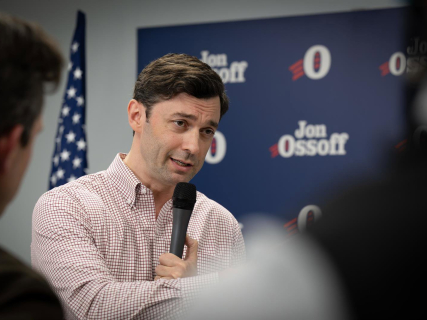
Jon Ossoff: showing that Georgia can be a national platform
Senator Jon Ossoff offers Democrats a territorial argument: his electoral trajectory has been built in Georgia, a central state in the dispute between both parties. His possible candidacy would allow the argument to be defended that the path to the White House runs through competing where the outcome is not assured.
The question is how much of that appeal can be transferred to the rest of the country. Winning a Senate election and putting together a presidential campaign are different tests. The second requires raising funds, recruiting teams, and persuading voters with very different priorities across a succession of primaries.
Ossoff figures among the names the Council on Foreign Relations identifies for 2028. His presence on those lists demonstrates political interest, not a decision to compete. The pending leap is turning a prominent position in the Senate into a recognizable national proposal.
Marco Rubio: experience to offer a handoff without a break
Marco Rubio combines a career in the Senate, a previous presidential campaign, and his current responsibility as Secretary of State. It is a profile distinct from Vance: he can invoke diplomatic experience and prolonged knowledge of the Republican Party.
That experience would be an asset, but it also ties him to the Administration’s international decisions. He could not present himself to voters as an observer detached from his foreign policy.
His potential space would be among those seeking Republican continuity with another style of leadership. The obstacle is convincing them that he offers an alternative of his own and, at the same time, assembling enough support within a party whose transformation has been dominated by Trump.
Kamala Harris: the advantage of being known and the weight of having lost
Kamala Harris starts with a level of recognition that other contenders would have to build over months. She was vice president and a presidential candidate in 2024. Voters know who she is; the challenge would be explaining why a new campaign would have a different result.
Her possible return would force Democrats to evaluate two things at once: the resources and the experience she brings, and the advisability of again presenting the person who lost to Trump.
Harris has not closed her future. After the legislative elections, she told Associated Press that she wants to play a role, regardless of whether she decides to run again. That formulation leaves the candidacy open without taking it for announced.
For her, the test would not be to present herself again to the country. It would be to make the country look at her differently.
Gavin Newsom: leaving California without stopping to be answerable for her
Gavin Newsom has executive experience and a political platform that goes beyond California. His name has been showing up for some time in conversations about the Democratic future.
A candidacy of his would bring the balance of his administration to the national debate. His rivals would have at hand issues such as housing, the cost of living, or the situation of people experiencing homelessness. His campaign would have to explain what part of California experience it proposes to extend and what problems it considers pending.
The challenge is especially relevant for a governor: a state career can demonstrate management capacity, but it also offers a specific track record to examine. Newsom would need voters in other territories to find answers for their own circumstances, beyond his political showdown with Trump.
Alexandria Ocasio-Cortez: turning influence into a majority
Alexandria Ocasio-Cortez represents another path for Democrats. She came to Congress after defeating in the 2018 primaries Joe Crowley, a consolidated party figure, and took the seat in January 2019. Her career began by showing that an apparently strong structure could be defeated from within.
A presidential candidacy would put that experience on a different scale. She would have to transform her political influence and her identification with the progressive wing into a coalition capable of competing in states with very different electorates.
The question for Ocasio-Cortez would be how far she can expand her support while maintaining the positions that have made her recognizable. For the party, her eventual candidacy would open up a discussion about the program with which she intends to recover the presidency, as well as about the person who must lead it.
Josh Shapiro: the Pennsylvania argument
Josh Shapiro has an easy card to explain in some primaries: he governs Pennsylvania, one of the states where an important part of the presidential contest is decided.
That allows a candidacy to be framed from the experience of disputing a territory that both parties need. It is a different argument from national notoriety or strength within an ideological current.
But a state victory does not automatically turn into a presidential victory. Shapiro would have to move his governor’s profile to national debates and build an organization that would work outside Pennsylvania.
His possible candidacy would test a recurring hypothesis among Democrats: that choosing someone competitive in a contested state can help assemble the coalition needed to win the country.
Pete Buttigieg: a second chance with more experience
Pete Buttigieg already knows a presidential campaign. He was mayor of South Bend, competed for the Democratic nomination in 2020 and subsequently led the Department of Transportation during Joe Biden’s presidency.
His track record would allow him to return with added federal experience to the municipal level. The University of Chicago’s Institute of Politics also includes his military service in Afghanistan and his victory in delegates in the 2020 Democratic caucuses in Iowa.
The challenge of a new candidacy would be to broaden the coalition it achieved then. Having competed before makes it easier to know the process, but it also leaves a reference point with which to compare the next campaign.
Buttigieg would have to demonstrate that this time he can sustain his support beyond the first states and assemble the delegates needed to win the nomination.
Ron DeSantis: returning after not having been able to with Trump
Ron DeSantis represents the possibility of a second Republican attempt from outside the federal Administration. His profile is tied to the Government of Florida and to a conservative career of his own.
For him, 2028 would offer a competition different from that of 2024: Trump cannot be elected again. That removes the rival who dominated that race, but it does not guarantee that the difficulties of his previous candidacy will disappear.
DeSantis would have to justify why now he can gather the support he did not achieve then. He would also need to find room between a continuity candidacy from Washington and other Republican alternatives.
His opportunity would depend on whether the party was looking for a handover with experience in state executive leadership. His problem would be convincing him that this renewal must be led by someone who already had a chance.
What the polls say and why they still do not choose the frontrunner
Early polls offer a snapshot of recognition and current preferences, but results change a lot between studies.
The compilation by RealClearPolling shows, for example, that Harvard-Harris had Kamala Harris at 34% of Democratic preferences in its survey from October 24 to 26. AtlasIntel, with fieldwork from October 31 to November 1, placed her at 13%, behind Ossoff and Ocasio-Cortez, both with 18%.
The difference also appears among Republicans. Harvard-Harris gathered 40% for Vance and 21% for Rubio; AtlasIntel placed Rubio at 46% and Vance at 33%.
These are not percentages of chances of becoming president. They measure declared preferences within the universes and name lists of each poll. They also should not be confused with the quotes from prediction markets.
To assess who advances, more concrete signs will be needed: campaign announcements, teams in the states, fundraising, endorsements, and polls conducted after those moves.
The two elections the successor of Trump needs to win
Before taking on the White House, each contender must win or secure the nomination of their party. That first process may reward a profile different from the one that later proves more competitive against the opponent.
For Republicans, the discussion will be how much to keep from Trump and what to change. For Democrats, how to turn opposition to the president into a shared program and shared leadership.
The list also does not end with these nine names. Andy Beshear, Gretchen Whitmer, J. B. Pritzker, Cory Booker or Mark Kelly appear among the possible contenders collected by the Council on Foreign Relations. James Talarico is drawing national attention, but that visibility should not, by itself, turn into a presidential candidacy attributed.
The election date is set, though: November 7, 2028. Until then, the primaries and conventions must convert a set of names and expectations into the candidacies that will compete for the presidency.