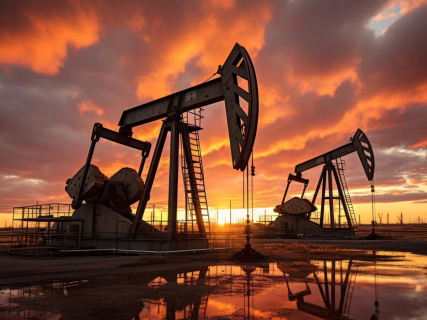

The Brent oil barrel, a reference for Europe, exceeded 87.5 dollars this Friday in a new rise of crude, with an intraday advance close to 4% as attacks between the United States and Iran intensify.
At the same time, West Texas Intermediate (WTI), a key indicator for the U.S. market, was around 82.15 dollars per barrel, after increasing by about 4% throughout the session.
On the military front, Iran has claimed responsibility this Friday for an attack on a U.S. base in Qatar, stating that it has destroyed "several strategic refueling aircraft" in retaliation for "recent U.S. crimes."
"During this attack, the long-range radar system and several strategic refueling aircraft have been completely destroyed, while several more have suffered severe damage," stated the Iranian Revolutionary Guard, before adding that "the U.S. Army and those hosting its bases in the region must know that crossing red lines and attacking the population and infrastructure (in Iran) will have very serious consequences."
In parallel, Iranian authorities have updated the victim count to nearly 40 dead and more than 400 injured due to the bombings launched by the United States in recent days. At least eight people died on Thursday night as a result of a U.S. Army operation in the south of the country.
The recent attacks have struck dozens of locations within Iran. The deadliest episode has been recorded in Jamir County, in Fars Province, near the coast of the Persian Gulf, where at least six bridges have been bombed.
This spike in tension is cooling talks to seal a lasting peace, despite the signing of a memorandum of understanding between both sides about a month ago. In this context, the oil market has reacted with new increases: after having reached 70 dollars a few weeks ago, Brent has been hovering around 85 dollars in recent days.
Furthermore, the International Monetary Fund (IMF) has recently warned that the global supply of crude may need between two and three months to regain a certain normalcy once the Strait of Hormuz is fully operational for ship transit, while traffic in this strategic passage remains practically paralyzed due to the new tensions.
"A longer-term concern is that prolonged production interruptions could lead to permanent production losses, especially in those cases where the necessary funding to reactivate the wells is scarce," the international organization has warned in the latest entry of its blog.