
CAF has closed the first half of the year with a net profit of 99 million euros, which represents an increase of 36% compared to the same period in 2025, after reaching sales of 2.527 billion, 16% higher, according to the Basque company.
The railway firm highlights that its order book, of 17.743 billion euros, increases by 9% in the first half of the fiscal year, driven mainly by intense contracting in the railway area. In addition, it emphasizes that the result's advance, exceeding 30%, has occurred in a semester "of increased activity and margin expansion."
The company also notes that Solaris records "record" figures since its acquisition by CAF in 2018, having "substantially" increased its contribution to the Group. During the semester, 725 buses have been contracted, of which 80% are zero-emission. However, its order book decreases due to the high activity developed in the second quarter of 2026.
This order book does not yet incorporate several already announced and signed awards, which together exceed 700 million euros, including contracts for the rehabilitation and maintenance of the Cairo Metro (Egypt) and the supply of commuter trains for Belgrade (Serbia). It also does not include the high volume of future options that clients can execute, associated with existing contracts, for an amount exceeding 10 billion euros.
The operating result (Ebit) stands at 150 million euros in the first six months of the year, 32% more, with a margin of 5.9%. This translates into a result before taxes of 137 million, 31% higher. The company has applied an effective tax rate of 26%, slightly below that of the previous fiscal year.
After a temporary drop in sales of the railway business in the first quarter due to accounting effects (-5%), the activity accumulates at the end of the semester a positive growth of 3%, up to 1.703 billion euros, in line with forecasts. The impact of the conflict in the Middle East on the execution of railway projects in that area remains, although CAF indicates that it has no relevant material effects.
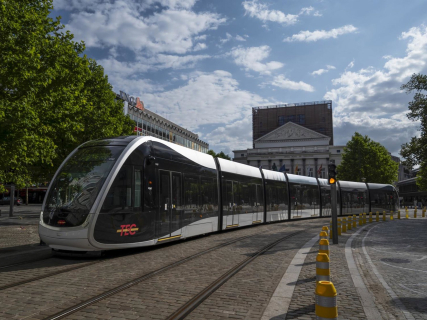
Among the projects that have most boosted sales in the period are the metro units for Madrid (Spain), regional trains for New South Wales (Australia) and for SNCF (France), as well as trams for Tel Aviv (Israel) and Rome (Italy). There has also been an increase in railway vehicle maintenance activities in South America, the United Kingdom, and Italy, which support the advancement of the services business, with 400 million euros in revenue, 10% more.
In the bus area, a "strong" increase in sales is recorded, reaching 824 million euros, 59% more, due to the high volume of deliveries scheduled and executed in the first half of 2026, unlike the previous year, when most were concentrated in the second half.
Thus, deliveries in the first quarter increase by 41% year-on-year, while the second quarter presents a delivery pattern aligned with that of previous years.
SOLARIS
CAF details that Solaris has delivered in the first quarter the record figure of 1,079 buses (+41% year-on-year), fulfilling the annual delivery plan, which this year shows a more balanced distribution between quarters compared to previous years, in which activity was concentrated in the fourth quarter.
A "surge in the proportion of zero-emission buses delivered is observed (rising from 68% to 90%), marking a historic high and "highlighting Solaris's operational capacity in executing a highly demanding portfolio."
Within the zero-emission range, the increase in electric buses, both battery and hydrogen, stands out again, accounting for 81% of total deliveries, with 873 units compared to the 489 buses supplied in the first half of 2025.
The delivery of trolleybuses also grows, with 95 units compared to 33 in the same period of the previous year, in the run-up to the start of trolleybus supplies to the new Canadian market. By the end of June, the order book amounts to 2,387 urban buses, with delivery commitments until 2028 in Europe, the United States, and Canada.
The EBIT of Solaris skyrockets by 114% in a year, reaching 60 million euros, driven by the increase in activity and the significant improvement in profitability.