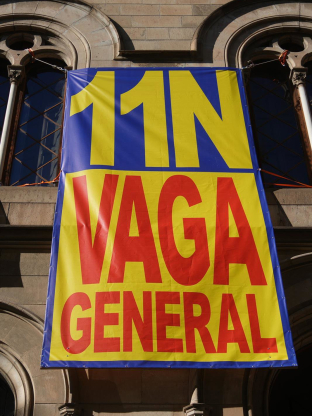

The Department of Business has released this Thursday the order that regulates the essential services that must be maintained in Catalonia during the general strike of November 11. The text establishes 25% service in peak hours of public transport and in primary care centers (CAP).
The stoppage, as detailed in the resolution, was promoted by CC.OO Catalunya and UGT Catalunya, CGT, Intersindical Alternativa de Catalunya-IAC, Intersindical CSC, COS, CATAC-CTS, CNT, Sindicato Único de trabajadores Solidaridad Obrera, COBAS, OSAD and ASC.
The resolution emphasizes that "the services provided by the companies that cover the emergency and emergency telephone numbers are necessary and indispensable to meet vital needs and, therefore, the handling of public order emergencies, firefighters, police, gender-based violence, civil protection, maritime rescue, emergencies of health services and other similar ones must be considered and constitutionally protected."
Urgencies, emergencies and basic supplies
The Government establishes that telephone care for urgencies and emergencies must be ensured at 85%, while serious incidents in the supply of electricity, gas, water, evacuation, wastewater treatment and public lighting may not be delayed beyond the period that the strike lasts.
Fire-fighting services at factories, explosive storage facilities, nuclear and thermal power plants and other energy production centers will operate under the same regime as on a public holiday.
In private security companies, minimum services are set at 70% for facilities such as petrochemical complexes, refineries or factories producing hazardous material, as well as in banking entities; at 75% for security in public transport (ports, airports, railways), at 80% for accompanying, defense and protection personnel for people, and at 60% for the alarm centers.
Public transport and social services
In passenger transport, Rodalies and Regionales, Transportes de Barcelona, Ferrocarril Metropolità de Barcelona, Ferrocarrils de la Generalitat, Tram Barcelona and the rest of the urban and interurban services must cover 25% of the usual supply in time slots with the highest demand.
The bus line connecting Barcelona with the airport will have a minimum service of 50%. As for the transport of persons with disabilities and school transport without a viable alternative, the provision of the service will be maintained.
In the audiovisual sector, 50% of the service will be guaranteed in the broadcasting of the news programs of the public radio and television. In residences for persons with disabilities and for older persons, minimum services are set at 85%; in day centers, at 50%, and in telecare, at 85%.
Health and education
In healthcare assistance, both in public and private centers, the Govern foresees normal operation of emergencies and special units (intensive care, intensive monitoring, coronaries, hemodialysis, neonatology, births, radiotherapy and chemotherapy). In primary care centers, 25% of the service will be guaranteed, while in the Banc de Sang i de Teixits a 50% is ensured.
The Conselleria also determines the minimum staff in public and private educational centers: one teacher for every six units in early childhood education; 50% of staffing in special education and 33% of staffing in nurseries. The specific order also sets the minimum services that must be respected by staff from the different departments of the Generalitat.