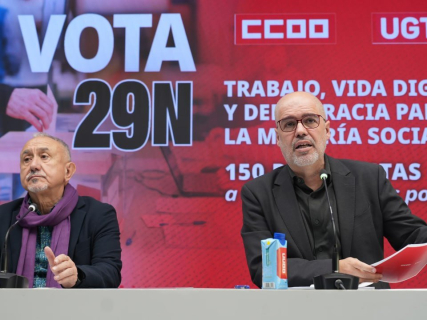
What do the unions and the Círculo de Empresarios ask of the Government: that it step down from 29N

CCOO and UGT demand 67.600 million for housing, reduce the working day and guarantee pensions. The Circle of Entrepreneurs calls for tax reforms, changes to collective bargaining and a review of the retirement system, as well as calling for agreements in education, energy and institutional quality.

fotonoticia 20261123122312 1920

fotonoticia 20261123122312 1920

Add DEMÓCRATA to Google

Ask FREN

Published

7 minutes

Most read

Elecciones 29N · Encuestas

La media de las encuestas

Media a 23 de noviembre de 2026 · 23 institutos

  • PP31,3 %
  • PSOE28,7 %
  • Vox18,2 %
  • Frente Amplio6,1 %
  • ERC2,6 %
01020304050ene 2024jul 2024ene 2025jul 2025ene 2026jul 2026

Media del último estudio de cada instituto en 30 días y su evolución semanal desde el 23J. Partidos con al menos un 2 %.

Todas las encuestas

Elecciones generales del 29 de noviembre · Demócrata

Six days before the general elections of 29 November, CCOO, UGT and the Circle of Businesspeople have presented their proposals for the next Government, with significant differences about the future of pensions, the labor market and fiscal policy. The unions demand achieving full employment in four years, mobilizing 67,600 million euros for protected housing and reducing the weekly workday, while the business organization proposes changes to the retirement system, collective agreements and social contributions.

During the presentation of their 150 proposals, grouped into eight major areas, the general secretaries of CCOO and UGT, Unai Sordo and Pepe Álvarez, have defended the labor and social reforms of recent years. The president of the Circle of Businesspeople, Juan María Nin, has in turn presented a 54-page letter with reforms in ten areas that cover institutions, the public administration, education, pensions, taxation, employment, housing, innovation and energy, as well as demographic and migration policy.

According to the calculations of the business organization, the sustained application of these measures could raise Spanish GDP by between 3% and 6% compared with the scenario without reforms over a period of ten years, with an acceleration of annual growth of between 0.3 and 0.5 percentage points.

Housing: more public investment and collaboration with the private sector

With the aim of expanding the stock of protected residential units, CCOO and UGT propose allocating 67,600 million euros over the next four years, an investment equivalent to 1% of annual GDP, to build, acquire and secure affordable homes.

Sordo has defended the need to have 1.5 million protected homes and has called for mobilizing vacant properties, homes owned by investment funds and more than 132,000 tourist homes for other uses. Álvarez has insisted that developments must be adapted to citizens’ financial capacity and their wages.

The Circle of Businesspeople also considers it a priority to increase the residential supply, especially in affordable and social rentals. Its document calculates that in 2025 Spain had accumulated a deficit of around 750,000 homes and proposes a long-term strategy coordinated between administrations and companies.

To facilitate the new promotions, claim the ability to mobilize public and private land, reduce the licensing concession times, and extend formulas such as the right of surface, which allow developing housing on public land without the Administration losing its ownership.

The organization also asks to strengthen legal certainty for owners, landlords, and investors, speed up the response to illegal occupation and missed payments, and avoid regulatory changes which, according to its assessment, reduce incentives to expand supply.

Pensions: the unions defend their funding and the Círculo proposes adjustment mechanisms

Unai Sordo has called on the parties to clarify whether they are willing to dedicate up to 15% of GDP to the public system. In the opinion of the CCOO leader, guaranteeing these resources would make it possible to maintain benefits without the need to apply cuts.

"If the answer is yes, the system is perfectly sustainable. If the answer is no, there will be drastic cuts in pensions," he warned.

From UGT, Pepe Álvarez has warned of the risk of reversing the agreements reached through social dialogue and has recalled the 2013 reform, which limited the annual revaluation of pensions to 0.25% and introduced the sustainability factor.

For its part, the Círculo proposes a State pact that incorporates automatic adjustment mechanisms linked to life expectancy, demographics, and the financial balance of Social Security.

It also proposes studying the gradual introduction of individual notional accounts, a system that links the calculation of the pension to the contributions accumulated during working life. The organization also advocates promoting private retirement plans, both individual and company-based, and preventing new increases in social security contributions from becoming the main instrument for financing the increase in spending.

Working hours, collective agreements, and dismissal: the main differences

CCOO and UGT call for approving the maximum working week of 37.5 hours during the first year of the legislature and continuing to move afterwards toward 32 hours. Among their proposals they also include ensuring that the minimum interprofessional wage is equivalent, at least, to 60% of the average wage and reviewing the regulation on dismissal.

Instead, the Business Circle proposes restoring the prevalence of the company agreement over the sectoral or national one, a modification that would affect one of the central elements of the 2021 labour reform.

The organization also calls for stopping the increase in social security contributions and studying a gradual approach to severance pay for contract termination to those existing in other European countries.

In this area, it asks for assessing the implementation of individual capitalization instruments such as the Austrian backpack, which could be used to supplement a dismissal severance payment, fund training, or increase income during retirement.

The letter also includes an evaluation of the effects of the ban on work and service temporary contracts and the possible distortions associated with the use of discontinuous fixed contracts. For the latter, it calls for statistics that make it possible to know how many workers remain active and how many are in periods of inactivity.

Employment, medical leave, and artificial intelligence

On employment, the unions aim for Spain to achieve full employment during the next legislature, relying on the energy transition and attracting new industrial investment.

"If Spain continues to create jobs, if Spain moves closer to full employment, wages in our country, I am convinced, can rise over the next four years," Sordo has said.

The Circle also proposes reducing structural unemployment, especially among young people, by boosting dual training, greater public-private collaboration in employment services, and programs that facilitate the voluntary continued employment of older workers.

The differences reappear in the management of temporary incapacity. UGT calls for the decision on medical admissions and discharges to remain exclusively in the hands of the professionals of the public health system. Álvarez has warned of the risk of expanding the powers of mutual insurers in this area.

For its part, the Circle proposes a national agreement to review the management and the control mechanisms for temporary incapacity. Its document states that the percentage of workers in this situation has risen from 2.8% at the end of 2019 to 4.6% in the second quarter of 2026.

On artificial intelligence, CCOO and UGT call for specific regulation of its use in the workplace. The business organization proposes speeding up its incorporation into companies, especially small and medium-sized ones, through digitization, training, and reskilling programs for workers.

Taxation, Budgets and Public Administration

The letter from the Círculo also includes a broad agenda of tax and institutional reforms.

Among its tax measures, it proposes indexing IRPF brackets to inflation, reducing the tax burdens on microenterprises and small businesses, and eliminating sectoral levies, including those applied to banking and energy companies.

It also calls for simplifying VAT, reviewing the distribution of its rates, and establishing a multi-year strategy to reduce the structural deficit and public debt. It proposes setting a maximum limit on the weight of public spending as a share of GDP and strengthening efficiency evaluations to direct more resources toward education, infrastructure, and research.

In the institutional sphere, the Círculo asks for a State Pact for the quality of institutions, with measures to strengthen the independence of regulatory bodies, improve the functioning of Justice, and combat corruption in public procurement, large infrastructure projects, and party financing.

It also requests professionalizing public management, linking the professional progression of public employees to performance evaluation systems, and improving coordination among the different administrations.

Education, immigration, and energy on the business agenda

Beyond labor measures, the Círculo devotes an important part of its proposal to education and innovation.

It calls for a State Pact for education, to promote dual Vocational Training and selectively extend dual university education in degree programs with a shortage of professionals. It also proposes creating an National Innovation Agency to coordinate public research policies and facilitate the transfer of knowledge between companies and universities.

In migration policy, it proposes a long-term strategy linked to the needs of the labor market, to facilitate the hiring of qualified workers and to speed up the homologation of foreign qualifications. At the same time, it calls for reviewing migration regulations and strengthening educational and labor integration policies.

Energy policy is another of its priorities, and in this regard the Círculo advocates extending the operating life of nuclear power plants when there are no technically viable, competitive, and emission-free alternatives that can replace them, always under the supervision of the Nuclear Safety Council.

In addition, it proposes increasing investment in power grids, storage, and European interconnections, reducing administrative obstacles to develop strategic infrastructure, and strengthening water security.

The reforms that will depend on the next Government and Parliament

Implementing much of the proposals will require legislative changes during the next parliamentary term.

Reducing the maximum working week to 37.5 hours, modifying the dismissal compensation regime, or restoring the priority of the company agreement in the matters affected would require amending the Workers’ Statute.

Regulatory reforms would also be needed for the new pension calculation mechanisms and the tax changes demanded by the Círculo. The public investment of 67,600 million for housing advocated by CCOO and UGT would, for its part, depend on budgetary commitments and coordination with the competent administrations.

At the same time, the negotiation of the VI Agreement for Employment and Collective Bargaining will remain pending, which corresponds to the trade union and employer organizations.

The Círculo’s agenda also has a longer path than the electoral campaign itself. The organization has announced that during the next two years it will deepen the technical development of the reforms included in its charter to specify their implementation.

More key points, information and questions with FREN

AI-GENERATED CONTENT

What is the current status of the parliamentary processing of the labor and tax proposals presented by the Círculo de Empresarios?

No specific parliamentary processing attributable to the labor and tax proposals of the Círculo de Empresarios has been identified. The sources consulted confirm that the organization has made public recommendations, but they do not allow an unequivocal link to an initiative from the Congress or the Senate. Therefore, it would not be correct to state that this set of proposals is pending amendments, in committee, or awaiting a vote.

Labor proposals: recommendations without identified file

Among the measures advocated by the Círculo are contract simplification, reduction of differences between temporary and permanent workers, convergence of dismissal costs, promotion of youth and part-time employment, and improvement of active employment policies. Also included are the reduction of employer contributions, linking wage increases to productivity, and strengthening negotiation within companies.

The entity's documentation, including its 2023 report, records its propositional activity. However, the consulted sources do not show which parliamentary text would have expressly incorporated these recommendations, who would have presented it, or what path it would have followed. This does not mean that no similar measure has been debated: it means that its connection to the Círculo's proposals is not proven.

Tax proposals: no own progress recorded either

In tax matters, the Círculo has proposed a reform aimed at growth, competitiveness, savings, and investment. The located documentation also includes incentives for investment and innovation, reduction of employer contributions, and proposals to contain tax pressure and improve the sustainability of public accounts. Its 2022 annual report documents this line of work.

No bill, amendment, or non-legislative initiative unequivocally linked to this tax package has been found. Consequently, it cannot be assigned an approval date or parliamentary phase. The publication of a business document and the formal presentation of an initiative in the Cortes are different facts.

What has been debated on related matters

There are parliamentary actions on coinciding issues, but the sources do not prove that they are the translation of the Círculo's proposals:

  • October 22, 2025: the Congress approved a request to the Government to reduce taxes on families and self-employed workers, simplify tax obligations and administrative burdens, and boost productivity. It was a political impetus agreement, not the approval of a tax reform, according to the official information from Congress.
  • September 30, 2025: the Senate Finance Committee approved a motion to modernize the Economic Activities Tax in support of SMEs and economic sectors. No attribution to the Círculo appears in the Senate information.
  • March 26, 2026: the Congress approved a motion on fiscal and economic difficulties that included requests related to companies, contributions, and self-employment. A motion requests actions from the Government but does not by itself modify taxes, according to the official summary of the agreement.

In short, the proven point is public proposals without identified formal parliamentary transfer. Agreements on similar matters do not allow stating that Parliament has approved, rejected, or is processing the Círculo's labor and tax program.

What are the main competencies of the general secretaries of CCOO and UGT according to current legislation?

Legislation does not establish a specific catalog of competencies for the general secretaries of CCOO and UGT. Their specific functions mainly come from the statutes of each union, within the framework of the Constitution and Organic Law 11/1985, on Trade Union Freedom. In both cases, their central role is to legally and publicly represent the confederation, without replacing the decisions of their collective bodies.

Legal framework: union autonomy and representation

The Organic Law on Trade Union Freedom recognizes unions' autonomy to draft their statutes, organize their structure, and establish their governing bodies. Therefore, to know the powers of a general secretariat, it is not enough to consult legislation: one must also refer to the organization's internal rules.

It is useful to distinguish two levels. Institutional representation, collective bargaining, and defense of labor interests correspond to the trade union organizations. The general secretary acts on behalf of their union with the powers granted by the statutes and internal agreements; these functions are not personal and unlimited powers.

Main competencies in CCOO

The Statutes of the 13th Congress assign the general secretary of the CCOO Trade Union Confederation the following main functions:

  • Legal and public representation: act on behalf of the confederation and exercise the powers inherent to that representation, according to the agreements of the Confederal Council and the Confederal Executive Commission.
  • Direction and coordination: unify and promote the activity of the confederal bodies and coordinate the secretariats and technical services.
  • Presidency of bodies: preside over meetings of the Confederal Council, the Confederal Management Committee, and the Confederal Executive Commission.
  • Internal organization: ensure the functioning of central services and intervene in the appointment and dismissal of its technical and administrative staff, under statutory terms.
  • Accountability: present the Council's report to the Confederal Congress and submit periodic reports to the Council on behalf of the Executive Commission.
  • Management and delegation: exercise the patrimonial and financial powers provided by the statutes, as well as delegate and revoke certain functions.

The essential characteristic is collective direction and representation: the general secretariat must act bound by the agreements of the confederal bodies.

Main competencies in UGT

The UGT Confederation Statutes mainly assign the following to its general secretary:

  • Legal and public representation: represent the confederation before administrations, authorities, courts, business organizations, and other entities.
  • Legal defense: exercise judicial and extrajudicial actions in defense of UGT's interests, within the statutory powers and agreements of competent bodies.
  • Granting powers: grant and revoke powers for others to act on behalf of the organization.
  • Patrimonial and financial management: exercise the administration and disposal powers provided in the statutes, including operations on current accounts, credit accounts, savings, and other assets and rights.
  • Delegation: delegate totally or partially their competencies to members of the Confederal Executive Commission or competent bodies.

Common limits

Both positions are subject to the law, statutes, agreements of their bodies, and internal controls. Economic powers do not equate to freedom to dispose of assets without conditions. In case of absence, the consulted statutes provide that the Executive Commission collectively assumes their functions.

In summary, they are the main representatives of their confederations, but do not concentrate all the union's competencies by themselves.

What legal requirements must the Government meet to modify the pension financing system in Spain?

The Government can promote changes in pension financing, but it cannot alter by simple administrative decision what is established by law. It must use the appropriate norm, respect constitutional guarantees, and ensure budgetary coverage. It is useful to distinguish a reform of the financing model from the adjustments already allowed by current legislation.

1. Respect constitutional guarantees

Article 41 of the Constitution requires maintaining "a public Social Security system" that guarantees sufficient benefits in situations of need. Article 50 obliges to guarantee, through "adequate and periodically updated pensions," economic sufficiency during old age. Therefore, changing income sources does not allow emptying these guarantees. These provisions do not set a specific percentage of financing through contributions or taxes (Spanish Constitution).

Equality, legal certainty, and prohibition of arbitrariness must also be respected. This does not mean that all future rules are unchangeable: a reform can change expectations but must justify differences in treatment and their temporal effects.

2. Choose the correct normative instrument

The usual route for a structural reform is an ordinary law: the Government approves a draft and submits it to the Cortes. An organic law is not required merely because it concerns pensions. A regulation can develop the law or execute its authorizations but cannot contradict it.

The General Social Security Law establishes that the financial system "will be pay-as-you-go": current income finances current benefits. It also allows regulatory development of certain financial matters. That authorization does not permit replacing by decree the model established by the law itself (General Social Security Law).

The royal decree-law is another possibility but requires proving a situation of extraordinary and urgent need and respecting the limits of article 86 of the Constitution. It is not automatically prohibited for addressing pensions; its validity depends on content and justification of urgency.

3. Ensure financing and budgetary coverage

If the State's contribution is increased, the corresponding credits must be enabled through the Budgets or legal budget modification procedures. The Social Security budget is integrated into the General State Budgets and subject to authorization, execution, and expenditure control rules (General Budget Law).

The reform must be compatible with budgetary stability and financial sustainability, considering its effects on income, deficit, and debt. These requirements do not impose by themselves a single combination between contributions and taxes (Budgetary Stability Law).

If new taxes are created, a law is needed: article 133 of the Constitution reserves their establishment to the State through that instrument. It is not enough to announce that their revenue will be destined to pensions.

4. Distinguish legal obligations from political agreements

The preparation of the reform must justify its necessity and economic and budgetary effects, and comply with participation procedures and reports corresponding to the chosen instrument. The Toledo Pact politically guides these reforms, but does not replace legal approval. Social dialogue should not be confused with a general requirement of unanimous agreement between unions and employers.

In short, the decisive requirement is to combine sufficient legal basis, constitutional guarantees, parliamentary intervention, and budgetary financing. The specific procedure changes depending on whether contributions, state transfers, taxes, or reserve mechanisms are modified.

Play

Test your knowledge with FREN!

How much do you know about this topic? Answer the following 3 questions.

What amount of public investment for protected housing do CCOO and UGT propose for the next four years?

Question 1 of 3

What is one of the proposals of the Business Circle for the pension system?

Question 2 of 3

What labor measure do CCOO and UGT defend regarding the weekly working hours?

Question 3 of 3