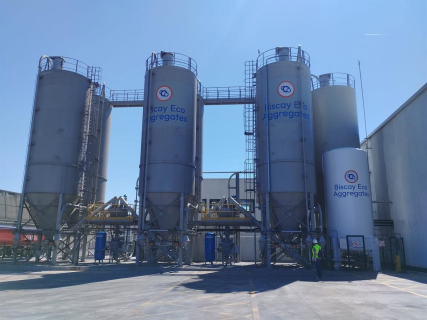

Petronor and O.C.O Technology, a firm specializing in carbon capture, sustainable construction materials, and waste management, have launched this Thursday at the Port of Bilbao the first facility in the European Union dedicated to producing synthetic aggregates capable of fixing CO2, with an estimated capacity of up to 125,000 tons of eco-aggregates annually and a total investment of 20 million.
The inaugural ceremony was attended by the CEO of Petronor, José Ignacio Zudaire, the executive director of O.C.O Technology, Steve Greig, and the general deputy of Biscay, Elixabete Etxanobe. After the ribbon cutting, they toured the new construction materials plant, which will use CO2 from the Muskiz refinery (Vizcaya) and various waste materials as raw materials.
The project, in which Petronor (75%) and the British O.C.O Technology (25%) participate, has involved an investment of 20 million euros and the creation of 20 direct jobs.
The facility, named Biscay Eco Aggregates, will utilize urban waste that would otherwise end up in landfills, along with CO2 from Petronor, to generate synthetic aggregates with a negative carbon footprint through a chemical process. This product replaces natural quarry aggregate, avoiding mountain excavation and contributing, as they emphasize, "to the decarbonization of the construction sector."
This waste is transformed into a sustainable construction material through the accelerated carbonation technology (ACT) developed by O.C.O Technology, which already operates four similar facilities in the United Kingdom and, as they point out, promotes "the circular economy, reducing CO2 in the environment and decreasing the consumption of natural raw materials."
Forecasts indicate that, thanks to this CO2 mineralization plant, up to 50,000 tons of thermal ash from waste can be reused annually, up to 6,000 tons of CO2 from Petronor can be captured, and up to 125,000 tons of eco-aggregates can be produced per year. This will avoid the extraction of up to 170,000 tons of natural aggregates annually.
This project, recognized with various awards, has received a grant of 3.2 million from the European Commission's Innovation Fund 2020 program and has also been selected for the Indartu program, with additional funding of 1.16 million.
Zudaire: collaboration, technology, and industry
During his speech, the CEO of Petronor, José Ignacio Zudaire, emphasized that the new plant is "a clear example of a development model based on collaboration, a commitment to technology, and industrial impetus."
"It is a project based on sustainability, an example of 100% circular economy, and which also demonstrates the attractiveness of Biscay for the implementation of new projects," he stated.
He insisted that to launch an initiative of this type, it is essential to have a "solid" ecosystem, with public policies that favor these investments, companies with experience in waste treatment capable of supplying raw materials, and an environment and market "committed to sustainability and willing to bet on this new path that we are making available to you today."
After thanking the "serious" trust and support of European institutions, he called for them to continue supporting the initiative and recalled that they have a "powerful" tool such as "innovative public procurement," so that these materials are incorporated into works promoted by administrations, which would represent "great support" for projects of this type.
Zudaire, who stressed that "technology and sustainability are two sides of the same coin," also encouraged the Association of Valorization Plants to embrace this technology.
For his part, the director of new transformation projects at Petronor, Aitor Arzuaga, indicated that this initiative "fits perfectly" into the company's decarbonization strategy, as the plant transforms waste and CO2 into a new sustainable material, thus avoiding landfill and CO2 emission problems (which are removed from the atmosphere) and, on the other hand, "having to use more natural aggregate with the impact it entails."
The executive director of O.C.O Technology, Steve Greig, recalled that his company is a leader in the recycling of ash from waste in the United Kingdom, where it reuses up to 250,000 tons annually, approximately 35% of the British market.
"We are delighted to partner with Petronor, which shares the same values and vision as O.C.O, in the first plant of its kind in the EU. Although we have focused on treating annual tons of thermal ash from waste, our technology can be used in a wide variety of applications," he specified.
The Deputy General of Biscay, Elixabete Etxanobe, has highlighted that the new plant allows for the production of construction materials that reduce the carbon footprint by up to 16 times compared to conventional materials. "This plant adds value to Biscay's waste management strategy, reinforcing Zabalgarbi's role as a key player in energy efficiency and the circular economy. This is industrial innovation with purpose," she indicated.
Etxanobe presented this infrastructure as an example of "innovating to solve problems," in this case, those associated with CO2 emissions and generated waste. She added that initiatives like the one inaugurated this Thursday stem from an "innovative business ecosystem, from companies like Petronor, which not only generate wealth and employment but also position Biscay in a leadership role."
"It happens here because we foster a framework where companies and institutions collaborate naturally, sharing the ambition to lead decarbonization and the energy transition," she added.
The Deputy General recalled that the Provincial Council of Biscay has been preparing the ground for some time to receive this type of investment and, after alluding to the approved tax review, emphasized that in the territory, "those who bet on decarbonization find conditions that facilitate it." "The Economic Agreement is only valuable if we use it intelligently. If we put it at the service of the economic model we want to build," she emphasized.
During the event, a video from the European Commissioner for Climate Action, Wopke Hoekstra, was also shown, who highlighted the relevance of this project that uses CO2 and waste to produce eco-aggregates and helps Europe move towards a "clean transition" in its industrial processes.
Operation of the eco-aggregate plant
The plant, which began its activity this very week, uses CO2 captured from industrial processes, such as that generated in the Petronor refinery, along with thermal ashes from waste.
In the production process, using technology developed by O.C.O, the CO2 chemically reacts with the waste, resulting in aggregates with a negative carbon footprint, which can be used as raw material in the construction sector.
Furthermore, thanks to O.C.O Technology's Accelerated Carbonation Technology (ACT), the plant reduces the need to extract natural aggregates and promotes "the maintenance of the landscape and the circular economy by using waste produced by society (garbage that citizens deposit in bins) whose destination was the landfill".
O.C.O Technology is currently one of the few companies in the world that has the recognition of the "end of waste" status for its technological process for treating this type of material, which allows the resulting aggregate to be classified as a "product".