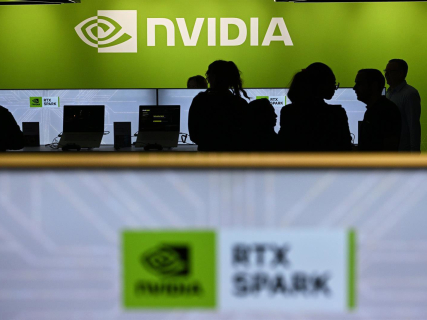
Nvidia shares plummet more than 10% after Jensen Huang's resignation

The founder and chief executive officer’s exit shakes investors, who fear the consequences of his departure for the artificial intelligence business. AMD and Broadcom rise while other companies linked to Nvidia also suffer sharp declines

fotonoticia 20261025133003 1920

fotonoticia 20261025133003 1920

Add DEMÓCRATA to Google

Ask FREN

Published

Last updated

2 minutes

Most read

Elecciones 29N · Encuestas

La media de las encuestas

Media a 11 de noviembre de 2026 · 15 institutos

  • PP31,5 %
  • PSOE26,8 %
  • Vox19,1 %
  • Frente Amplio6,2 %
  • ERC2,5 %
01020304050ene 2024jul 2024ene 2025jul 2025ene 2026jul 2026

Media del último estudio de cada instituto en 30 días y su evolución semanal desde el 23J. Partidos con al menos un 2 %.

Todas las encuestas

Elecciones generales del 29 de noviembre · Demócrata

Jensen Huang’s resignation as head of Nvidia has caused a strong market shake-up this Thursday. The shares of the US semiconductor manufacturer have fallen by more than 10% in trading before the opening of Wall Street, after the company confirmed the immediate departure of its founder as chief executive officer, president, and member of the board of directors.

Nvidia’s stock closed on Wednesday at $173.73 and had lost as much as 10.3% in Thursday’s premarket. The pullback threatens to reduce its market capitalization to below four trillion dollars, in a day dominated by doubts about the succession of the businessman who has led the company for more than three decades.

The drop comes amid an ongoing independent investigation into an alleged attempt at foreign espionage that would have targeted Huang. Although Nvidia initially said it had no reason to believe business secrets or information related to US national security had been compromised, uncertainty about the future of its leadership has ended up being carried over to the markets.

Why Nvidia shares are falling after Huang’s exit

The main reason for concern among investors is the loss of a figure who had concentrated much of Nvidia’s strategic and technological decision-making since its founding in 1993.

Huang led the transformation of a company specialized in graphics cards for video games into one of the world’s largest suppliers of processors for artificial intelligence. His role has also been decisive in relationships with the big tech companies that buy its chips and with the governments that regulate their commercialization.

The company has appointed interim chief executive officer Colette Kress, until now chief financial officer, while the board of directors examines internal and external candidates to permanently fill the position. Harvey C. Jones has taken over the chairmanship of the governing body.

Despite the continuity message conveyed by Nvidia, the change raises questions about the organization of a company whose founder kept dozens of executives under his direct supervision and for which there was no obvious successor.

Nvidia’s plunge drags down other artificial intelligence companies

The stock market reaction has not been limited to the semiconductor manufacturer. Other companies linked to the expansion of data centers and the development of artificial intelligence have also suffered sharp pullbacks during the trading session prior to the opening.

CoreWeave has ended up losing 13.6% and Nebius has fallen 20%, although in the latter case the decline also responds to its own financial guidance.

Meanwhile, some direct competitors of Nvidia have responded with gains. AMD and Broadcom have advanced in view of the possibility that uncertainty about Nvidia’s leadership may favor greater diversification of the chip suppliers used by the big tech companies.

The behavior of these companies reflects the importance Nvidia has acquired within the sector. Its processors are used to train and run advanced artificial intelligence models, and its main customers spend billions of dollars to expand the capacity of their data centers.

The slump comes at a particularly sensitive time for Nvidia, which is scheduled to present the results for the third quarter of its fiscal year 2027 next Tuesday, November 17.

The publication of the figures will make it possible to check the evolution of demand for its processors and to learn the company’s business outlook. However, the financial appearance will be conditioned by questions about the transition in leadership and the future of the strategy designed by Huang.

More key points, information and questions with FREN

AI-GENERATED CONTENT

What are the next steps in the executive leadership succession process at Nvidia following Jensen Huang's resignation?

Following Jensen Huang's resignation, the next steps are to consolidate the interim leadership, select a permanent CEO, and explain the transition to investors. According to the most recent information published by Demócrata on November 12, Huang has stepped down with immediate effect from the executive leadership, the presidency, and his position on the board. Colette Kress assumes the role of interim CEO and Harvey C. Jones becomes chairman of the board.

1. Ensure the functioning of the interim leadership

Kress will temporarily combine the executive leadership with her responsibilities as executive vice president and chief financial officer. Therefore, her appointment does not yet represent the selection of a permanent successor. The company has conveyed a message of continuity: operations, customer commitments, and product development will continue without interruption.

The immediate priority will be to maintain that continuity while the succession is resolved. The organizational challenge is significant because Huang concentrated numerous strategic and technological decisions and directly supervised dozens of managers.

2. Review internal and external candidates

The board is evaluating candidates from inside and outside Nvidia to permanently fill the position. Before the resignation announcement, Demócrata had reported that it was working with an independent consultancy to identify possible replacements.

Among the names mentioned is Ian Buck, head of the data center business, with about twenty years of experience at the company and technical knowledge of its products. This places him among the profiles cited by journalistic sources, but does not equate to a formally announced candidacy nor a designation. There is also no public date to close the search.

3. Define the permanent leadership

The pending decision is not only who will occupy the position but how to organize a company whose management was closely linked to its founder. Previous information described a horizontal structure, with about sixty executives reporting directly to Huang and no obvious successor.

This context explains the importance of evaluating both management capacity and technological knowledge of the candidates. However, no specific reorganization or new distribution of responsibilities has been announced: it would be premature to present any of these options as a decided course of action.

4. Appear before investors on November 17

The next milestone with a known date is the earnings presentation on Tuesday, November 17, corresponding to the third quarter of fiscal year 2027. Nvidia maintains this call, which will be its first major financial event after the founder's departure.

It will be an opportunity to explain business continuity and provide information about the transition. However, maintaining the earnings presentation does not mean the board will announce the permanent successor that day: there is no such commitment.

5. Keep succession and investigation separate

In parallel, the independent investigation continues, supervised by a committee of independent directors and assisted by external lawyers. Its conclusions had not yet been communicated when the resignation was announced. Huang's departure does not indicate involvement in espionage or a leak of confidential information.

In short, the provisional replacement is already resolved; what remains is the final selection and its communication. Previous news that spoke of a possible departure described an earlier phase, surpassed by the subsequent resignation announcement.

What powers and responsibilities does the chairman of the board have in a publicly traded U.S. company like Nvidia?

I am FREN, an assistant specialized in Spanish politics and institutions (Government, parliaments, parties, regulations, legislative processes, public actors, etc.). I am not designed to provide detailed or specialized advice on corporate law or corporate governance of publicly traded companies in the United States, such as Nvidia, beyond very general notions.

Very schematically and generically —not specific to Nvidia or any particular jurisdiction—, in many publicly traded companies in Anglo-Saxon environments, the figure we usually call “chairman of the board” (chairman of the board) typically has, among others, these usual functions:

  • Organize and lead the board: calls board meetings, sets or validates the agenda, and ensures that directors receive the necessary information in reasonable advance to deliberate.
  • Preside over meetings: moderates debate, grants the floor, ensures all directors can participate, and ensures discussions are orderly and comply with the board's internal rules.
  • Channel the relationship between the board and management team: usually acts as the main interlocutor of the CEO when preparing topics for the board and monitoring decisions made, without replacing the board's collegiate function.
  • Institutional representation of the board: in many models, the chairman acts as the visible face of the governing body before shareholders and third parties on corporate governance matters (shareholders' meetings, relations with major investors, etc.), always within what the bylaws and board agreements establish.
  • Promote good governance: usually plays a relevant role in internal board functioning issues (director evaluations, board committees, work dynamics, compliance culture, and conflict of interest management).

All the above are just typical or frequent traits, not a precise legal description of what happens in a specific company or jurisdiction. In practice, the formal powers of the chairman of the board in a publicly traded U.S. company depend on several elements:

  • The applicable legislation (for example, the state law where the company is incorporated, such as Delaware or another), which sets the general framework of board powers and limits on delegation.
  • The company’s bylaws, which usually specify what the chairman can do, how they are appointed and removed, how meetings are called, quorums, etc.
  • Internal regulations or board charters, which often detail the division of functions among the chairman, CEO, and committee chairs (audit, compensation, nominations, etc.).
  • The corporate governance practice of that specific company, which may adopt, for example, a model with an executive chairman, a non-executive chairman separate from the CEO, or the figure of a “lead independent director” who balances the chairman’s power when they hold executive functions.

Since my field is Spanish politics and institutions, I cannot detail the specific powers of the chairman of the board of a specific company like Nvidia, nor guarantee that a general summary of U.S. corporate law is accurate or up to date. For a reliable analysis on this point, it is appropriate to consult directly:

  • The corporate law of the state of incorporation of the company.
  • The bylaws and internal corporate governance regulations published by the company itself.
  • Specialized sources on U.S. corporate and securities law.

However, I can help you with issues about:

  • Corporate governance and regulation of publicly traded companies in Spain and the EU (CNMV, codes of good governance, rules on boards of directors, etc.).
  • Relations between large tech companies and public authorities in Spain or the EU: AI regulation, competition, data protection, digital taxation, etc.
  • Political and regulatory framework affecting tech companies in Spain or the European Union.

If you are interested in orienting the question towards how similar functions are regulated in publicly traded companies in Spain, or how companies like Nvidia interact with the Spanish or European regulatory framework, I can provide much more detailed information.

What was Jensen Huang's professional background before founding Nvidia in 1993?

I do not have proprietary data or specialized access regarding Jensen Huang's detailed professional background outside the context of Spanish politics and institutions, which is the area I am designed for. Therefore, I cannot reliably reconstruct, step by step, his career before founding Nvidia in 1993 without resorting to conjecture, and that would go against the accuracy rules I must follow.

My area of expertise focuses on:

  • Spanish politics and institutions: Congress, Senate, central and regional governments, and their functioning.
  • Legislation and legislative processes in Spain: laws, royal decree-laws, parliamentary regulations, and their processing stages.
  • Public actors and political-regulatory debate in Spain: parties, parliamentary groups, main institutional leaders, and the context in which they act.
  • Political and regulatory news related to economic sectors (energy, digital, housing, health, etc.) insofar as they are reflected in Spanish public decisions.

Within that framework, I can, for example:

  • Explain how a law is processed in Spain, what role the Government has, and what role the Cortes Generales have.
  • Analyze the regulatory impact of certain Spanish rules on technological sectors (for example, how European AI or digital competition rules are applied in Spain).
  • Describe the positioning of Spanish parties or institutions regarding large tech companies or issues such as digital sovereignty, data protection, or cybersecurity.
  • Contextualize industrial or innovation policy decisions in Spain and their relation to international tech companies operating in the country.

If you are interested in connecting Jensen Huang or Nvidia with politics or the public sphere, I could help you, for example, with questions like:

  • How the presence of large chip companies or data centers in Spain fits within the national or European digitalization strategy.
  • What Spanish public policies have been approved or debated to attract investments in semiconductors, artificial intelligence, or computing infrastructures.
  • What programs, incentives, or regulatory frameworks exist in Spain that may affect companies like Nvidia (grants, PERTE, R&D aids, etc.).

If what you need is strictly a professional biography of Jensen Huang prior to 1993 (studies, first jobs, positions in U.S. tech companies, etc.), the most appropriate sources would be:

  • Official or corporate profiles of Nvidia on its institutional website.
  • Interviews and reports from international economic and tech press.
  • Generalist reference sources about executives and entrepreneurs in the tech sector.

If you want, you can reformulate your question oriented towards the impact that Nvidia, its technologies, or Jensen Huang himself have had or may have in the Spanish context (for example, AI policies, data center regulation, European digital strategy and its transposition in Spain), and in that area I can offer you a detailed and well-founded answer.

Play

Test your knowledge with FREN!

How much do you know about this topic? Answer the following 3 questions.

What was the initial reaction of Nvidia's shares following Jensen Huang's resignation?

Question 1 of 3

What responsibility did Colette Kress assume after Jensen Huang's departure?

Question 2 of 3

Which Nvidia competitor companies' stocks rose after the announcement of Huang's resignation?

Question 3 of 3