
Pimec reiterated this Friday that increasing wages is "urgent and necessary," while emphasizing that any increase must be linked to advances in productivity so that companies do not see their competitiveness or viability compromised.
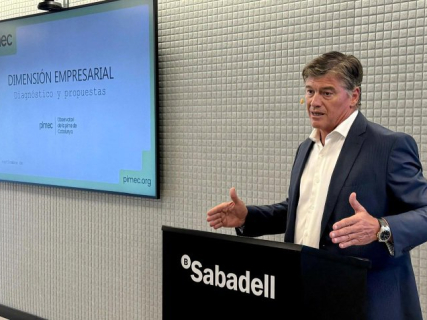
"Let's pay the highest salaries, but let's not make our companies lose competitiveness, viability, and productivity, because then it is bread for today and hunger for tomorrow," said Pimec president Antoni Cañete at an information breakfast, where he unveiled several proposals for the general elections on November 29.
The employers' association has argued that Spain needs a legislature in which regulation is done "thinking first about the small ones in order to be able to make ourselves big" and has proposed a business growth law that would concentrate measures from different economic areas and make it easier for microenterprises to become small ones, these to become medium-sized ones and the medium-sized ones to become large.
According to Pimec, 75% of companies state their intention to grow, but only 30% have managed to do so, mainly due to bureaucratic, fiscal and administrative obstacles. Among the initiatives put forward is cutting by 35% the administrative burden associated with complying with business obligations and adjusting regulatory requirements to the size of each company.
In the labor field, the organization has requested a pact for work that deals comprehensively with wages, productivity, the working day, sick leave, and the sustainability of the public pension system.
Regarding the interprofessional minimum wage (SMI), the employers' association has stressed that it does not put "obstacles" in the way of its increase and that it should be set at "as high as possible that can be paid," provided that it does not imply job destruction or a loss of competitiveness.
At the same time, it has rejected that the minimum wage becomes a "bidding process" or an instrument of political confrontation and has emphasized that wage increases must go hand in hand with improvements in productivity.
Increase in sick leave and sustainability of pensions
Along these lines, the entity has warned of the rise in sick leave, which, it said, has doubled in Spain. At the same time, it has maintained that it would be possible to reduce it to the levels of 2013, which would make it possible to recover around 8,000 million euros per year for the pension system.
It has also advocated for strengthening active employment policies, raising the quality of training, and making it easier for unemployed people to enter the labor market.
Calls for deflating the IRPF and combating late payments
Among the measures presented, grouped into 22 areas of economic policy, Pimec has also called for a tax reform that includes the deflation or indexing of the IRPF brackets, so that wage increases do not translate into a loss of purchasing power.
In the area of late payments, it has called for implementing a sanctions regime and rolling out e-invoicing to strengthen the traceability of payments, while in industry and energy it has defended the approval of specific regulations and making it easier to connect industrial estates to the grid.
The business organization has also focused on the gap between small and large companies in access to artificial intelligence (AI) and has requested specific programs to drive its adoption in SMEs.
Lastly, it has warned about the effect of rising housing costs on economic activity, by making hiring and attracting talent more difficult. According to a study from its observatory, almost half of the companies consulted in Catalonia have had problems incorporating workers or have declined new hiring due to difficulties in accessing housing and its high costs.