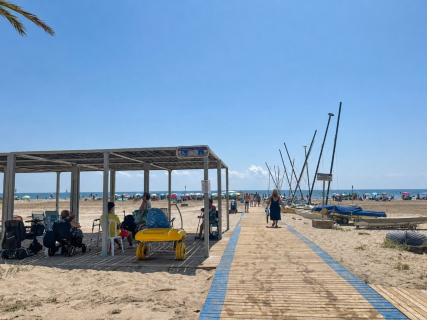

Spain currently has 504 adapted bathing points, although the differences in equipment and services between municipalities prevent offering uniform accessibility along the entire coast, according to the latest Accessible Beaches Guide from Discapnet.
For thousands of people, choosing a sun and beach destination remains a complicated process, as they need to check in advance if the accesses, available services, and bathing areas include the essential adaptations for their use.
From AccessibleEU, the European Resource Center on Accessibility coordinated by the ONCE Foundation, they warn that isolated interventions are not enough if continuous accessibility throughout the tourist experience is not guaranteed.
Elements such as the existence of reliable and updated information, accessible transportation, well-connected parking spaces, uninterrupted walkways, adapted changing rooms, or adequate training of staff are key factors to ensure enjoyment of the coastline with autonomy and safety.
"Choosing a holiday destination should depend on where we want to go, not on the barriers we may encounter.
Having a disability should not limit the right to discover, improvise, and enjoy the coastline on equal terms," says the director of AccessibleEU, Jesús Hernández-Galán.
Measuring quality and moving towards smart tourist destinations
The shortcomings in the accessibility chain —such as walkways that do not reach the water or restrooms that cannot be used by all people— turn a visit to the beach into an itinerary full of obstacles that conditions the development of vacations.
To correct these deficiencies, Segittur includes in its model of Smart Tourist Destinations (DTI) a set of 17 requirements and 43 indicators aimed at assessing accessibility in a transversal manner, personalized attention to the visitor, and the quality of pre-trip information.
At the same time, reference seals in environmental and tourist management, such as the Blue Flag awarded by ADEAC in Spain, incorporate among their essential criteria accessibility and the inclusive use of coastal spaces.
Economic impact on an increasingly aging society
The European Center for Resources on Accessibility reminds that adapted environments are not only beneficial for people with disabilities but also for elderly people, families with baby strollers, pregnant women, or users with temporarily reduced mobility.
In a demographic scenario marked by the progressive aging of the European population, the adaptation of tourist areas is configured, in their opinion, as a quality requirement and a factor of economic competitiveness for destinations.
AccessibleEU, an initiative of the European Union launched in 2023, collaborates with a consortium formed by the ONCE Foundation, ENAT, EASPD, UNE, and Johannes Kepler University Linz with the aim of monitoring compliance with community regulations, providing specialized training to professionals, and promoting the transversal incorporation of accessibility criteria in member states.