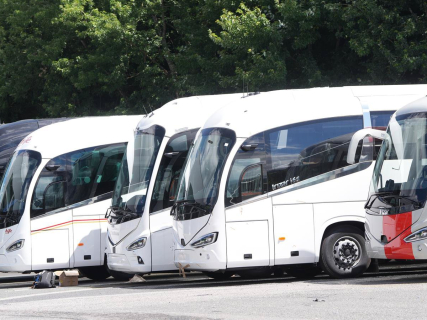

The expenses that companies incur for operating coach services of between 39 and 55 seats have increased by 10.8% in the first nine months of the year compared with the same period of the previous financial year, reaching 123,414 euros, according to the Cost Observatory of passenger transport by coach.
This amount, which represents a 2.4% uptick compared with July, translates into 1.90 euros per kilometer traveled or 68.56 euros per hour of service, without considering tolls or parking costs.
The increase affects all types of vehicles. On a year-on-year basis, costs rise by 11.8% for coaches with more than 55 seats, by 10.8% for those with 39-55 seats, by 9.8% for those with 26-38 seats, and by 8.7% for minibuses with 10-25 seats.
The factor that most drives this rise is fuel, whose price has surged by 33% in year-on-year terms and by 9.1% compared with the quarterly period. In addition, it accounts for 20.4% of the total cost of the standard coach and lies behind 60.3% of the annual increase in costs and 78.5% of the quarterly cost increase.
"The sector is facing significant pressure on its operating costs, especially from fuel, which reinforces the need to adequately update the prices of services and contracts," this Monday Confebús says regarding the "Cost Observatoire of passenger transport by coach no. 47", updated to 1 October 2026 and which the Ministry of Transport and Sustainable Mobility presented last Thursday.
The Spanish Confederation of Bus Transport also emphasizes that labor costs continue to be one of the most relevant items, since driving staff and per diems add up to 37.1% of total spending, ahead of fuel (20.4%), depreciation (12.5%), and indirect costs (11.1%). According to the report, personnel costs show a year-on-year increase of 5.3%.
With regard to the supply of passenger transport by coach, the study finds that the number of buses available is growing, but the number of operating companies continues to decline.
On October 1 of this year, the fleet of publicly authorized buses with national scope reached 47,156 units, 530 more than in July, while the number of companies with authorized public-service buses and national scope fell slightly to 2,671. The average number of vehicles per company stood at 17.65 buses, which, according to the analysis, would point to a trend of "business concentration".