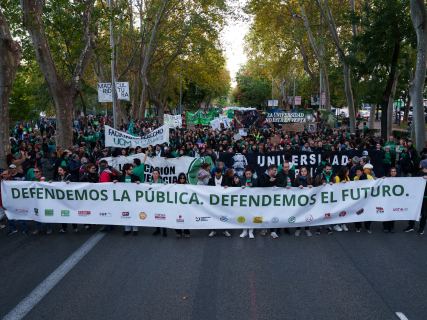
The education strike in Madrid brings together teachers and university students and leaves one detained in protests against Ayuso

The second day of strike at the six Madrid public universities coincides with the indefinite strike by teachers at primary and secondary schools. The protesters have blocked Alcalá Street in front of the Department of Education and have called for a new march through the city center.

EuropaPress 7894483 cientos personas concentracion huelga educativa noviembre 2026 madrid

EuropaPress 7894483 cientos personas concentracion huelga educativa noviembre 2026 madrid

Add DEMÓCRATA to Google

Ask FREN

Published

Last updated

3 minutes

Most read

Elecciones 29N · Encuestas

La media de las encuestas

Media a 5 de noviembre de 2026 · 15 institutos

  • PP31,0 %
  • PSOE26,3 %
  • Vox19,5 %
  • Frente Amplio6,5 %
  • ERC2,5 %
  • Podemos2,2 %
  • SALF2,2 %
01020304050ene 2024jul 2024ene 2025jul 2025ene 2026jul 2026

Media del último estudio de cada instituto en 30 días y su evolución semanal desde el 23J. Partidos con al menos un 2 %.

Todas las encuestas

Elecciones generales del 29 de noviembre · Demócrata

The strike of public education in Madrid has brought together this Thursday teachers, students and workers from the six public universities in the region with teachers from schools and secondary schools, who have kept their walkouts since October 14. Hundreds of demonstrators have gathered in front of the Department of Education, on Alcalá Street, where the Police have cut traffic due to the influx of people. The protest has resulted in one arrest for disobedience and resistance, according to the Municipal Police.

The mobilization coincides with the second and final day of the university strike called for November 4 and 5. The unions and educational platforms are calling for more funding for public education, workplace improvements, and the opening of negotiations with the Minister of Education, Mercedes Zarzalejo.

During the gathering in front of the Department of Education, some demonstrators staged a "funeral procession" for public education, dressed in black and with green paper carnations. The day began with information pickets on the campuses and will continue with a demonstration called for this afternoon by the center of Madrid.

The arrest has prompted criticism among the organizers. The spokesperson for Menos Lectivas, Claudia Saralegui, has denounced that the arrested teacher was taking part peacefully in the gathering and has questioned the police action. The Municipal Police, for their part, attributes the arrest to alleged crimes of disobedience and resistance.

The six public universities join the protests

The university strike affects the Complutense, Autónoma, Politécnica, Carlos III, Alcalá and Rey Juan Carlos. The call, driven by the Coordinadora en Defensa de la Universidad Pública and backed by CCOO, UGT, CGT and CNT, includes teaching and research staff, researchers, administration and services workers, and students.

The organizers denounce the insufficiency of economic resources at the Madrid universities and the deterioration of working and study conditions. They also criticize the growth of private education and demand public funding that will make it possible to cover the needs of the campuses.

Eva Aladro, a member of the platform Universidad Complutense por la Pública, has described the second day of strike as “a success” and has stated that almost all faculties have remained closed, with few exceptions. According to the data released by the conveners, the participation rate has reached the 95% in universities such as the Complutense, the Politécnica and the Autónoma. These are union figures that do not correspond to an official tally of the entire university system.

The protests come after the funding agreement reached in March between the Government of Isabel Díaz Ayuso and the rectors of public universities, which provides for 14,800 million euros until 2031. The calling platforms are questioning that commitment because they consider that part of the announced resources come from contributions by families or are conditioned on meeting objectives. The Community of Madrid, for its part, defends the agreement.

Teachers in primary schools and high schools maintain the indefinite strike

The coincidence of the university mobilizations with the strike by non-university teaching staff has made it possible this Thursday to bring together workers from all educational stages.

Teachers in primary schools and high schools began their indefinite strike on October 14 and are demanding a reduction in weekly instructional hours. In secondary education, Vocational Training and special regime education, they are asking to move from 19 to 17 hours, while in preschool and primary education they are seeking a reduction from 25 to 22.

They also demand a pay increase of 600 euros per month, fewer students per classroom, more resources to attend to students with special educational needs, and a reduction in bureaucratic workload. Their demands also include improvements to facilities at the centers and to air-conditioning systems.

Unions are calling for the minister Mercedes Zarzalejo to sit down to negotiate with the strike committee. Protests had been temporarily suspended during the days of official mourning for the train accident in Urda, although the strike call continued to be in effect.

New demonstration for the center of Madrid

Thursday’s day includes a new joint demonstration by the education community, called at 17:30 from Atocha to Puerta del Sol, with a stop at the Ministry of Education.

The march will close the two days of strike of public universities, although it will not put an end to the indefinite work stoppages by non-university education teachers, who maintain their labor demands and their request to negotiate with the regional Government.

More key points, information and questions with FREN

AI-GENERATED CONTENT

What is the parliamentary status of the negotiation on public education funding in Madrid?

As of November 5, 2026, the funding of public education in Madrid is in the initial parliamentary processing phase of the 2027 Budgets, with the amendment period open. There is no record in the consulted sources of a specific parliamentary committee nor a comprehensive agreement closed between the regional Government and the groups on this matter. It is advisable to separate this budget debate from the university agreement already reached and the labor negotiation with teachers.

1. The procedure open in the Assembly

The Government presented the Draft Law of the General Budgets of the Community of Madrid for 2027 on October 30. That day, the Board admitted it for processing, agreed on its publication on November 3, opened the amendment period, and referred it to the Budget and Finance Commission. Therefore, the accounts are not yet approved: now they must be examined and modifications proposed. This is stated in the parliamentary documentation of the draft.

The approved calendar specifies the following milestones:

  • Informative appearances: scheduled for November 13, 16, 17, 20, and 23.
  • Total amendments: until November 18, at 8:00 p.m.; they allow requesting the return of the draft. Their debate in the Plenary is scheduled for December 3.
  • Partial amendments: until December 2, at 2:00 p.m.; they allow proposing changes in the articles and budget items.
  • Commission debate: on December 11, 14, and 15, with approval of the report scheduled for the 15th.
  • Final approval in the Plenary: scheduled for December 17 and 18.
2. What funding is on the table

The proposal allocates 7,740.3 million euros to Education, Science, and Universities, 11.2% more than in 2026. This figure corresponds to the entire Ministry, not exclusively to public centers. It includes 1,509.9 million for Early Childhood, Primary, and Special Education; 1,702.9 million for Secondary and Vocational Training; 283.8 million for scholarships and grants; and 136.4 million for educational infrastructure. These are proposed amounts, still subject to parliamentary processing, according to the official budget presentation.

While these accounts are debated, the budgetary framework approved for the current fiscal year is the Law 6/2025, of Budgets for 2026. Therefore, the already authorized expenditure should not be confused with the announced increases for 2027.

3. Universities: agreement closed, debate open

The negotiation with the six rectors did produce an agreement on March 3, 2026, for the period 2026-2031, amounting to 14,790.7 million. The Government Council approved the model on May 20. It is not a pact between parliamentary groups: it is an agreement between the Executive and the universities. Furthermore, the total amount combines different sources of income, not only regional transfers, as explained in the official communication of the model.

The political disagreement continues: Más Madrid and PSOE considered the pact insufficient, while Vox questioned its conditions and demanded prior transparency in university management (Demócrata, March 5).

4. Teacher negotiation is another path

In non-university education, differences persist regarding salaries, schedules, ratios, and resources. The Ministry defends compliance with the sectoral agreement; the strike organizers demand a specific negotiation of their demands, different from the ordinary meetings of the Sectoral Committee, according to Demócrata, October 20.

In summary: the decisive parliamentary space now is the 2027 budget. There is a calendar to discuss and modify funding, but no definitive approval nor an accredited comprehensive educational agreement yet.

What are the competencies and main functions of Mercedes Zarzalejo as Minister of Education of the Community of Madrid?

Mercedes Zarzalejo is the Minister of Education, Science, and Universities of the Community of Madrid: her responsibility covers both non-university education and universities, research, and technological innovation. Her main function is to politically lead this department, coordinate its bodies, and execute the regional Government's policies in these areas. She was appointed by Decree 7/2026, of February 16, published the following day, and took office on February 18, 2026.

Main areas of competence

It is advisable to distinguish between the competencies of the Ministry and the powers of its holder: Zarzalejo directs and supervises the whole, but management is distributed among deputy ministries, general directorates, and territorial bodies. According to the institutional information of the Ministry, her main areas are:

  • Non-university education. Planning, organization, and supervision of Early Childhood, Primary, Secondary, and Special Education teachings. Includes schooling, educational organization, evaluation, quality programs, and bilingualism.
  • Educational centers and resources. Management direction of public centers and relations with subsidized and private education within regional competencies. Also includes teaching staff, human resources, infrastructure, and educational services.
  • Vocational Training and specific teachings. Development of the regional policy of Vocational Training, special regime teachings, and artistic teachings, including their connection with educational institutions and professional sectors.
  • Scholarships and study aids. Promotion and supervision of economic support policies for students and families, through the bodies responsible for these aids.
  • Universities. Direction of regional university policy and institutional relations with public and private Madrid universities, including the funding and planning aspect corresponding to the Community.
  • Science and innovation. Promotion of scientific research and technological innovation, as well as coordination with universities, scientific institutions, companies, and other administrations.

Functions exercised as minister

Her position combines strategic direction, administrative management, and institutional representation. Specifically, she is responsible for:

  • Setting the department's priorities within the general policy of the regional Government and supervising their execution.
  • Coordinating and controlling the activity of deputy ministries, general directorates, and other dependent bodies.
  • Promoting regulatory proposals, plans, and programs, and submitting those requiring approval to the Government Council.
  • Issuing acts and resolutions that correspond to her and supervising the budget and its execution within her competence.
  • Representing the Community of Madrid in educational, university, and scientific matters and signing agreements within her powers.
  • Politically responding before the Assembly of Madrid for the actions of her department.

How this responsibility is organized

The support structure comprises two main areas: the Deputy Ministry of Educational Policy and Organization and the Deputy Ministry of Universities, Research, and Science. It also has a Technical General Secretariat, specialized general directorates, and five territorial area directorates: Madrid-Capital, North, South, East, and West.

As a member of the Government Council, Zarzalejo also participates in its deliberations and decisions, proposes measures from her department, and coordinates its actions with other ministries. Therefore, her responsibility does not consist of personally resolving each educational file, but in directing, coordinating, and supervising the regional policy of education, universities, and science, while specialized bodies carry out ordinary management.

What legal requirements must be met to call a strike in the education sector in Spain?

To call a strike in the education sector, three basic requirements must be met: call by a legitimized subject, written communication with the required advance notice, and respect for essential services. Administrative authorization is not needed to exercise this right. The rules are based on Article 28.2 of the Constitution, Royal Decree-Law 17/1977, and public employment legislation, with particularities depending on the affected service.

1. Who can call it

It can be called by unions with presence in the affected area, workers' representatives, and the workers themselves by majority agreement in assembly. In private centers, company committees or staff delegates intervene; in public employment, trade unions and representative bodies according to applicable rules.

A legitimized union does not need the company committee to also approve the call. A strike committee must be constituted, distinct from the permanent representative body, which acts as interlocutor and negotiates during the conflict.

2. What the communication must include

The call must be notified in writing, clearly identifying:

  • The calling subject and the territorial, professional, and personal scope affected.
  • The objectives or demands and the centers or services included.
  • The start date and expected duration, indicating the days or time slots of the strike when applicable.
  • The composition of the strike committee and contact details.

It must be addressed to the employer and the competent labor authority. In public education, the employer recipient is the corresponding educational Administration: notifying only the school management does not replace this notification. When essential services must be guaranteed, the competent authority to establish them must also be informed. It is important to keep proof of receipt.

3. How much advance notice

The general period is five calendar days. If the strike affects entities responsible for public services, the notice is ten calendar days, a rule especially relevant for public education. The STC 124/2013 expressly recalls this last period.

It is not advisable to automatically equate private education with five days: it must be checked whether the affected activity is subject to the public service regime. The purpose of the advance notice is to allow negotiation and organize indispensable guarantees, not to request permission, as explained in STC 36/1993.

4. Minimum services and obligations during the strike

In compulsory education, minimum services may be established to protect essential provisions. They are set by the competent authority through a motivated, concrete, and proportional decision; the school management executes the instructions but cannot replace it by unilaterally setting them.

They may include custody, security, or indispensable care of students, according to the applicable resolution. They must not equate to ordinary functioning nor nullify the strike. STC 36/2007 rejects that essentiality allows suppressing the right, and STC 310/2006 requires sufficient justification.

Designated personnel must receive communication of their functions and fulfill them. Those not designated may support the strike without individual authorization. Security and maintenance measures and the freedom of those who want to work must also be respected.

5. Limits and final verification

Failure to comply with the call rules or advance notice may determine illegality. There are also limits for political objectives unrelated to professional interests or to alter existing agreements, with applicable exceptions. Abusive modalities require specific analysis: several unions or committees do not prove abuse by themselves, according to STC 130/2021.

Before calling, the scope, recipients, period, and corresponding regional minimum services resolution must be verified. During the conflict, negotiation with the company or Administration must be maintained.

Play

Test your knowledge with FREN!

How much do you know about this topic? Answer the following 3 questions.

What percentage of union participation do Complutense, Polytechnic, and Autonomous universities claim to have reached during the strike?

Question 1 of 3

What reason did the unions and educational platforms give for calling the strike in Madrid?

Question 2 of 3

When did the indefinite strike of school and institute teachers in Madrid begin?

Question 3 of 3