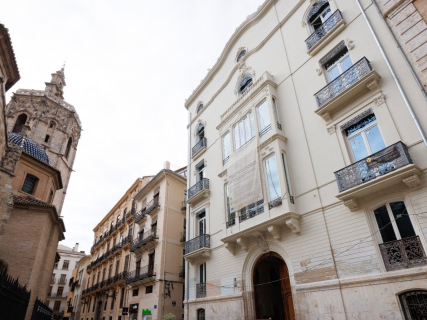

The International Monetary Fund (IMF) has selected Valencia as the location for its first Global Information Technology Center outside Washington, after several months of conversations with the Generalitat Valenciana and the Government of Spain.
According to the Generalitat in an official note, the regional government will cede the historic Palacio de Calatayud to the international organization so that it can become its new technology base. This early 20th-century building, located on Micalet street, is in the final phase of its rehabilitation and the works are expected to conclude before the end of the year.
The 'president' of the Generalitat, Juanfran Pérez Llorca, has stressed that the arrival of this IMF headquarters "is the result of the firm commitment that the Generalitat is making to turn the Comunitat Valenciana into a benchmark in the field of innovation and technology".
He has also highlighted the work carried out over the last few months by the Consell so that this infrastructure would be located in the Valencian capital. "Its achievement demonstrates that the Comunitat Valenciana has the talent, the capacities, the infrastructures and the good work required to be the technological headquarters of one of the most influential institutions in international economic and financial governance", he said.
Pérez Llorca has also stressed that the establishment in Valencia of the IMF Global Information Technology Center is "a strategic opportunity for the Comunitat Valenciana by consolidating the city and its metropolitan area as one of the main European hubs of digital services for multilateral organizations, attracting investment, talent and high value-added economic activity".
The head of the Consell has likewise emphasized that the Comunitat Valenciana is advancing in its consolidation as a leading enclave in innovation and digital transformation on a global scale. In the Generalitat's view, the fact of having been chosen by the United Nations, the European Union and the Asian Development Bank, among other bodies, as a location for their digital infrastructures evidences the trust that these entities place in the technological and logistical potential of the territory.
In this line, Llorca has recalled that previous projects such as the United Nations Information and Communications Technology Facility (UNICTF) of the UN in Quart de Poblet, the European Union Intellectual Property Office (EUIPO) in Alicante and the technological center of the Asian Development Bank (BAD) in València, together with the new headquarters of the IMF, "reinforce the international positioning of València as the headquarters of multilateral organizations, consolidating its prestige as a city of innovation, talent and key digital services at a global level".
Generation of qualified employment and tractor effect
Regarding the labor impact, the 'president' has advanced that the new headquarters "will generate qualified employment, will strengthen the technological ecosystem, will boost innovation and will increase the international projection of the city in particular and of the Comunitat Valenciana in general, producing sustained benefits for the regional economy".
The project will involve the creation of direct highly qualified jobs —such as software engineers, cybersecurity experts, cloud architects or data analysts—, which will facilitate the attraction of top-level professional profiles and will contribute to retaining Valencian talent currently displaced to other major European hubs.
Along with this, the Generalitat foresees a notable increase in indirect employment, "producing a multiplying effect on the local economy" through the demand for professional services, technological consulting, telecommunications, engineering, auditing, legal advice, infrastructure maintenance and specialized training, in addition to a boost to sectors such as accommodation, catering and transport.
Boost to collaboration and technological R&D
According to the regional administration, the Global Information Technology Center will act as a "tractor element for the regional digital ecosystem", promoting cooperation with universities, research centers and Valencian technology companies, and facilitating the training of specialized talent and the launch of R&D initiatives in fields such as artificial intelligence, cloud computing, cybersecurity or data analytics.
Likewise, the presence of this international economic organization will increase Valencia's attractiveness for new technological investments and projects linked to the digital economy, generating a spillover effect that will extend beyond the center's own activity.