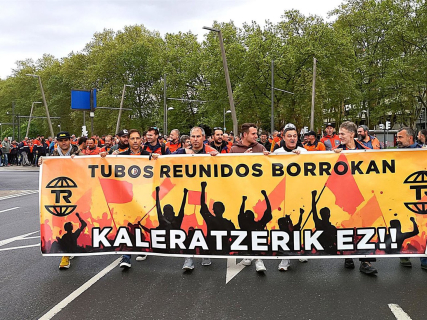
The situation of Tubos Reunidos reached Brussels this week. A delegation of representatives from the Basque Nationalist Party met this Wednesday with officials from the Directorate-General for Internal Market, Industry, Entrepreneurship and SMEs of the European Union to convey the seriousness of the situation the company is going through and to demand institutional support.
The meeting has served to put on the table the strategic role of Tubos Reunidos within the Basque and European industrial fabric. The delegation defended the need to guarantee not only employment in Amurrio, where one of its main plants is located, but also the continuity of an industry considered key for the energy, metallurgical, and infrastructure sectors.
After the meeting, José Ramón Molinuevo, at the head of the delegation, has assured that neither the region of Aiaraldea nor Europe can afford to lose this industrial muscle, and has described the meeting as productive. Alongside him participated the president of the ABB, Jone Berriozabal, the parliamentarian Jonatan Moreno, and the MEP Oihane Agirregoitia.
ERE for more than 240 workers
The visit occurs at a particularly critical moment for Tubos Reunidos. The company is going through a deep financial crisis marked by millionaire losses, high debt, and a restructuring plan that includes an employment regulation file (ERE) for more than 240 workers.
The company has defended that the adjustment is part of a viability plan aimed at ensuring business continuity, while unions and local representatives warn of the social and economic impact that a significant reduction in activity in the region would have.
Tariffs, cost increase, and fall of industrial markets
One of the main problems facing the group is its high exposure to external factors. The tightening of international tariffs, the increase in energy costs, and the fall in certain industrial markets have reduced the company's competitiveness in recent years.
In Brussels, the PNV has put forward three lines of work to try to alleviate the situation. The first involves exploring European mechanisms linked to debt rescue and compensation derived from the impact of tariffs. The second focuses on aid for electro-intensive industries, especially relevant in a context of rising energy costs. The third aims to promote industrial reconversion projects linked to the ecological transition.
Within this last section, the Basque representatives have proposed that Aiaraldea and Euskadi can become the seat of a European pilot project for low-carbon industrial reconversion, aligned with the new community strategies to preserve strategic manufacturing sectors.
While institutional negotiations continue, Tubos Reunidos remains focused on finding a balance between financial survival, job maintenance, and adaptation to an increasingly demanding industrial market.