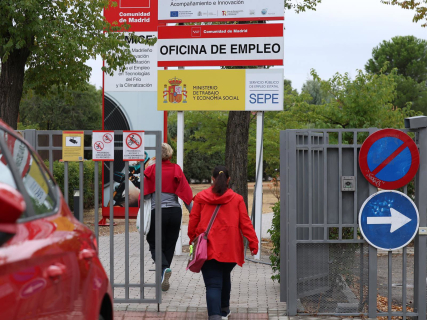

The number of registered unemployed people in the offices of public employment services increased in October by 43,128 people compared with September (+1.8%), an advance driven mainly by the performance of the services sector, which added almost 27,000 new unemployed people after the end of the tourism campaign, according to data released this Wednesday by the Ministry of Labour and Social Economy.
Despite this October rebound, the total number of unemployed people stood at 2,422,633, which represents the lowest level for an October since 2007, as the department headed by Labour has stressed.
The increase in registered unemployment last month constitutes the most intense rise in an October since 2020, when unemployment rose by more than 49,000 people (+49,558 unemployed).
Since the comparable historical series begins, in 1996, unemployment has only fallen in October on two occasions and has increased by 29. The only declines were recorded in 2021, with 734 fewer unemployed people, and in 2022, with a drop of 27,027 people, while the biggest rebound occurred in 2008, when the financial crisis caused unemployment to jump by more than 192,000 people. In October 2025, unemployment increased by 22,101 people.
If seasonal and calendar effects are removed, registered unemployment increased by 9,405 people compared with the previous month.
In year-on-year terms, unemployment adds up to a reduction of 21,133 people, which is equivalent to a 0.86% decrease, with a drop in female unemployment of 29,360 women (-2%) and an increase in male unemployment of 8,227 men (+0.85%).
SERVICES DRIVE THE INCREASE IN UNEMPLOYMENT
By branch of activity, registered unemployment rose mainly in services, with 26,853 more unemployed people (+1.58%), followed by industry (+1,911 unemployed people, +1.06%), agriculture (+1,547 unemployed people, +2.21%), and construction (+102 employed people, +0.06%).
The group with no previous employment, made up largely of young people looking for their first job, also saw unemployment rise, with 12,715 more unemployed people (+4.9%).
In October, unemployment increased for both men and women, although the absolute increase was somewhat higher in the case of women.
Specifically, female unemployment rose by 22,700 women compared with September (+1.59%), while male unemployment increased by 20,428 unemployed people (+2.1%).
At the close of the tenth month of 2026, the number of men who were unemployed reached 971,528, while that of women came to 1,451,105, marking for them their lowest figure in an October since 2007.
By age groups, unemployment among people aged 25 and over increased by 27,296 jobless persons (+1.2%), while among those under 25 it rose by 15,832 people (+8.4%).
Thus, youth unemployment, corresponding to those under 25, stood at 204,973 unemployed people, compared with 2,217,660 unemployed people aged 25 and over.
UNEMPLOYMENT RISES IN THE 17 AUTONOMOUS COMMUNITIES AND FALLS IN CEUTA
Registered unemployment rose in October in the 17 autonomous communities compared with the preceding month.
The biggest monthly increases in absolute figures occurred in Catalonia (+8,174 unemployed), the Valencian Community (+6,716) and Castile and León (+4,404).
In the autonomous city of Ceuta, unemployment fell by 151 people in October, which represents a relative decrease of 1.9%, while in Melilla it increased by 144 jobless persons (+1.9%).
By province, registered unemployment decreased in three: Córdoba (-583 unemployed persons), Seville (-405) and Ceuta (-151), and it rose in the other 49, especially in Barcelona (+4,869 unemployed persons), Madrid (+4,071) and Alicante (+3,400).
Unemployment among foreign workers also grew strongly: registered unemployment among immigrants rose by 27,744 people compared with September (+6.9%), to stand at 427,407 unemployed people, which represents 92,224 more unemployed than a year earlier (+27.5%).
43.3% OF CONTRACTS, PERMANENT
During October, 1,491,069 contracts were signed, 1.3% less than in the same month of 2025.
Of that total, 645,173 were permanent contracts, 0.3% more than in October 2025, so that 43.27% of all contracting in the month was permanent in nature.
Within permanent contracts, 257,400 were full-time, 1.4% less than a year earlier; 178,962 part-time (+6.2%) and 208,811 discontinuous permanent contracts (-2.2%).
The remainder, 845,896 contracts, were temporary, 2.5% less than in October 2025, representing 56.73% of the contracts signed in the tenth month of the year.
Between January and October, more than 13.64 million contracts (13,645,679) have been formalized, 4% more than in the same period of 2025, of which 5.76 million have been permanent (+5.7%) and 7.82 million temporary (+2%).
In accumulated terms, full-time indefinite contracts total, from January to October, 2,423,543, which represents 121,828 more (+5,3%) than in the same stretch of 2025. Part-time indefinite contracts reach 1,457,663, with an increase of 127,895 (+9,6%) compared with the same period of the previous year.
THE COVERAGE RATE AGAINST UNEMPLOYMENT STANDS AT 80,8%
The Ministry has also detailed that spending on unemployment benefits rose in September (the last month with available data) to 2,134.8 million euros, 6.6% more than in September 2025.
The average monthly spending per beneficiary, without including the agricultural allowance for Andalusia and Extremadura, stood at 1,233.9 euros in the ninth month of the year, which represents an increase of 1.1% (13.6 euros more) compared with a year earlier.
The average gross amount of the contributory benefit received per beneficiary in September was 1,037 euros, 22.3 euros more than in the same month of 2025 (+2.2%).
The total number of beneficiaries of unemployment benefits as of the end of September stood at 1,763,649 people, 5.17% more than in the same month of the previous year.
The unemployment coverage rate, which a year earlier was at 74.1%, rose in September 2026 to 80.82%, the highest figure in a September month across the entire historical series.
Benefit statistics are always published with a one-month lag with respect to unemployment figures, so this Wednesday the unemployment data for October were released and, in parallel, the information on benefits corresponding to September.